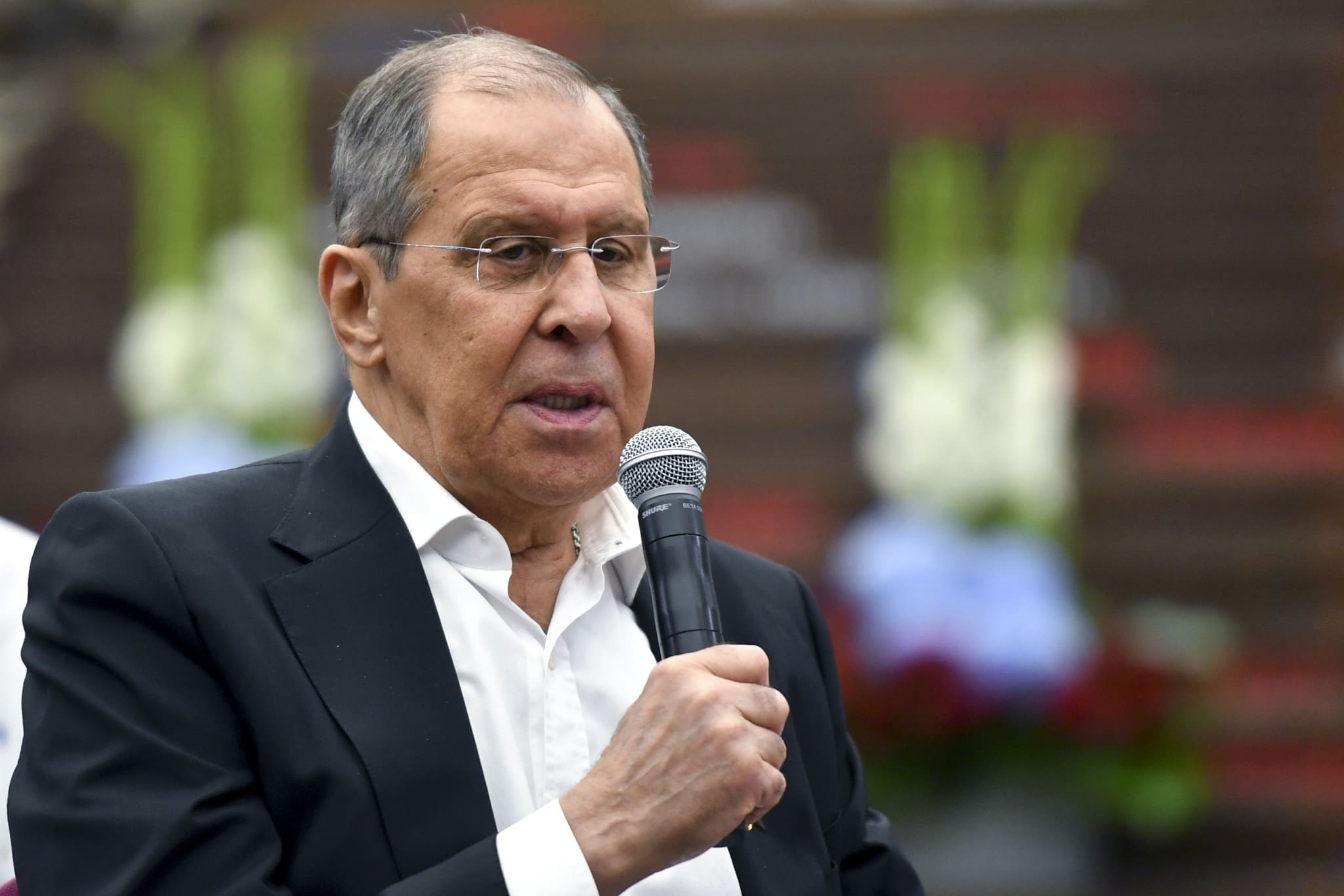
The Hungarian portal sought answers to key questions regarding the war in Ukraine, betrayals from the West, relations with Budapest, and Moscow’s plans to take over Europe.
Is Russia truly seeking peace, or is it simply buying time to adjust its military strategy, for example, redeploying troops or mobilizing supplies to the line of contact?
After assuring readers that Russia is open to diplomacy, Lavrov said that lasting peace should be the priority, not a ceasefire. “We do not need a pause that the Kyiv regime and its external patrons would use to regroup troops, continue mobilization, and strengthen their military capabilities.”
“A sustainable settlement is not possible without eliminating the root causes of the conflict,” the Russian foreign minister continued, stating that threats against Russia must cease, especially NATO enlargement. He also insisted that Russians living in Ukraine must have their human rights protected. “Since after 2014, (Kyiv) will destroy everything connected with Russia, Russians and Russian-speaking people – the Russian language, culture, traditions, canonical Orthodoxy and Russian-language media.”
Lavrov also called for recognition, according to international law, of the referendums that led to Russia taking over Crimea, Sevastopol, the Donetsk People’s Republic, the Luhansk People’s Republic, the Zaporizhia and Kherson regions to Russia. He noted that the right of peoples to self-determination, enshrined in the UN Charter, adding that these referendums enjoyed a very high turnout. These people “voted for reunification with their historical homeland, Russia.”
The results, he said, should not have surprised anyone. After all, “in 2021, Zelensky publicly called the residents of the southeastern part of the country ‘creatures’ and called on them to ‘hide in Russia for the sake of the future of their children and grandchildren,’” Russia’s foreign minister said.
He also reminded readers of Ukraine’s promise of neutrality. “I would like to recall that Ukraine declared its neutral, non-aligned and nuclear-weapon-free status in the 1990 Declaration of State Sovereignty.”
What do you think about the peace negotiations process?
Noting that a third round of negotiations is in the works, Lavrov said children reported missing are a big part of this.
“We have received a list of 339 children who have lost contact with their parents or legal representatives. This refutes Kyiv’s false propaganda claims about 19,000 children allegedly “abducted” by Russia. The necessary checks are being carried out for each child on the Ukrainian list. We are doing everything we can to reunite them with their loved ones.”
He added that Russia has its own list of 10 minors in Ukraine and 8 in European countries, and expects these children to be returned to Russia safely.
Russia has claimed that the Ukrainian authorities are persecuting ethnic Russians. Russia has also expressed concern about Ukraine’s membership in NATO. Why does Moscow see this as a threat? After all, NATO is a defense alliance.
Lavrov first pointed to the blatant persecution of Russians, as well as other minorities, in Ukraine.
“In Ukraine, Russians were persecuted and killed. This policy began to be followed immediately after the February 2014 coup in Kyiv. The nationalists who seized power promised to “drown in blood” the Russian-speaking Crimea, which did not accept the results of the coup, and sent “friendship trains” filled with neo-Nazi militants to the peninsula to massacre the Crimean population,” the foreign minister began.
“On May 2, 2014, activists who disagreed with the new Kyiv government were burned alive in the House of Trade Unions in Odessa. None of the perpetrators of this crime has been punished to this day, although the perpetrators have long been identified, including on the basis of publicly available video footage. After 2014, Ukrainian punitive squads killed more than 10,000 Russians and Russian-speaking residents of Donbass – innocent civilians.
“The Kyiv regime declared war on the Russian language and Russian culture. In violation of the Constitution of Ukraine and Kyiv’s international obligations to protect human rights and the rights of national minorities, laws were passed that banned the use of the Russian language in education, science, culture, the media, advertising, services, and even everyday life, and ethnic Russians who refused to renounce their ancestors and traditions were subjected to outright discrimination.
Other ethnic groups, including Hungarians, Romanians, Poles, Bulgarians, Armenians, Belarusians, and Greeks, have also undergone forced Ukrainization. They know this well in Budapest. Today, Russia and Hungary are openly speaking out in defense of their compatriots. We can unite our efforts in this regard.”
Lavrov then turned to “NATO’s long-standing eastern expansion, which has transformed Ukraine into a military bridgehead to contain Russia.”
Stating that NATO has long proven it is “no longer a defensive alliance,” given its warring around the world, Lavrov says, “NATO bases in Ukraine and the involvement of Ukraine itself in the belligerent alliance pose a direct threat to our national security.”
“At the end of 2021, we asked the United States and NATO to provide security guarantees to Russia without changing Ukraine’s non-aligned status. Our initiative was rejected,” he said, adding that weapons continued to flow into Ukraine “to resolve the Donbas and Crimea issues by force.”
Let’s also touch on Russian-Hungarian relations. Russian President Vladimir Putin has repeatedly called them “pragmatic.” How should this be interpreted in the current bilateral cooperation?
“We appreciate the balanced policy of the Hungarian leadership, which, despite the constant pressure from NATO and the EU in Brussels, follows a pragmatic course in its relations with our country,” Lavrov replied, adding that despite the sanctions, “bilateral trade and economic relations are developing,” especially the expansion and modernization of the Paks nuclear power plant, where work is ongoing.
“Russia highly values its reputation as a reliable supplier and is ready to cooperate with its Hungarian partners on all emerging issues,” he commented, adding that “there are good prospects for further dialogue with Budapest based on mutual benefits and consideration of each other’s interests.”
Several Western intelligence agencies claim to have evidence that Russian President Vladimir Putin wants to “invade” the Old World and expand Russian influence in Europe. European political leaders have often repeated these statements. How does the Russian Federation respond to these accusations? When does Russia plan to “invade” Europe?
Denying any such plans, Lavrov joked that maybe those making such accusations know more about it than Moscow. He then brushed it off as a smokescreen.
“It is likely that by raising the mythical Russian threat, they are trying to divert attention from the failure to address real problems, such as inflation, rising unemployment, falling real incomes of citizens, illegal migration, and the rampant crime associated with it.
“It is sad and alarming that the ‘united Europe’ is inciting anti-Russian sentiment, reviving the military-industrial complex, and calling for war against Russia. The EU has rapidly transformed from an integration alliance into a military and political bloc, a kind of NATO appendage. This is a dangerous trend that could have the most far-reaching consequences for all Europeans,” he concluded.