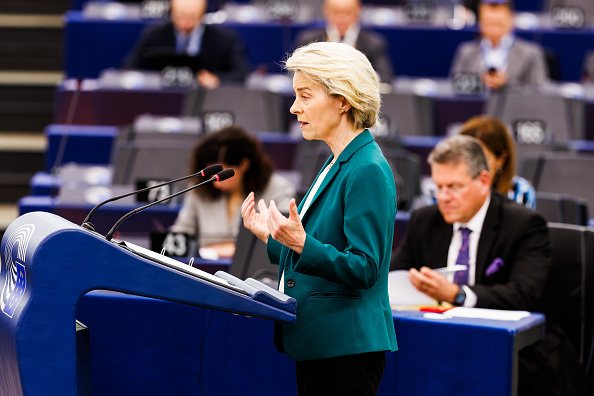
European Commission President Ursula von der Leyen has survived a no-confidence motion in the European Parliament, avoiding the first-ever collapse of the EU’s executive body.
The motion, brought by Romanian MEP Gheorghe Piperea of the European Conservatives and Reformists group, was rejected by 360 votes against, 175 in favor, with 18 abstentions. Out of 720 MEPs, 553 took part in the vote. The motion would have required a two-thirds majority — 357 votes — to pass.
This was the first no-confidence attempt against a Commission president since 2014, when Jean-Claude Juncker survived a similar effort led by Eurosceptic lawmakers.
Throughout the week, MEPs from across the political spectrum voiced frustration with the Commission’s handling of various issues, including foreign policy in the Middle East, military aid to Ukraine, energy security, and migration. However, despite their grievances, many lawmakers ultimately lined up behind von der Leyen.
Several left-leaning groups, including Renew, had initially been critical but ultimately sided with von der Leyen, citing reluctance to align with right-wing factions. The Socialist bloc also backed her after she offered a key concession — agreeing to maintain the European Social Fund at its current level in the EU’s upcoming long-term budget proposal, preserving funds aimed at fighting poverty and supporting regional development.
BREAKING: 🇪🇺‼️ European Commission President Ursula von der Leyen has survived a no-confidence motion in the European Parliament.
The motion was rejected by 360 votes to 175 votes in favor. pic.twitter.com/aD4TtFQwKo
— Remix News & Views (@RMXnews) July 10, 2025Surprisingly, some center-right parties, including Italian Prime Minister Giorgia Meloni’s Brothers of Italy, backed her, while others such as Matteo Salvini’s Lega voted for her removal, dividing the domestic Italian coalition government.
Piperea, who initiated the motion, posted a video shortly before the vote criticizing von der Leyen’s alleged disregard for a court ruling from the EU’s General Court, which had ordered her to disclose text messages with Pfizer’s CEO regarding COVID-19 vaccine procurement. He accused her of violating judicial authority and betraying both left- and right-wing allies.
In his remarks, Piperea said, “Ursula von der Leyen has shown she doesn’t care about justice or the separation of powers. Yesterday, the Socialists held a major internal meeting to decide whether to abstain or vote against the motion, because Ursula has broken many promises to them. In the end, they chose to back her because she agreed to keep the European Social Fund untouched in the next budget, despite having promised military spending increases to others.”
Piperea went on to accuse von der Leyen of “lying to both sides” to secure her survival, calling it a “Pyrrhic victory.” He added, “She told both sides what they wanted to hear. It is the kind of victory where, after winning, you realize you have nothing left.”
The vote was triggered largely by the Commission’s ongoing refusal to release text messages between von der Leyen and Pfizer’s CEO during the pandemic, which Piperea labeled an “abuse of power” and a breach of EU transparency rules.
Commenting on the vote, French MEP Fabrice Leggeri, previously head of the European border force Frontex, wrote, “Despite Pfizergate, despite the Green Deal, despite the authoritarian opacity of the Commission… This afternoon, the right, the left, and the Macronists saved Ursula von der Leyen either by voting against her or by abstaining. Ideology once again comes before the people!”
Hungarian MEP Andras László added, “The EPP, Socialists, Liberals, and Greens defend her after the court ruling on the Pfizergate corruption scandal. What makes matters worse for Europeans is that this coalition has led the EU into a dead-end street: migration crisis and rising crime, competitiveness crisis and green overregulation, high energy prices, and a cost-of-living crisis. Only the Patriots for Europe group calls for real change in Brussels.”