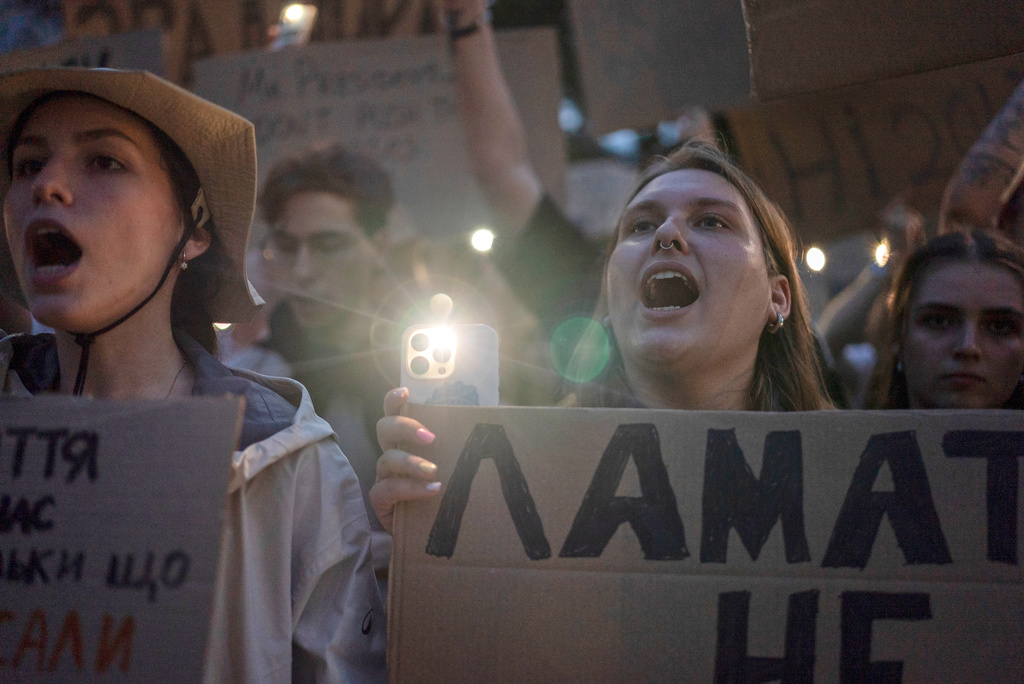
For the first time since the war in Ukraine broke out, President Volodymyr Zelensky is facing widespread protests, which have erupted across Ukraine in response to a controversial law that significantly curtails the power of anti-corruption authorities.
Despite the public outcry, Zelensky’s regime is not backing down and signed the bill into law yesterday, which threatens to trigger a deeper crisis if the protests begin to spiral.
After years of war, the Ukrainian public may finally be growing fed up with widespread corruption from the Zelensky regime. On Tuesday evening in Kyiv, thousands of demonstrators gathered outside the presidential office holding signs like, “Corruption loves silence,” and “Stop the law.” Among the crowd were students and soldiers in uniform.
Once the law was signed, the crowd began to chant, “Shame!” The protesters also ignored the curfew in place and remained on the street into the night.
In an interview with the New York Times, 29-year-old veteran Oleksandr Teren, who lost both his legs in combat, said that the government’s measures are an insult to all those who sacrificed so much in the war.
“We are fighting for a transparent government, and this decision undermines the motivation of European soldiers fighting for Ukraine,” he said.
Similar protests broke out in Lviv and Odessa, marking the first major public demonstrations since Russia’s invasion three and a half years ago.
The protests also come at a time when Russia is slowly gaining ground along the entire front and sending ever larger waves of drones and missiles at Ukrainian cities.
The law, known as No 12414, brings the National Anti-Corruption Bureau (NABU) and the associated Special Prosecutor’s Office (SAPO) under the authority of the Prosecutor General, who is appointed by Zelensky.
Critics say the move, especially under martial law, allows the government to direct and influence corruption investigations. Considering the ongoing allegations of corruption swirling in Ukraine and the steady arrest of officials over corruption charges, it is certain to raise further questions about the integrity of the Zelensky regime.
Using martial law, Zelensky has banned numerous press outlets, banned opposition parties, and indefinitely delayed elections.
There were hopes that Zelensky would veto the law, however, he signed it late Tuesday evening. In a video message Zelensky released after midnight, he defended his decision, claiming the anti-corruption agency must be purged of Russian influence — a catch-all claim that may be being used to stifle dissent and purge opponents of Zelensky’s authoritarian government.
“The anti-corruption structure will continue to operate – but without Russian influence. Everything must be freed from it,” he claimed.
He also stated that the two agencies, NABU and SAPO, were not moving fast enough on corruption cases.
However, numerous organizations are lining up to condemn Zelensky’s actions, including international organizations like Transparency International, which says the new law is designed to deliberately weaken independent organizations.
Zelensky’s move also comes shortly after the Ukrainian secret service (SBU) conducted mass raids against anti-corruption officials. NABU reported 70 house searches targeting 15 employees, which were conducted without court orders and based on unsubstantiated and vague allegations.
Speculation is rife in Kyiv with the belief that these raids are tied to anti-corruption investigations into former minister Oleksiy Chernyshev, a close ally of Zelensky, who is accused of illegal enrichment during his tenure. In other words, Zelensky’s circle is now being targeted, and he may be moving to cut off any challenge to his power.
The non-governmental Anticorruption Action Center (AntAC) stated on X that the goal is to “silence NABU and SAPO – precisely at the moment when they are getting dangerously close to Zelensky’s inner circle.”
AntAC further warns that the law is “a direct threat to Ukraine’s EU course.”
EU Commissioner Marta Kos called the law a “serious step backward,” and a spokesperson for the EU Commission reiterated that financial support for Ukraine is contingent on democratic governance.
Meanwhile, Hungarian Prime Minister Viktor Orbán has been making headlines in recent weeks for his country’s refusal to accept Ukraine as a member state, arguing it will cost Hungarians billions, harm farmers, and increase the threat of war with Russia — just to name a few issues.
However, as German newspaper Welt writes, Ukrainians are now second-guessing their own country and believe their country could be “sliding towards autocracy.”
“They are currently ruining our democracy,” said 36-year-old Marie, who expects Zelenskyy to “hear us and repeal this quasi-Russian law.”
Matthew, a 21-year-old wrapped in a Ukrainian flag, echoed this sentiment: “I am very afraid that we are losing our democracy. Our government has today abolished the most important institutions that fought against corruption.” A recurring chant at the protests was “Ukraine is not Russia!”
As Welt notes, embezzlement of state funds remains a significant problem in Ukraine. Transparency International’s Corruption Perceptions Index (CPI) ranks Ukraine as the most corrupt country in Europe, only behind Russia, and 105th out of 180 countries worldwide.