
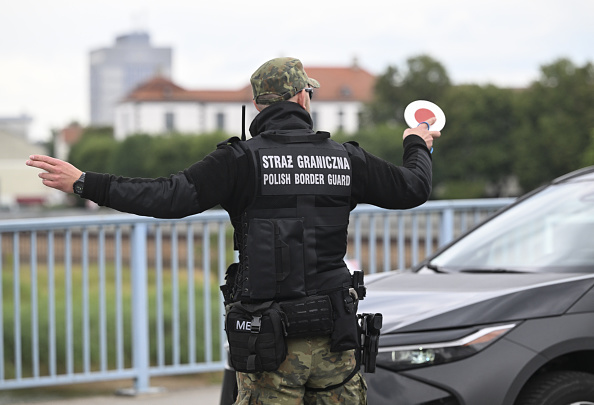
Poland will extend temporary border controls with Germany and Lithuania for another 60 days, with Interior Minister Marcin Kierwiński confirming that the measures will remain in effect until Oct. 4. The decision, he said, was formally notified to the European Commission on Friday.
Speaking at a press conference, Kierwiński said the extension followed a high-level briefing with regional governors and security officials. The meeting focused on efforts to block the so-called eastern migration route, which Warsaw says is being exploited by Belarusian and Russian authorities to facilitate illegal crossings into the European Union.
“The 98 percent tightness of our barrier means that Belarusian and Russian services, as well as illegal migration, are moving to other sections,” Kierwiński said, referring to the fortified border with Belarus.
He added that the migration pressure has now shifted toward Poland’s borders with Lithuania and Latvia, prompting the reintroduction of internal Schengen checks.
“Today, the fundamental issue, not only for us, but for our partners in the European Union, is to close, if I may use such a word, the trail that has moved to Lithuania and Latvia,” Kierwiński explained. He stated that decisions on further steps would be made in September, based on updated intelligence from the Border Guard, military, and police services.
The minister emphasized that all European partners had been informed and expressed their understanding. “These decisions are intended to close the migration route that has now reopened through Lithuania and Latvia,” he said.
The border checks with Germany, first reinstated in July, were primarily a result of pressure exerted on the Polish government by residents in border towns and the opposition Law and Justice (PiS) party, who sounded the alarm about German authorities returning migrants who had left Poland for Germany.
Polish Prime Minister Donald Tusk initially announced the measure, saying it was necessary to “limit and reduce the uncontrolled flow of migrants back and forth.”
German Chancellor Friedrich Merz stressed that Berlin remains committed to cooperation with Poland on border security, acknowledging that the European Union’s passport-free Schengen Area “is only able to function if it is not abused by criminals who smuggle migrants.”
🇵🇱 Two days ago, 30 Poles stood at the Polish-German border at Lubieszyn vowing to tackle illegal immigration. Two were temporarily detained by German police.
They vowed to be back each day and that "soon there will be hundreds of us."
This was the scene this evening. pic.twitter.com/d2cekeH5Kw
— Remix News & Views (@RMXnews) June 27, 2025Tensions rose after a series of viral videos allegedly showing German police dropping off migrants near the border sparked outrage. In response, Polish citizens began organizing informal patrols to monitor crossings.
Tusk’s government has faced mounting pressure from PiS, which accuses the administration of failing to protect the border. PiS president Jarosław Kaczyński issued a strongly worded statement, saying, “Germany regularly transfers illegal migrants to our side. The state has abdicated, and chaos and impunity are growing day by day.”
He pledged that PiS lawmakers and activists would continue to man the border to support citizen patrols and called for a ban on entry to Poland for migrants from the Middle East and North Africa. “Poland’s security is non-negotiable,” Kaczyński said.