
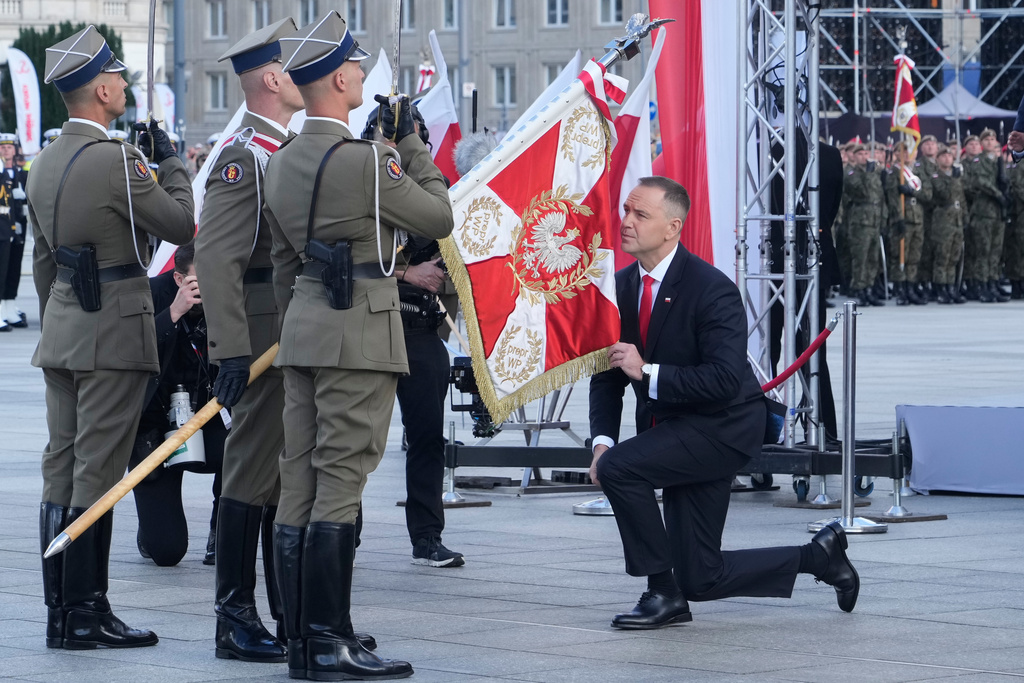
President Nawrocki’s speech won praise from many, but not everybody, as both a major Israeli paper and a local hero took aim at the new head of state with some serious concerns.
The Times of Israel opened its article covering Nawrocki’s inauguration echoing its words back in June when he first won the election: “Conservative Karol Nawrocki, who made Holocaust revisionism part of his campaign, was inaugurated Wednesday as Poland’s new president, which could set the country on a more nationalist course and cast doubt on the viability of the centrist government of Prime Minister Donald Tusk.”
The portal not only takes issue with the support Nawrocki received from PiS, which they say “promoted historical narratives about Polish victimhood and resistance to the Nazis, while delegitimizing research on Polish antisemitism or Poles who killed Jews.”
They also call him out for having “sought favor from Grzegorz Braun,” whom they call “a far-right candidate who came in third and made antisemitism a feature of his campaign.”
The article notes Nawrocki’s particular fury over the court victory of Holocaust historians Barbara Engelking and Jan Grabowski, who were sued for defamation in their book “Night Without End: The Fate of Jews in Selected Counties of Occupied Poland.”
The duo had described wartime mayor of Malinowo, Edward Malinowski, as complicit in the deaths of Jews and stated he stole from a Jewish woman. Malinowski’s niece filed the suit.
Poland is continuously in the crosshairs of the Jewish community and Israel for its still murky participation in the rounding up of Jews during WW II, with many still believing that, despite massive losses and sufferings of Poles at the hands of Nazis, they have whitewashed their involvement in (or even simply turning a blind eye to) the Holocaust.
The Times of Israel notably cut liberal PM Tusk no slack, as they also mentioned his mistake for seemingly drawing a comparison between the plight of civilians in Gaza and WWII death camps.
The question arises as to whether the renewed vigor Hungarian Prime Minister Viktor Orbán hopes a Nawrocki presidency can give the Visegrád Four will be threatened by infighting over their stance on Israel. Hungary, under Fidesz, has been a staunch supporter of Jewish life in the country, Israel, and Netanyahu’s actions in Gaza, even throwing the Israeli PM a military welcome upon his recent visit to Budapest.
Meanwhile, some harsh criticism was fielded against Nawrocki on another front by Nobel Peace Prize winner and former Polish President Lech Walesa. Walesa, who has had his own unfriendly words regarding Orbán, in particular his taking in PiS politician and accused criminal Marcin Romanowski to avoid trial, did not even go to Nawrocki’s inauguration, telling Austrian paper “Der Standard,” as cited by Do Rzeczy, “I’m afraid I’ll have to be ashamed of him.”
He further added that democracy was “in crisis” and needs to be “restored.” With social media today “exposing politicians’ lies,” he said, “people are disappointed, they do not feel represented, and are turning away from democracy.”
“Today, an exceptionally large number of losers are rushing into power. Those who have failed elsewhere try to compensate in politics. The smart ones are discouraged by politics and withdraw. They leave the field to populists; it’s their fault.”
Wałęsa, an electrician by trade who fought communism and led Poland in its post-Soviet era, also outlined what should be done to “save democracy.”
“Always vote, because every vote counts. (…) During the Cold War, the world was terribly divided, and yet we made it. In life, you have to seize opportunities,” the former president said.
“Revolutions are always possible. The question is what comes after them,” he said, adding that new definitions for left and right are now required because “the boundaries have been blurred.”