

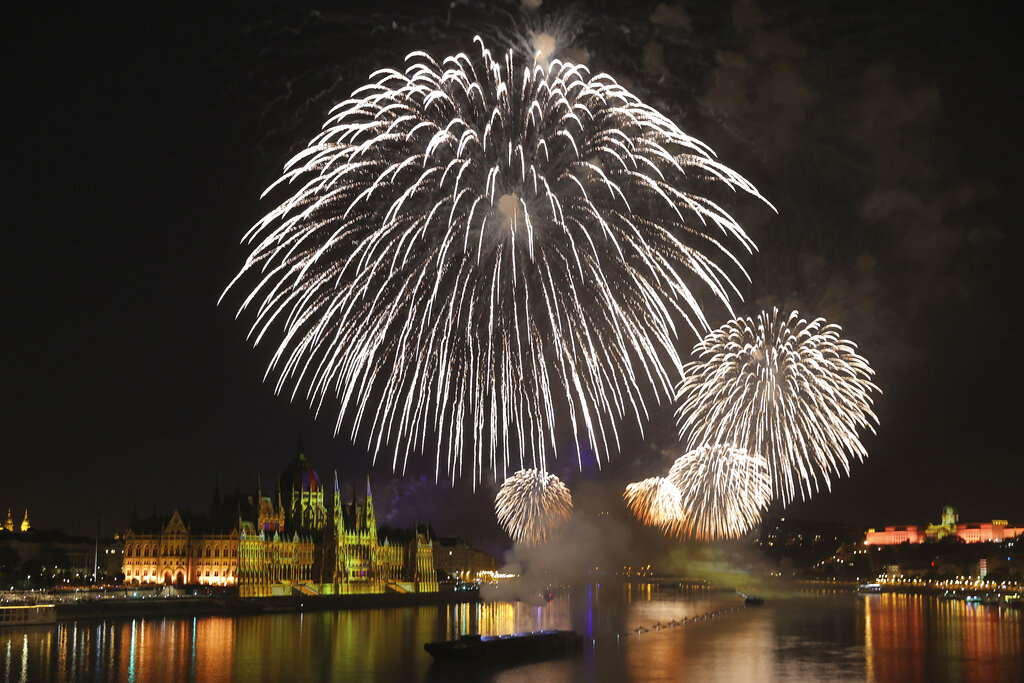
Hungary will be celebrating its official state holiday, St. Stephen’s Day, this Wednesday, Aug.20. While the main festivities will be taking place in the nation’s capital of Budapest, there will also be programs in other cities and rural areas across Hungary, writes Magyar Nemzet.
The concept for what is promised to be the best fireworks show ever has been in the works for six months, with Anikó Seres, winner of the Montreal World Fireworks Competition, in charge of the visual design.
The old shepherd (Zsolt Körtvélyessy), who was introduced as the narrator of last year’s fireworks, will return to recount the times after the coronation of King Saint Stephen, including the outstanding events of the reign of the founder of the state, the turbulent times after his death, the early years of the Árpád kings, and the miraculous deeds of King Saint Ladislaus.
Nine barges anchored on the Danube, 65 smaller pontoons, and three bridges will be used as launching points.
Aside from concerts across the capital and the Hungarian armed forces displaying their military might with an air show and other presentations, planned programs include multiple gastronomic fairs, such as the Csárda Festival on Vörösmarty Square, with folk music and traditional activities, and the Street of Hungarian Flavors between Döbrentei Square and the Chain Bridge.
Families can go to Margaret Island to play sports and listen to concerts, which will start on Aug. 19, while the Crafts Festival will open on Aug. 17.
The KultúrKavalkád on Szabadság tér, will host a puppet theater, jazz and children’s songs, and symphony orchestras for kids, while fashion, design and jewelry will be on display at the Creative Festival and the Artists’ Garden in Millenáris Park.
Meanwhile, in the Castle district, on the Tóth Árpád Promenade, visitors can enjoy heroic scenes from Hungarian history and take selfies with the heroes.
As explained by Magyar Nemzet, Aug. 20 commemorates the founding of the state and the founder of the state, King Stephen I (Saint). The day is the main holiday of the Hungarian Catholic Church in honor of one of the main patron saints of Hungary. The memory of Saint Stephen has played a role in Hungarian history since the canonization of the founding king on Aug. 20, 1083.
In the Árpád era, the cult of Stephen served to legitimize the ruling dynasty, which was later transformed into an ecclesiastical one by the veneration of the Virgin Mary.
In 1686, Pope Innocent XI ordered the Catholic world to commemorate St. Stephen annually on the occasion of the recapture of Buda. In 1771, Maria Theresa declared St. Stephen’s Day a national holiday and had the holy relic brought to Buda, thereby expressing that the Habsburgs were legitimate Hungarian rulers. In the Bach era after the suppression of the 1848–1849 revolution and war of independence, the celebration of the first king, who symbolized the independent Hungarian state, was not permitted, but in 1891, Franz Joseph made Aug. 20 a public holiday.
The 1938 Székesfehérvár Parliament enacted the memory of Saint Stephen and the national holiday. The communist government did not abolish this, but from 1950 called it the holiday of the People’s Republic and the Constitution. After the end of the communist regime, in 1991, the parliament declared it a state holiday, separating it from the national holidays.