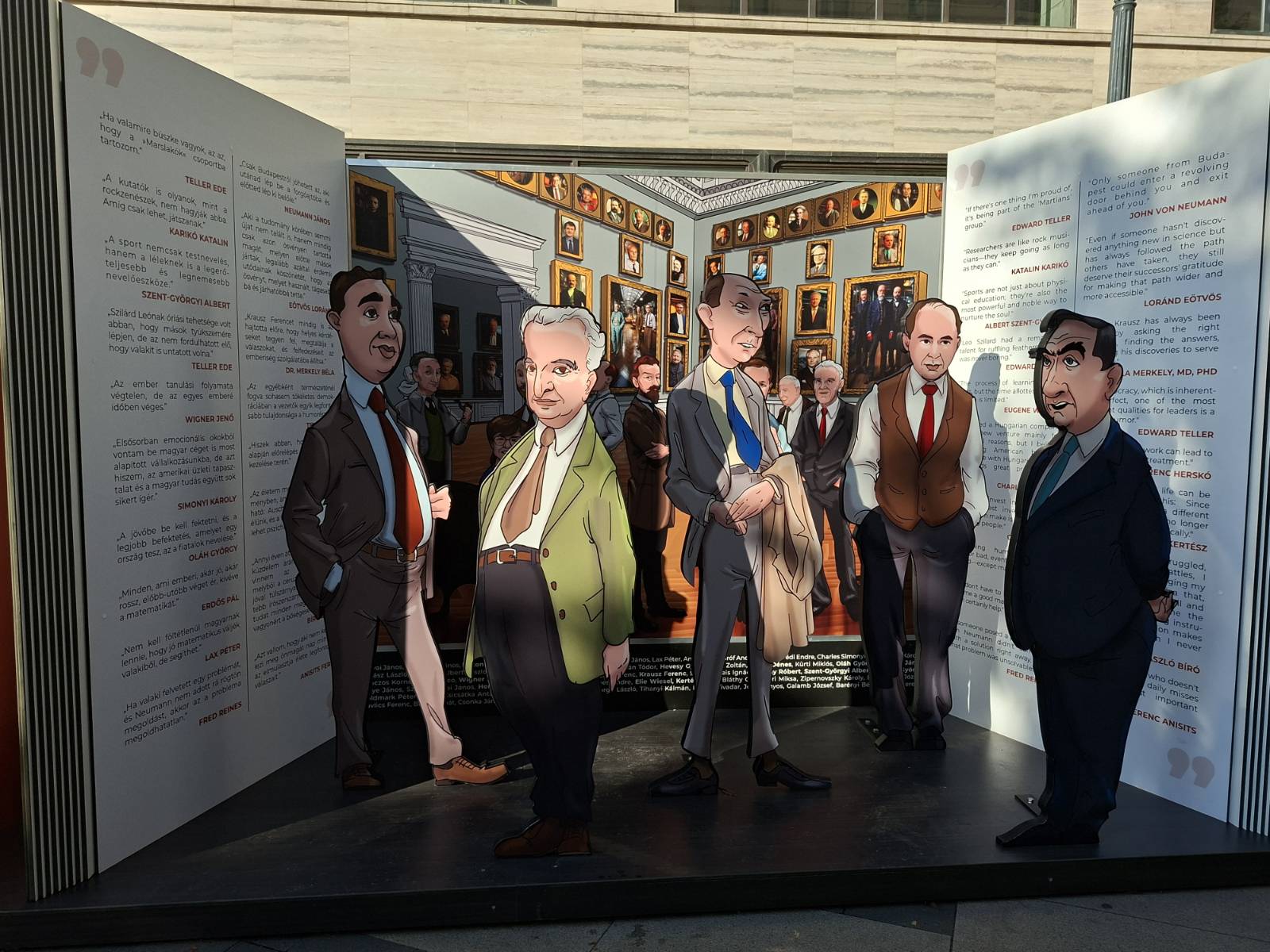
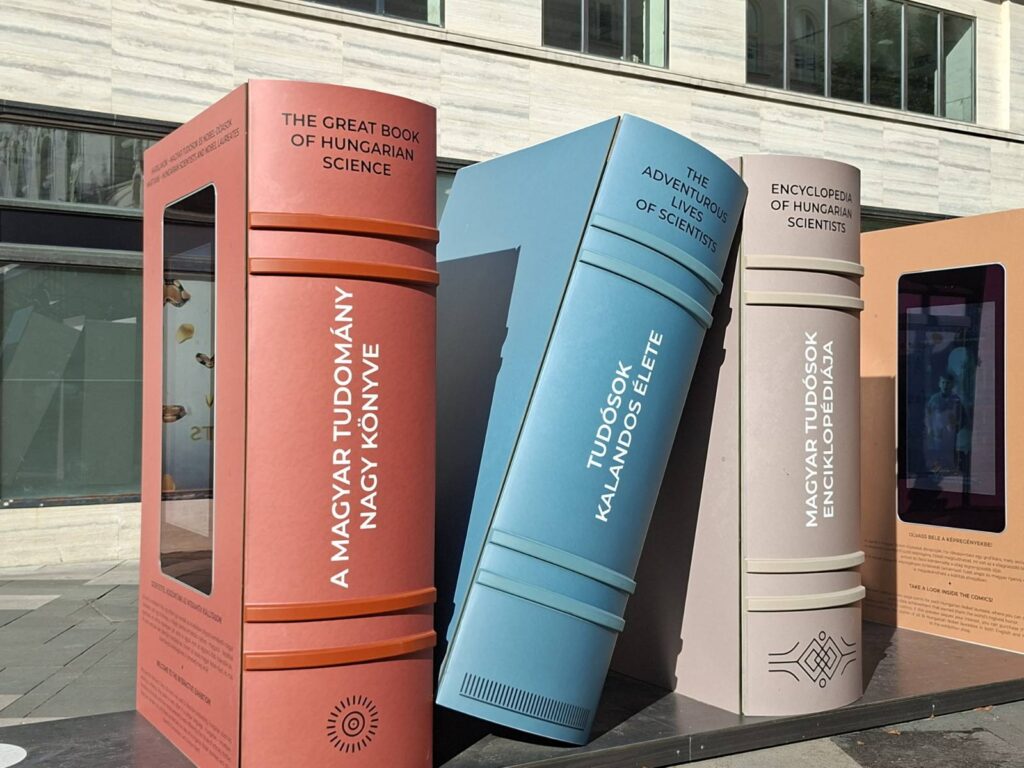
Right now in Budapest, visitors can enjoy an interactive exhibit of Hungarian Nobel laureates and famous scientists.
The title of the exhibit is “The Martians – Hungarian Scientists and Nobel Laureates” and includes names such as physicist Loránd Eötvös, Covid-vaccine researcher Katalin Karikó, mathematician and pioneering computer scientist János Neumann, inventor of the Rubik’s Cube Ernő Rubik, “father of the hydrogen bomb” Edward Teller, another contributor to the Manhattan Project Leó Szllárd, and even economist Milton Friedman, whose parents came from the Kingdom of Hungary in present-day Ukraine.
The touch-screen displays take you through the history of some of Hungary’s greatest minds, while a large centerpiece features cartoon representations of each one, complete with some of their famous quotes.
Miklos Szantho, director general of Budapest’s Center for Fundamental Rights, delivered a speech at the opening ceremony of the exhibit on Aug. 19, an edited version of which was run by Magyar Nemzet, which we have posted in English below.
Martians. This exhibition opening, with a groundbreaking name and a good sense of rhythm, connects the greatness of Hungarian scientists and our founding king. We can thank all of them for the success not only of the Hungarian state, but also – as the forced careers of many of our Nobel laureates abroad show – of the Hungarian nation, which knows no borders or barriers.
Of our national greats, thank God, most of them worked, researched, or fought for their country, but many of them ended up emigrating. Typically, when some empire tried to absorb us, but in inverse proportion to the achievements of our scientists, fortunately with less success rather than more.
And what doesn’t kill you makes you stronger.
One of our Nobel laureates, Imre Kertész, was right when he said that the Hungarian people have acquired “immeasurable knowledge at the cost of immeasurable suffering.” And imagine how much scientific and political success we would have had if peace and security, not suffering, had played a leading role in our history!
It is precisely because of our past, dotted with heroes, often war heroes or scientists fleeing war, that we can appreciate a life without war. And now we long for peace and security again, and we know that our American friends are with us in this.
And they will also understand the following statement. King Stephen – like our other great statesmen from Lajos Nagy to Széchenyi to István Bethlen – knew: in order to “prosper, create, and increase, and for the homeland to shine,” not only peace and security are needed, but also a balance of faith and wisdom, faith and knowledge, faith and reason.
The exhibition, the traveling exhibition, that we are opening here today, is perhaps unspoken, but it is based on this: It presents the giants of Hungarian science on the eve of the celebration of Christian Hungarian statehood. That a small people, speaking a language that sounds truly Martian to foreign ears, has been here for more than a thousand years, and that has given the world so many Nobel Prize winners, is a miracle in itself, but it is a fact. However, if the balance between faith and science is disrupted – usually to the detriment of the former – the end is a tragedy, from which both suffer equally.
And although he was neither a scientist nor a politician, just a simple patriot, Colonel Ferenc Koszorús, the savior of Budapest’s Jews in 1944, wrote the following in his memoirs: “The root of the troubles is found where and when they dared to express the denial of God, and the troubles turned into depravity, the rush of humanity into destruction, where and when the denial of God was institutionalized.”
The celebration of evil and the cynical mockery of good are just a consequence of everything in our time. In an age that thinks of itself as the most advanced in terms of infocommunication, while everyday communication is becoming more and more primitive than ever before. Unfortunately – recalling the worst memories of our history – there are still those today who disguise evil as good, who communicate grandiloquence as a plan, who explain lies as truth afterwards, and who certainly cannot be accused of treason only because, beyond their last name, nothing indicates that Hungary is their homeland.
Yet, even today, in the so-called post-truth era, the task of a politician and scientist is to represent the truth and the homeland: that knowledge is a gift from God; that He also set boundaries for peoples; that He created them male and female; and that peace is good.
If we walk this path, if we simultaneously look at our kings and Martians, Saint Stephen and Katalin Karikó, not only the homeland, but also the world will come to light, and Hungary will have dozens of Nobel Prize winners and at least a thousand more years ahead!
The Center for Fundamental Rights is very proud to be a part of this project, congratulations to the organizers! God bless America, God bless Hungary!