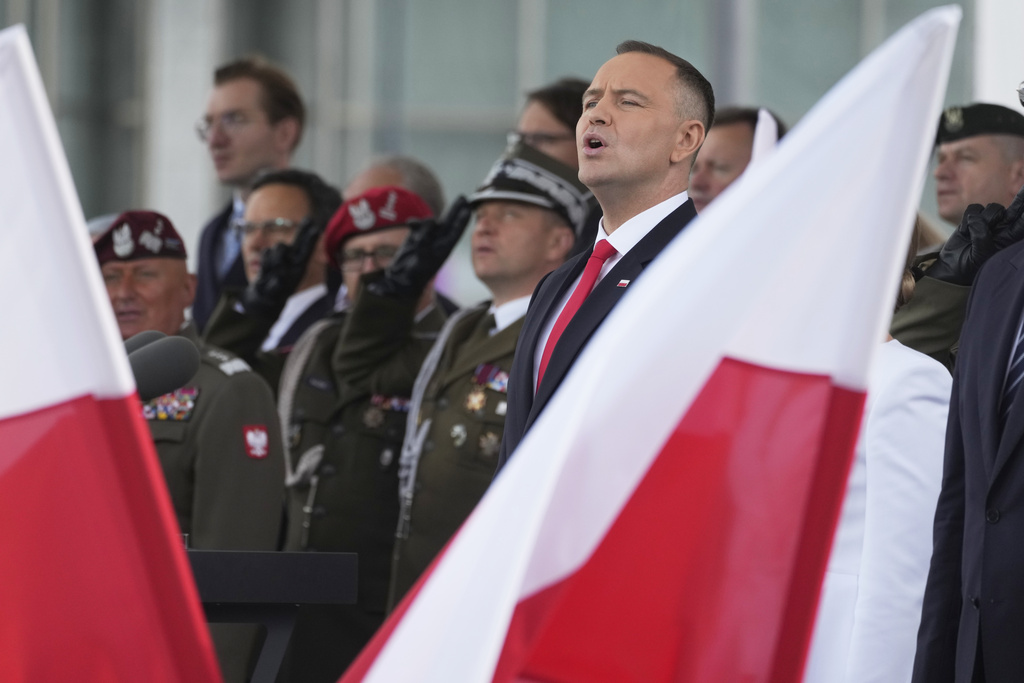
On Monday, the 86th anniversary of the outbreak of World War II was commemorated at Westerplatte in Gdańsk, with Polish President Karol Nawrocki using the occasion to say his country would demand reparations from Germany.
Also present at the Prime Minister Donald Tusk, Deputy Prime Minister and Minister of National Defense Władysław Kosiniak-Kamysz, and Speaker of the Sejm Szymon Hołownia.
Notably, Tusk is known for dropping the issue of reparations with Germany to repair bilateral relations, with Nawrocki’s demands sure to raise ire between the two nations.
“In order to build a partnership with our western neighbor based on truth and good relations, we must finally resolve the issue of reparations from Germany, which, as president of Poland, I unequivocally demand for the common good, for our future,” Nawrocki said.
As is tradition, the morning ceremony was preceded by the sound of air raid sirens just before 4:45 a.m., as that was the time of the German attack on the Polish Military Transit Depot, located on the Gdańsk Peninsula, on September 1, 1939. Soldiers of the Polish Army and invited guests sang the national anthem, and the white-and-red flag was raised.
Then the Candle of Peace was lit, the soldiers read the Remembrance Roll Call, and the heroism of the defenders of the homeland was honored with a cannon salute.
During his speech, Nawrocki noted that the war in 1939 was caused by “bad words spoken by Germans towards other nations and towards the Polish nation.”
“The Germans’ words were regularly spoken, recorded in the pages of successive books and philosophical treatises in the second half of the 19th century. First, these great theorists created a world without God, a world in which God was to die. And since there is no God, man must become God. To decide about life, about death. To decide who may live and who may not, ” said the president.
“It was at the end of the 19th century that a whole body of meanings and theoretical mechanisms for building German National Socialism emerged. That’s what the Germans’ bad words sounded like at the end of the 19th century,” he said, adding that at that time “anti-Polish, anti-Slavic, anti-Semitic theories, chauvinism, contempt, Nazism was born.”
“The Lebensraum theory and all the others that we know only from the practice of the 20th century were born,” he stated.
He added that “in German dictionaries, the word ‘Pole’ became synonymous with someone inferior. Poland was someone inferior, something inferior, something to be despised. Poles did not deserve to be treated like civilized peoples.”
He continued by saying that at the end of the 19th century, Polish patriotism was considered a threat to the German state, and religiosity was considered to be directed against the interests of the German state.
“On August 22, 1939, Adolf Hitler thundered to Wehrmacht officers: ‘Be ruthless, be brutal. The destruction of Poland is your first task.’ Then came September 1, 1939, and the attack by sea, land, and air on the Polish enclave, the German-dominated Free City of Gdańsk,” the president said.
He added that Poland faces great challenges.
“In the face of resurgent neo-imperialism and the post-Soviet Russian Federation, we face the challenges of building the European Union and the North Atlantic Alliance. We are pursuing these tasks together with our trading partner and our neighbor – Germany, the perpetrators of World War II, who, hand in hand with the Soviets and Stalin, led to the outbreak of that war and who attacked Westerplatte,” he said.
According to the president, building good relations with Germany is now dependent on Poland obtaining war reparations.
“In order to build a partnership with our western neighbor based on the foundations of truth and good relations, we must finally settle the issue of reparations from the German state, which, as the President of Poland, I unequivocally demand for the common good, for our future,” said Nawrocki..
He also appealed for the government’s support in demanding reparations from Germany.
“I believe that the prime minister and the Polish government will strengthen the president’s voice on the international stage and we will build our truly secure future together with our western neighbors,” said the president.