“There is still a big part of the 100,000 Jews in Hungary that we have not yet reached!” Rabbi Baruch Oberlander tells me, following my compliment on the work he and others in the community have done to raise awareness about Judaism among both Jews and non-Jews alike.
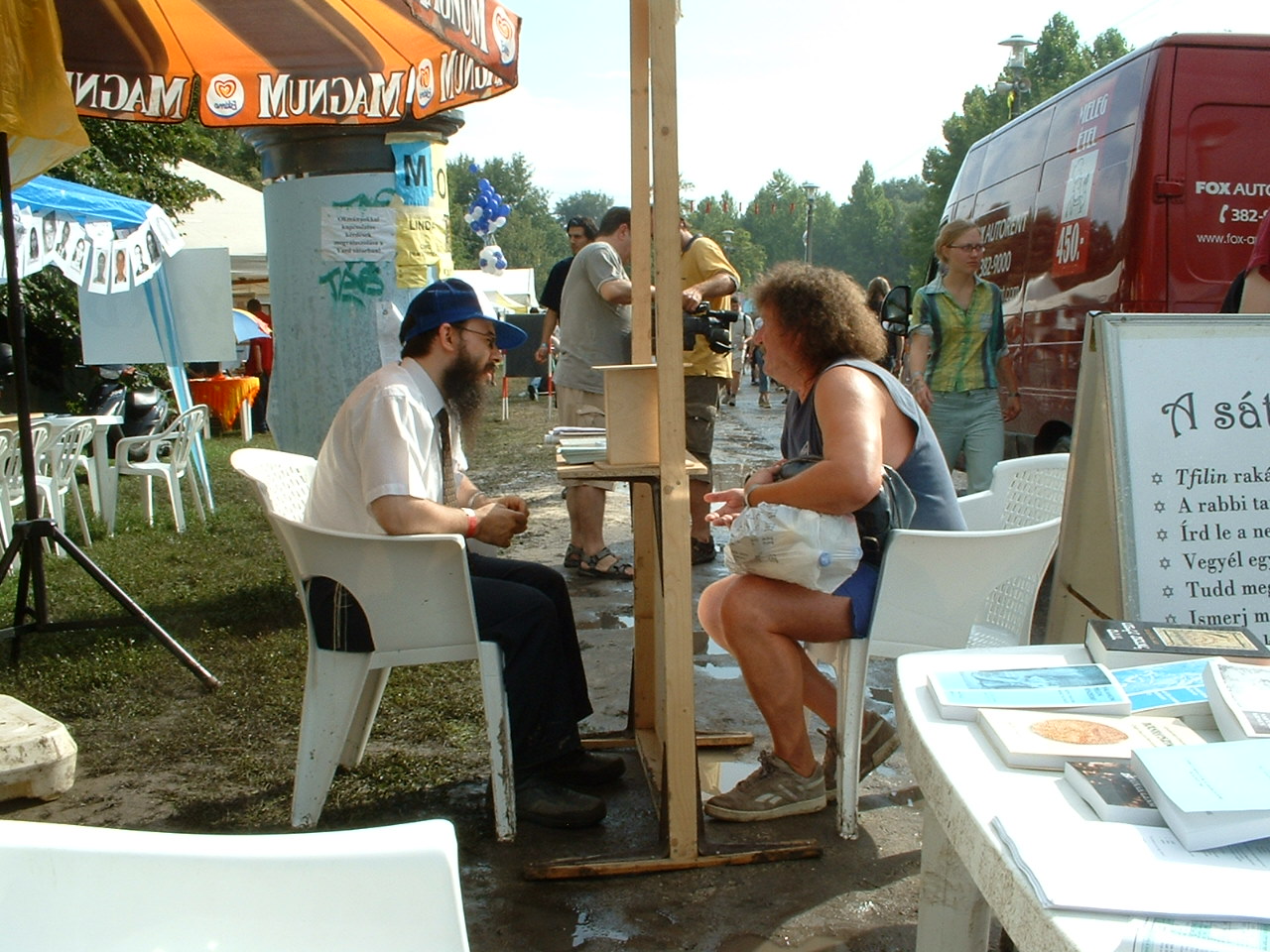
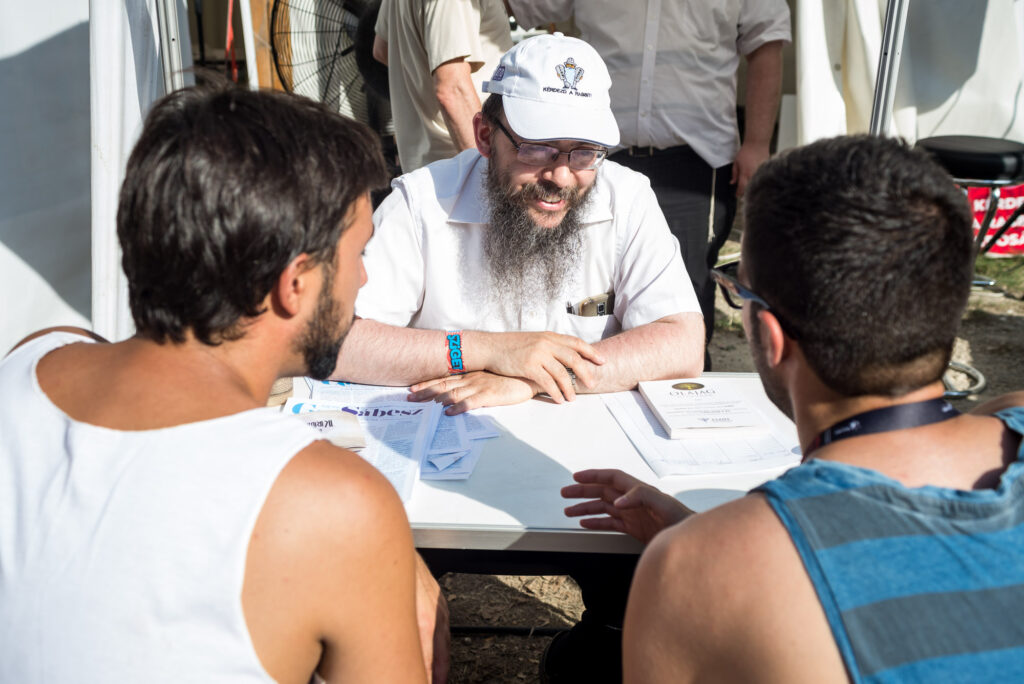
During this summer’s Sziget Festival, a music festival named after its location on Óbudai-sziget (“Old Buda Island”), Oberlander and a team of other rabbis sat in a tent, inviting attendees to come ask them anything. He has been doing this for nearly three decades. This year, in the midst of the conflict in Gaza, he was ready for the worst.
“I was really expecting something different. I thought, this year, we may have some problems. But there ended up being very few antagonistic remarks.”
Oberlander had previously told Zsido.com the same: “We expected a big ‘free Palestine’ tsunami this year, but there was almost nothing. Those who stopped to talk either didn’t bring up the topic, or you could talk to them very calmly. I don’t know what the reason was: People either left their views at home, or the majority of young people actually think sensibly. But as usual, there is a vocal minority, and you think because of them, all young people are like that.”
At his very first “Sziget” back in 1998, Rabbi Oberlander said the environment was very receptive.
“Of course, this is not a natural place for me to be, as an Orthodox, Chabad Lubavitch Hassidic rabbi,” he tells me, laughing. “But it is natural to be where I can find the people, especially young people who have questions.”
“Years ago, sometimes, we would be there until 1 or 2 in the morning. Sometimes, people would try to provoke me. One young man was insistent that 6 million Jews (ed. Note: a number well documented over the years using numerous sources) could not have possibly been killed in the Holocaust.
“I just kept asking him a very personal question, ‘Tell me, what happened to my great-grandmother who was deported from Újpest, with many of her children and grandchildren? What happened to her and to the rest of her family?’
“He had no answer. There is no purpose in these situations to discuss the 6 million number; that’s why I turned the conversation into something very personal.”
Another attendee left their conversation somewhat convinced, but not quite. “You’re a real good guy, really. I just hate all the other Jews,” he told Rabbi Oberlander, who laughs and throws up his arms as he relays this to me.
But more often than not, the interactions were positive and constructive. “I wanted to prove you’re an idiot, but you proved me an idiot,” one Hungarian told him.
Nowadays, what had been a purely Hungarian festival years ago is now international, with fewer and fewer Hungarians present, which he attributes to the festival’s increasingly high prices.
Oberlander and other Chabad rabbis, including from the Association of Hungarian Jewish Communities (EMIH), still show up to every festival. This year, other Jewish organizations planned to boycott the event after Sziget’s organizer refused to ban a rock band (Kneecap) that has been openly pro-Hamas during its concerts. However, Chabad insisted on going, as EMIH’s Rabbi Köves said: “Darkness can only be fought with light.” The Hungarian government ultimately banned Kneecap from entering the country.
Against this backdrop, it was a pleasant surprise when one rabbi was greeted by a ticket-checker who showed off her Star of David pendant.
The next few days were spent doing their outreach, i.e., working to communicate with others. Rabbi Oberlander described this work of Chabad perfectly in the Zsido.com interview. Referring to the two kinds of fruit yielded by their presence on Sziget Island, he said there are “Jews who, as a result of the island meetings, become closer to their roots, and non-Jews who, as a result of meeting Jews, become more open and resistant to anti-Semitic doctrines.”
This year, the harvest was plentiful.
Oberlander was approached by one woman who had started attending synagogue after a conversation she had had with him at Sziget 21 years ago at the age of 16.
A young French man brought four others along to their tent to say Kaddish (a prayer said in a quorum of 10 for those who have passed away) for his father.
Another girl who was not Jewish had concerns about how her relationship with her Jewish boyfriend would work out long-term. She has no intention of converting, while her boyfriend fully expects his future kids to have their Bar/Bat Mitzvah. Oberlander explained the issues and resentment that may arise down the road. “It was a nice conversation. She was very thankful,” he says.
Three other girls sat down for a chat, with one complaining to the rabbi that her mother had always forced her to go to Sunday Mass. This had made her drift away from the Church, but as she grows older, she is looking to go back. However, she is conflicted, still harboring resentment against her mom having imposed it on her.
“‘Did your mom insist that you wash your hands before eating? I asked her,” Oberlander tells me. “She replied, of course she did so, because that was understandable and the right way. ‘So why was it wrong to be forced to go to church, why resent one and not the other?’ I asked her.”
This seemed to help her get over her childhood grudge and move on with her journey back to a more spiritual life, which she clearly wanted, he says.
Another attendee expressed concerns over the deaths of Palestinian civilians in Gaza and confronted Oberlander on this subject. “I simply told him that after we lost 6 million, and nobody cared, I don’t expect anybody to care for us today. But what is surprising is how the world refuses to care about how Hamas terrorists treat Palestinians, how they use them as human shields, and allow them to be killed. This will never make sense to me that nobody seems to care about this.” The young man accepted this as a fair point and thanked Oberlander for his time.
Just this month, Kálmán Szalai, host of the program “50 Minutes,” visited Israel to personally investigate reports circulating in international media and on social platforms claiming that Israel is starving the population of Gaza.
At the Kerem Shalom border crossing, Szalai witnessed hundreds of trucks loaded with humanitarian supplies waiting to be collected. Representatives of the Israel Defense Forces (IDF) emphasized that Israel does not block the aid convoys, but noted that on several occasions, the United Nations and other aid organizations failed to show up to collect the shipments.
The IDF also stressed to Szalai that their ability to prevent the Hamas terrorist organization from seizing the aid is limited, as the responsibility for distribution lies with the humanitarian agencies. For this reason, Israel has expressed strong support for the Gaza Humanitarian Foundation, which delivers assistance directly to the civilian population in Gaza.
On the topic of Gaza, Rabbi Oberlander also emphasizes the power of social media, as well as what many have claimed to be doctored and outright fake photos and videos spread by Hamas. But more than this, Oberlander maintains that they put their own people in harm’s way and keep them there, on purpose.

“Still, most people did not even bring this whole subject up,” Oberlander says, still somewhat surprised. “We thought people might be screaming and demonstrating. But even those who breached the topic with us were not full of hate in any way.”
“I suspect maybe, and it would not be the first time, a very loud minority is behind this pro-Palestinian, anti-Israeli campaign. They end up representing ‘everybody’ because they are so loud.”
But this is not the case, at least not at Sziget. “All in all, the security guy with us was bored, nothing happened,” he says happily.
Still, in the eyes of many, Hamas has already won. They got what they wanted: the demonization and global hatred of Israel, making it even harder for the country to defend its territory, its people, and its right to exist. Even questioning if Hamas is doing this or that against civilians, or keeping aid from them, can bring defensive ire. And even if this is from a small group of people, it is loud enough to spur many to avoid confrontation.
As Kevin Myers wrote in his Brussels Signal piece, “The terrible truth is that Hamas has already won its Gaza war. Israel, the victim of the massive October 7th pogrom, has, by a brilliantly Satanic sleight-of-hand, been turned into the oppressor.”
Essentially, as Myers explains, the plan of the now-martyred Yahya Sinwar was to instigate Israel, force it to defend itself at all costs, and demonize it around the world.
And attempting to discuss the real issue, “Do Palestinians even want Israel to exist?” is no longer polite conversation for what seems to be many. Or, again, is it just this very vocal, visible few?
This brings us to the real issue for us all: Do we care about freedom? This has been another major win for Hamas and Palestinian sympathizers. They have essentially shut down any conversation about the values they aspire to by using the “freedom of speech” argument. And yet, these same people have made it clear they do not want Israel to have the freedom to exist.
But, forget Israel. What of America? Do they want the America we grew up in to exist? This is a heated topic, one my own alma mater is now paying dearly for.
This past July, Columbia agreed to pay the U.S. government over $200 million to restore its right to federal funding. The university has agreed to create a safer environment for Jewish students who had faced an onslaught of verbal and physical abuse from pro-Palestinian (and often pro-Hamas) protesters. The Columbia campus was occupied for more than 100 days back in 2024, leading to an obstruction of student life and classes, as well as clashes with police.
At one point, some students took over Hamilton Hall. Columbia has reported that it expelled these students, suspended them, or temporarily revoked their degrees.
There were many who believed these students were simply expressing their freedom of speech. But when your free speech seeks to shut down and shut out an entire community, not to mention shut down classrooms or seize buildings, we have a problem.
And then there is the issue of what these students were protesting for. Some were openly supporting a terrorist organization known to seek the destruction of Israel (“From the river to the sea”) not to mention their hatred of “Western imperialists,” while others seemed to be happy to support the “freedom” of a group of people who, as a populace, do not live in a democratic society and follow the laws of Islam. Palestine’s Basic Law purportedly calls for respect for other religions, and yet, Islam is the official state religion, and Hamas is known for seeking to impose its laws.
Perhaps your average Palestinian would prefer a “free” society, but they only seem to relish in the battle cries against their oppressor Israel, as well as its backer, the USA.
Myers also notes in his piece that approval among Palestinians of armed attacks on Israeli civilians now stands at 59 percent, up from 48 percent in 2023.
Meanwhile, even longstanding Christian communities there face discrimination and tensions, not to mention the third-world living conditions brought about by a country constantly run by militants.
So, would Palestinians ever choose a free and democratic society?
“My father, having had to flee to the U.S., adored, cherished democracy. After all, you should be able to say everything. When there isn’t freedom of speech, the first one who won’t have freedom of speech will be us! Freedom of speech and religion — this is a solid rule,” Oberlander tells me.
“After 9/11, my father was shaking,” he continues. “‘After surviving the Holocaust, we thought we would be safe here in the USA,’ he said to me. It was so sad. But the idea of freedom is key for all religions,” Oberlander insists.
As to the no-go zones in other European cities, areas riddled with crime and tolerance only for those who are Muslim, these should not exist, he says, emphasizing that the prevailing laws of the land must prevail and be enforced on all.
Bringing up the recent case in Austria, whereby a regional civil court upheld a contract between two men who had agreed to arbitrate any dispute according to Sharia law, Oberlander seemed neutral on the matter. Private parties should be allowed to arbitrate as they see fit, as long as this does not contravene the laws of the land. The practice of private arbitration is rife (and controversial) in the corporate world and is used amongst Orthodox Jews as well.
Upon first reading of this case, I myself was first shocked and then confused. If the two men had agreed on this privately, and both are presumably Muslim, why should the state intervene simply because one side is now upset over his obligation? Those concerned point out that once the state publicly upholds Sharia law over a business contract, what’s next? One could say, OK, but certainly lines can be drawn. Nobody will allow a woman to be forced to stay in an abusive marriage or a girl to be mutilated, right? Nobody is going to allow Islamic precepts to creep into state law, right?
🇧🇪🔴 Belgium: A politician in Molenbeek, Saliha Raiss, is under fire after telling residents to leave if they do not like the veil in her neighborhood, which is 44% Muslim.
One young Belgian woman responds: "Sad to say, but today Belgium is reaping what it sows, wanting to live… pic.twitter.com/mEuq4JnCHP
— Remix News & Views (@RMXnews) September 3, 2025Unfortunately, Muslims, especially the more religiously fervent ones, may not see it that way. Muslims comprised some 6 percent of Europe’s population — as of 2020. Estimates call for this figure to rise to over 11 percent by 2050.
As a comparison, Jews make up some .1 percent of Europe’s population, also as of 2020. As of 2022, Orthodox Jews made up 8 percent of Europe’s total Jewish population.
Jews have also lived across Europe since the Common Era. They have been a part of communities and a shaper of customs in almost every country. And despite almost being annihilated, they are still here and thriving as part of the European community. They have never sought to change the state laws of the countries they reside in, and those who are strictly religious maintain very private lives.
Muslims, on the other hand, have become known for wanting to impose their ways on others and dominate. This appears to be a recent phenomenon in Europe, and I feel for those Muslims who have been living quiet and free lives here in Europe for decades, and for those who came in the recent migration wave seeking a Western life. But sadly, the headlines write themselves, and when a Muslim cleric in Sweden says they will be the majority, or a group of Muslim boys harass a Christian girl for wearing a spaghetti-strapped shirt and calling out “Haram!’, you get the concerns.
🇫🇷 A French woman is allegedly told her outfit is "haram," which means "forbidden" in Islam.
The girl, wearing a cross necklace, responds: "It’s a good thing I’m a Christian."
The incident happened at Music Festival 2025 in Paris, which saw widespread violence and 371 arrests.… pic.twitter.com/f8s2H25WiG
— Remix News & Views (@RMXnews) June 23, 2025Europeans got a nasty wakeup call in 2015 with the Charlie Hebdo killings. Five years later, French teacher Samuel Paty was beheaded by Muslim students offended by his class featuring some of the Hebdo cartoons. Tragically, a student had lied about a depiction of Mohammed she said Paty had shown his students. Nevertheless, Muslims find any depiction of the prophet blasphemous, apparently on penalty of death.
Paty taught a class on freedom of expression.
Ten people in total faced charges for their involvement with the killing, besides the 18-year-old perpetrator. These included an Imam, two students at the middle school, and even one student’s parent.
Remix News recently ran harrowing comments from the deputy head of the German police union, Manuel Ostermann, who predicts Arab clans will dominate by the mid-century. He says multiple cities will have Muslim mayors, sharia law will be followed strictly in some districts, and the Bundestag, the lower house of the German parliament, will be home to representatives from an Islamic right-wing radical party. That is the future he sees if Germany does not change course, he warns.
Scaremongering? Muslims are loud and growing and backed by every liberal-card carrying Westerner flogging themselves for any civilizational pride they may be guilty of harboring.
And those of Jewish heritage or representing the Jewish faith? They’re just happy to be alive and trying to stay that way. And Chabad’s purpose is to remind them that living with religious beliefs is meant to be joyful. This message can be tough for some, even 80 years after their latest mass suppression, because no, that wasn’t the first.
I was surprised at the number Rabbi Oberlander gave for the number of Jews in Hungary he still sought to reach, as most sources cite some 50,000 living here. The truth is, many still today will not tick that box. Having grown up as a bi-coastal American, this makes me grimace. Then again, neither I nor my parents nor grandparents experienced the Hungary of WWII, nor the years preceding it.
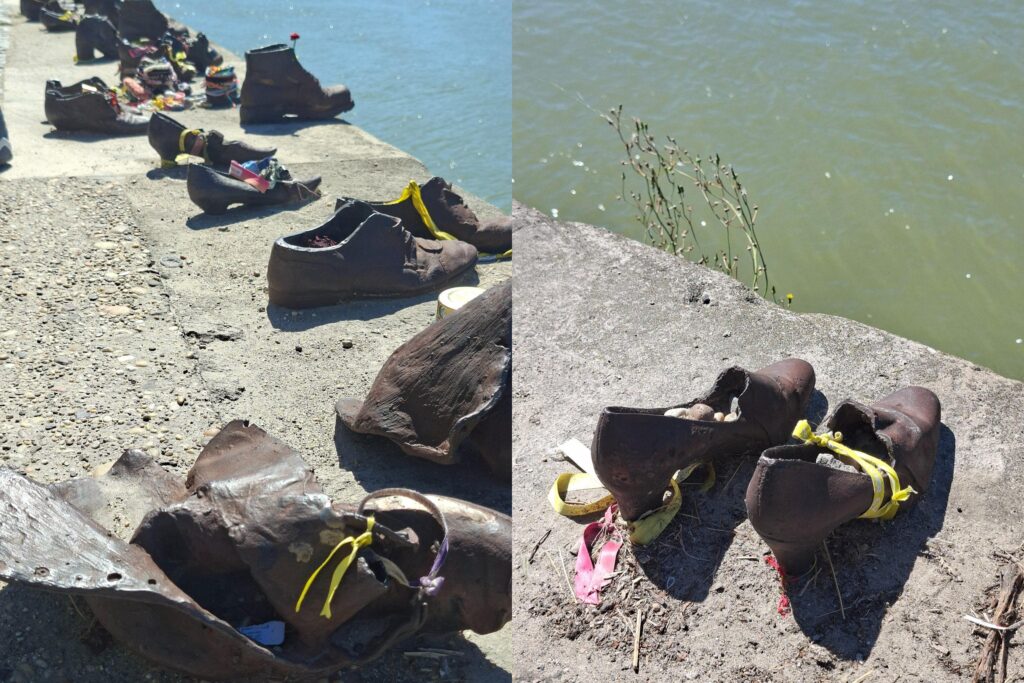
Between December 1944 and January 1945, 20,000 Jews were murdered by gunshot and tossed into the Danube. Forced to remove their shoes before facing the firing squad, a memorial today of 60 pairs of bronze shoes stands as a testament to the terror.
There are no laces, as the victims had to remove these so that their executioners could tie their hands together. Some were tied in groups of two or three, with one being shot, dragging the others with them into the ice-cold water of the Danube.
Budapest was liberated just a month later in February 1945. In total, over 550,000 Jews had died — from being forced into labor, sent to death camps, or shot on the ground in Budapest.
Shockingly, some 100,000 Jews remained in the city, although many of these would take the first opportunity to flee not just Hungary but Europe, with a vast majority ending up in the United States, a land where they could be free to live as Jews. The WJC puts the number of surviving Jews from “larger Hungary” at 255,000, still a fraction of the 825,000 known to have been living in the spring of 1944. Overall, Hungarian Jews were somewhat luckier than those living in other areas, but they survived with the knowledge that they had been hunted.
Rabbi Baruch Oberlander’s parents both survived the Holocaust. His father was in Budapest, with “false” papers, as he calls them. His mother was deported to Austria with her family. They both fled in 1947. That did not mean they stopped being Hungarian. The Hungarian language, their Hungarian Jewish traditions, and their way of life — all of that stayed with them in their new home in Brooklyn, New York.
For his part, Oberlander would come to adopt new traditions, too. Not just as an American, or a New Yorker, but as a Jew. Drawn to Chabad out of a desire to help others, he was ordained a rabbi at the Central Yeshiva Tomchei Tmimim Lubavitcher in 1988, after attending yeshivas in the U.S. and Israel. A year later, he was called upon to return to his Hungarian roots, arriving in 1989, just before the fall of communism, with his newlywed wife Batsheva (also of Hungarian heritage). In 1991, he became rabbi of the Orthodox Vasvári Pál Street synagogue.
During an interview on Neshama TV’s “50 Minutes,” Oberlander pointed out that Chabad’s own Hassidic traditions and interpretations differ from the Hungarian Ashkenazi customs of Orthodox Jews. And yet, a balance was found, especially since Hungary itself had a very big Hassidic heritage up until the Holocaust, whereby the community has always respected each other’s ways. Just like in America, a sort of melting pot ensued.
“We have preserved many local Ashkenazi customs to this day, for example, we recite Akdamut (a piyyut or liturgical poem) on Shavuot (when Moses received the 10 Commandments) because it is a beautiful text,” he said during the interview, as cited by Neokohn.
Today, under the leadership of Rabbi Oberlander, Hungary is now a major center of the Chabad Lubavitch movement. Whereas in his early years, he spent much time travelling the countryside of Hungary, as well as the pre-Trianon territories where so many Hungarians still lived, those areas all have their own Chabad rabbis today. The growth has been tremendous — and rewarding.
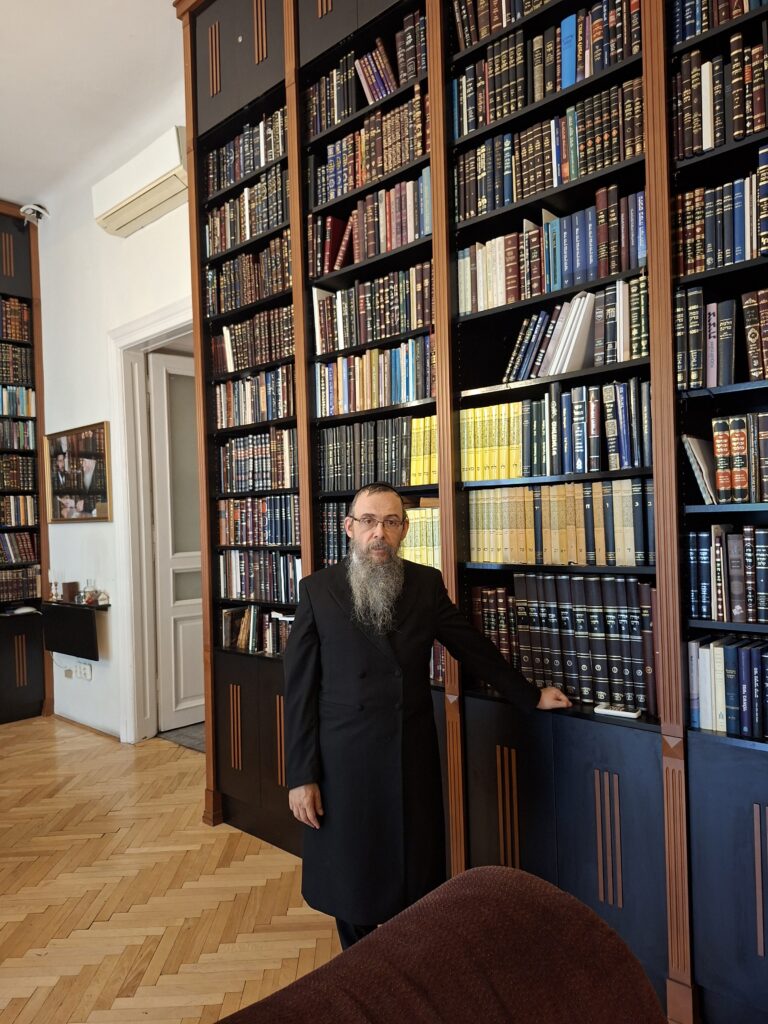
One young boy he knew and briefly taught in the village of Vynohradiv, western Ukraine (formerly Nagyszőlős, in the Kingdom of Hungary), is now a rabbi in Israel. Another girl ended up marrying a religious Hungarian boy in Brooklyn.
Oberlander has stayed busy over his decades here. One of his first projects was publishing a new siddur, or prayer book, as the ones used by the community were old, worn, and with archaic translations in Hungarian.
There have now been three printings of his new siddur, a total of 15,000 copies used by all the congregations in Hungary, he says. He also started Zsido.com, the largest Jewish website in Hungary. During Covid, having a digital format was especially important for the community. It was at that time that the rabbi started sending out a daily message via WhatsApp, Sunday through Friday. He still does so today.
Oberlander also obtained his PhD in history from the University of Debrecen on the making of a forgery, focused on volumes of the Jerusalem Talmud that had been at the center of a controversy for some time more than a century ago; they are now more or less accepted as fake.
He taught Jewish Law at Budapest’s ELTE for 20 years and also teaches Jewish medical ethics at Semmelweis (SOTE), in both English and Hungarian. He tells me this field is critical, as doctors and the medical practice, as well as patients, are facing so many new questions given the rapid advancement of medical treatments and the fact that we are living so much longer.

As our conversation turns back to the war in Gaza, Oberlander acknowledges the bad press and unfortunate casualties. “People question Israel, and are not aware how Israel is so so careful, and when you are dealing with terrorists, they will stop at nothing; they just sacrifice their own people to shield themselves, and you are left with the question of your survival.”
“Israel is a high-tech country, a place of business and innovation. People there are not interested in war, but they also do not want to be killed,” Oberlander tells me.
“No right-wing leader wants to be in war for long; it is bad for business, bad for the economy,” he continues. “After PM Rabin was assassinated in ‘95, Hirado, Hungarian TV’s main news program, interviewed me and asked, ‘Why is it that religious people are not pro-peace, and only the left wing? Why are the religious pro-war?’ And I told them, ‘Nobody in Israel is pro-war, but the debate is, will an agreement with the PLO bring actual peace, or will it bring war?’ This was the real question,” he underlines.
“We pray three times a day, and in that prayer, we pray for peace,” he adds.
On the topic of Judaism, I ask for two lessons from Judaism that he would like to share.
1. Judaism does not teach us not to live a normal life, to not enjoy life. It teaches us how, with the help of our religious beliefs, we should enjoy life, how to live a good life, live a life full of love, how to find purpose in life.
2. The concept of Teshuva, basically repentance or self-improvement. God is always ready and waiting for you. He will delete all so that you can move forward in life with a clean slate, but you must recognize your wrongs, decide to change, and ask for forgiveness.
The autumn days between Rosh Hashanah (Jewish New Year) and Yom Kippur are fast approaching. These are spent “doing Teshuvah”, followed by the one-day fast, after which the spiritual renewal is complete, i.e., the clean slate.
The Jewish philosopher Maimonides believed that even a lifelong sinner could repent on his deathbed and be forgiven by God. Judaism is certainly not alone in this thinking, and the theme of God believing in man’s ability to strive for goodness, even if he has lived a flawed life, is also present in secular literature, quite famously so in Goethe’s Faust.
These are the aspects of Judaism that Rabbi Oberlander, Chabad, and EMIH seek to communicate to and share with people around them. There is no obligation to adhere, agree, or accept. But the door is always open.
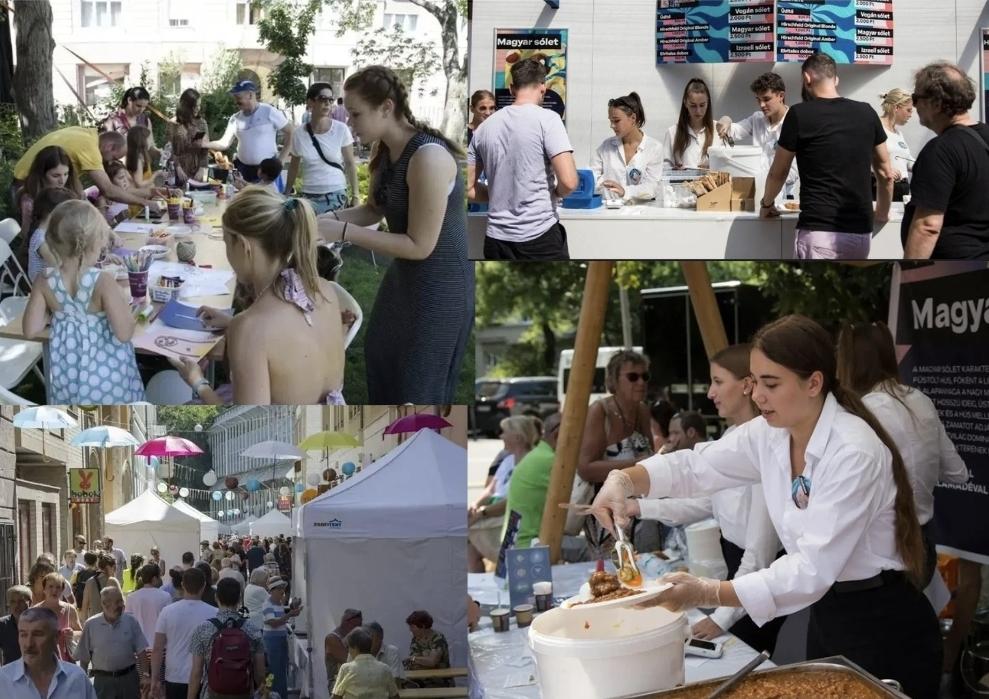
Chabad, along with EMIH, continues to work hard “normalizing” Jewish life, with numerous programs throughout the year. I say “normalizing” because the first time I asked someone where I could get good bagels in Budapest, like at a kosher deli maybe, they looked at me like I was an alien. (As it happens, a fantastic bagel place, with authentic New York bagels, complete with numerous optional toppings, opened in 2022, right next to Margaret Bridge and aptly named Brooklyn Bagel. It even has Oberlander’s Hechsher, the kosher certification granted by him as the head of the Orthodox Rabbinate in Hungary.)
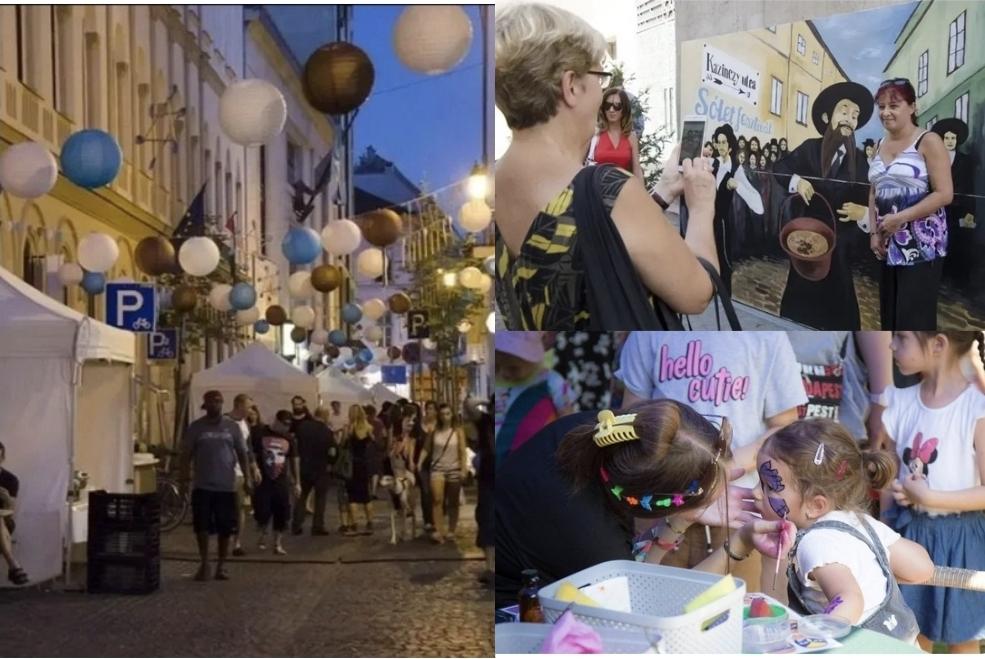
Autumn is a particularly active time for the Jewish community, with an entire calendar of concerts and events. The popular Sólet Festival is part of the annual “Synagogue Week” that local Budapestians and visitors flock to to savor multiple versions of the savory stew.
“Everyone’s welcome,” Oberlander says. Whether you are Jewish or not, his message of making sure to find joy in life is relevant to all, especially nowadays.