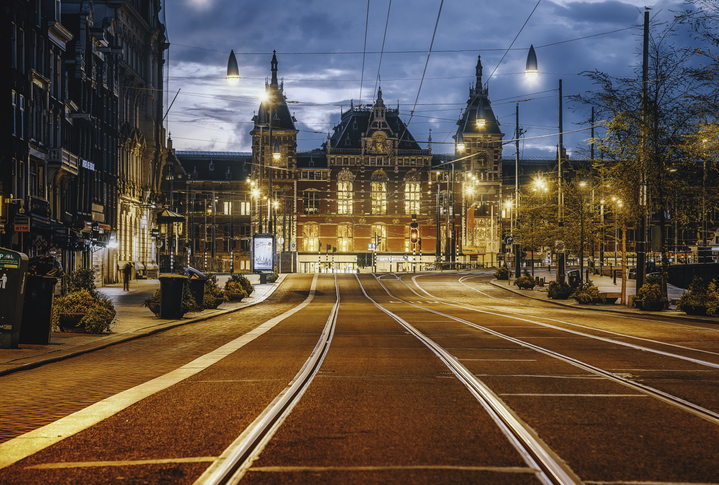
As recent as 2019, The Economist’s Safe City Index placed Amsterdam at the top in Europe and fourth worldwide, behind only Tokyo, Singapore, and Osaka, but a new debate hosted by local broadcaster AT5 has revealed that seven in ten panel members avoid certain parts of the city because they now feel unsafe.
That figure rises to 85 percent among women, while half of the women surveyed reported experiencing some form of harassment, with some subjected to intimidation, being followed, or assault.
The issue has gained urgency after several high-profile crimes, including the murders of two 17-year-olds, Rivaldo, shot dead on a soccer field, and Lisa, who was brutally murdered by a 22-year-old asylum seeker as she cycled home. Multiple sexual assaults have also rocked the city in recent weeks, and police were on high alert after recording three explosions in five days last week.
Silent marches, commemorations, and protests have filled city streets, turning safety, especially for women at night, into one of Amsterdam’s most pressing concerns.
Many panel members said they avoid parks such as Vondelpark, Sarphatipark, and Oosterpark after dark. “You have less of an overview and there are fewer people around,” explained Eva, one of the participants. “If something were to happen, you’d have less chance of getting to a safe place or being able to talk to someone. Then I do think something could happen.”
Others identified shopping streets, bicycle tunnels, and train station areas as unsafe. “There are places in Amsterdam I’d rather not go to after dark. The atmosphere on Leidsestraat and Kalverstraat can be quite grim after the shops close,” said one panellist. Another added: “I find bicycle tunnels difficult and I avoid them as much as possible after dark. I’d rather take a detour.”
The perception of danger is often linked to poorly lit areas and the presence of loitering groups. A woman described her unease near the Rozenburghlaan and Weesperzijde bike path: “There are so many places where someone can hide. It doesn’t feel safe there.”
One in two participants reported direct negative experiences on the street. The most common incidents involved catcalling and verbal harassment, but some women said they had been threatened, followed, or physically attacked. One participant recalled: “While grocery shopping, I was approached by a man asking for money. I told him I didn’t have any, but he didn’t believe me and started following me. Panicked, I went into a bar a street over because he was still following me. He stood in front of the entrance for a while.”
Others described more violent encounters. “A group tried to rob me on the street, and blows were exchanged,” said one panellist. Another woman, also named Eva, recounted being groped by a stranger after a night out: “One of them stepped out of the group, grabbed me from the front, and started rubbing against me. When the group continued laughing, he stopped too. You don’t really know what’s happening. You also start to doubt whether this really happened, or if you made it up. Afterwards, I didn’t have that feeling anymore, but because it’s so often downplayed and dismissed, you start to doubt it anyway.”
Despite these experiences, 91 percent of the women who reported incidents never went to the police. One panellist said she regretted not filing a report: “Every situation has to be reported, so that a file can be built. Then you can see how often it’s happened and that you’re taken seriously.”
More than half of the participants said they feel the police are not doing enough to ensure safety. “The police have become invisible since the neighborhood police officer disappeared. You feel like you’re being left to fend for yourself,” said one panel member.
Some also called for stronger awareness campaigns about harassment. “It needs to be discussed from a young age by parents, teachers, and everyone you come into contact with as a child,” said one participant. “The solution won’t come quickly; it will take many years.” Others went further, suggesting pepper spray should be legalized. “Yes, others can also buy pepper spray, but it has to be a way for women to defend themselves,” one added.
The feeling of insecurity comes amid a backdrop of the upcoming parliamentary elections, scheduled for Oct. 29. Geert Wilders’ Party for Freedom (PVV) is currently expected to become the largest party in the Dutch parliament, but could be sidelined by other parties refusing to work with him.
Wilders has placed immigration, asylum, and law and order at the heart of his party’s manifesto.
The PVV’s broader justice agenda proposes life sentences without parole, tougher penalties for violent and sexual crimes, and the chemical castration of serious child abusers. The program also calls for abolishing psychiatric detention (TBS), banning organizations such as the Muslim Brotherhood and Extinction Rebellion, and imposing stricter prison regimes, including mandatory work and the end of early release.