Recent news of California rolling out a far more generous tax refund for film and TV productions had many wondering: Will this be a significant drain on studios choosing to film in Hungary?
In recent years, Budapest has become so popular for film productions that it has been dubbed “Hollywood on the Danube,” so concerns were justified when this news from the Golden State hit.
And the state has made a significant move to lure productions back home. Starting this past July, California is allocating $750 million (up from $330 million) to its Film & Television Tax Credit Program, known as Program 4.0.
What exactly will this mean? For starters, eligible projects can now include animated films and short-format TV shows. Plus, the credit is now a 35%-40 percent refundable incentive.
By the way. California is not simply looking to keep productions from Hungary. It is seeking to up the ante against various locations around the world, as well as other states in the U.S.
Still, on the ground here in Hungary, people were abuzz with what this could mean for the sector here in Budapest. As Budapest Reporter noted, “Every big-budget series or feature filmed here delivers more than jobs for Hungarian crews. It fills hotels and restaurants, sustains construction and costume workshops, and boosts tax revenues.”
In other words, movie-making is a big part of the Hungarian economy, beyond the studio.
So what does an actual studio have to say about the development?
Remix News reached out to Origo Studios and Korda Studios for comment.
While we received no response from Korda, Origo had plenty to say and is clearly on top of the matter.
“California’s new incentive expansion is focused primarily on television productions. We expect that this will accelerate the trend of some U.S. series returning home, especially recurring shows where predictability and long-term planning are critical,” Origo’s head of marketing, Mihály Tóth told me.
Nevertheless, he maintained that Origo believes Hungary will remain “one of the most competitive filming destinations for feature films and international streaming projects.”
This is because Hungary has far more to offer than its popular 30 percent rebate system. Although Tóth concedes this “has been the cornerstone of our success,” there are other attributes in Hungary, and specifically at Origo that draw productions.
“Origo Studios is ranked among the top eight studio complexes worldwide,” he notes, adding, “We are proud to work with highly experienced local crews, including Academy Award winners such as Zsuzsi Sipos and Zsuzsa Mihalek, whose work in art departments has been internationally recognized.”
Then you have the factor of security, i.e., the safety enjoyed here in Hungary. “Actors like Tom Hanks have praised Budapest as one of the safest cities they have filmed in. During COVID-19, Hungary built a reputation for strict medical protocols, on-site facilities, and reliable safety measures, all of which reassured productions at a critical moment,” he tells me.
“These factors — safety, security, professionalism, and infrastructure — remain decisive advantages for producers choosing Hungary today.”
The smooth operation of Hungary’s rebate framework itself is also key to its competitiveness.
“The National Film Institute’s transparent and dependable registration process has been the bedrock of producers’ confidence over the past two decades,” Tóth emphasizes.
NFI processes applications, assesses eligibility based on cultural test criteria, and issues tax certificates for eligible productions. Being a reliable partner to studios from around the world is critical, as productions must have as few delays as possible.
This is yet another reason Hungary has achieved its status “as a global leader in film production.”
People also highlight that overall costs should still come in far lower in Hungary, not to mention the country, and specifically Budapest, offers an amazing array of diverse architecture and cityscapes to mimic other capitals.
And then there is production speed, with Budapest Reporter noting: “Faster permitting and less union complexity mean a shorter path from prep to wrap.”
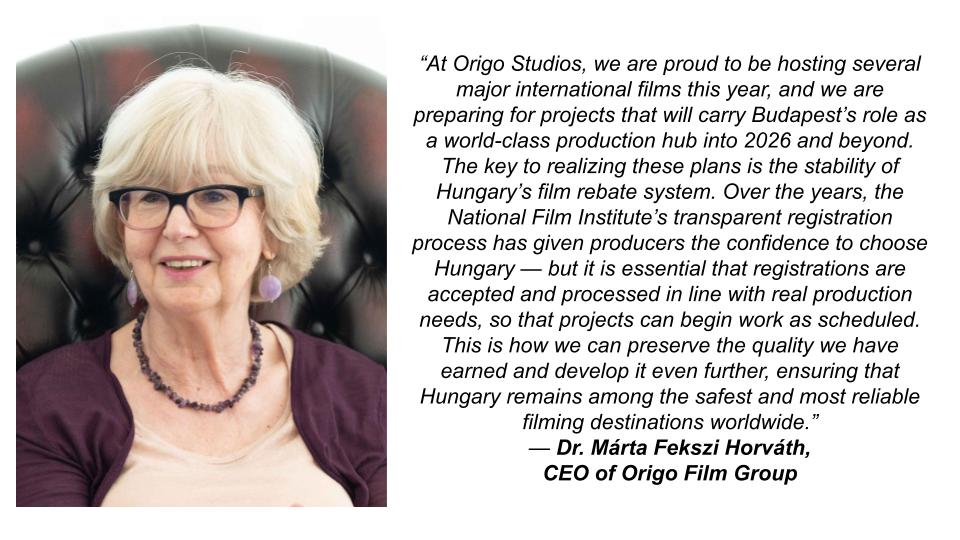
Only time will tell if Hungary experiences any impact from California’s new plan, but the CEO of Origo Film Group, Dr. Márta Fekszi Horváth, summed up where Hungary stands best.