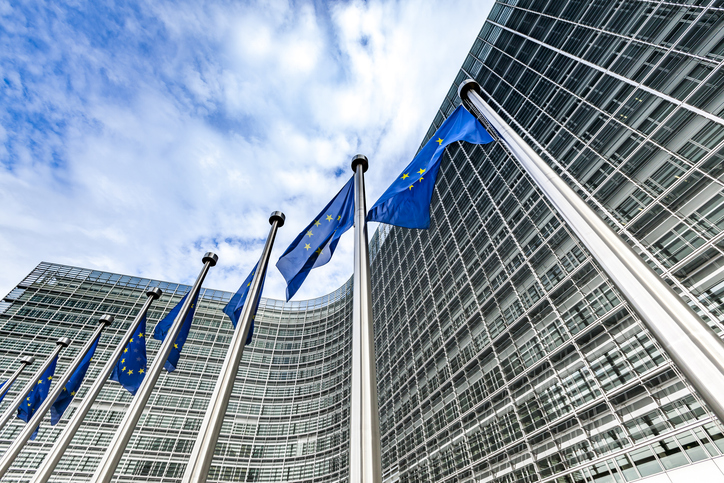
According to Marta Kos, European Union Commissioner for Enlargement, the screening phase of Ukraine’s and Moldova’s EU accession process is almost complete.
However, of course, there is still that pesky Hungarian veto the EU must find a solution to, at least regarding Ukraine’s accession.
Kos, echoing sentiments expressed by Denmark’s Minister for European Affairs Marie Bjerre, assured the press that they will “proceed with the technical aspects,” even if the EU Council does not give its political approval, reports Magyar Nemzet.
Previously, Bjerre stated: “We are still trying to find a solution to get Hungary to give up its veto. If that doesn’t work, we are ready to consider all political and practical means to succeed [in opening negotiations], because our security is at stake.”
Readers should note that Denmark is the current president of the European Union, and it has made it clear that starting accession negotiations with Ukraine is a top priority of its presidency. As noted above by Bjerre, they are directly linking it to the security of the entire EU.
Denmark is not alone. Lithuania has actually presented a way to get around Hungary’s veto by simply starting negotiations without it. Although it is unclear as to how this would work, European Council President António Costa also believes that negotiations on Ukraine’s accession to the EU should continue, despite Hungary’s veto.
A unanimous vote is required for negotiations to begin, so, again, it is not clear what the parties who seek to do otherwise have in mind. Then again, perhaps ECB chief Christine Lagarde has the answer.
According to the head of the European Central Bank, the unanimity principle that the EU follows should be tossed altogether. But would it be that simple?
Back in July, the New Union Post specifically addressed these sticky accession talks, namely, Hungarian PM Orbán’s committed veto. According to experts they spoke with, the Treaties would not need to be amended to shift from the now-followed unanimous voting to qualified majority rule; at least it could potentially be dropped at some of the stages of the accession process.
The real issue, however, is a lack of “political will.”
“The real question is whether there is enough political will within the Council. Orbán’s Hungary is little more than a fig leaf for the deeper reluctance of many other member states to give up their veto power,” they wrote.
According to Lagarde, speaking in Paris this past Monday, “Europe should extend qualified majority voting.”
“This is how decisions are taken at the ECB – and it works,” she said at the 25th anniversary of Institut Montaigne. Lagarde was addressing various efforts at making the EU economy and the euro more competitive being “hindered by indecision.” She has been specifically behind the push for a digital euro.
Further elaborating and pushing back against claims that switching to qualified majority voting would be undemocratic, the ECB head said, “It is not a weakening of democracy. It is the only way to exercise it fully: by pooling our resources and our capacity to achieve the required scale in these strategic fields, we give citizens back their ability to shape events, and Europe its independence in a world of rival powers, where size and the scale effect are critical.”
Not everyone agrees, with a harsh counterstatement coming from Harald Vilimsky, head of the Freedom Party delegation in the European Parliament.
“This call for the undermining of democracy must be firmly rejected. A weakening of the unanimity principle must not be up for debate,” Express reports Vilimsky as saying.
“Ms. Lagarde would be well advised to concentrate on her core task at the ECB – there is certainly plenty to do there – instead of depriving the people of Europe of their democratic rights.”
In a post on X, Vilimsky was more pointed: “The system wants to make the states totally totalitarian once and for all. Only we patriots stand for sovereignty and freedom.”