
The following letter was sent out by the Ordo Iuris Institute for Legal Culture.
On July 16, 2025, the European Commission proposed in its draft new EU budget for 2028–2034 that all EU funds would be paid to member states only if they meet the criteria of the rule of law.
“The rule of law is a necessary condition for all funds from the EU budget. In the new budget, we are going further: national and regional partnership plans will make the rule of law and fundamental rights a condition for investment and a subject of reform,” announced European Commission President Ursula von der Leyen.
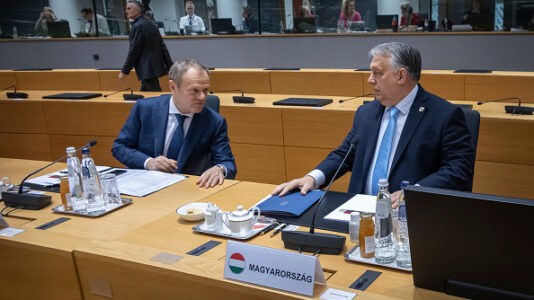
Poland’s experience in recent years clearly shows how this new rule will work in practice. For a number of years, our country was deprived of funds from the so-called National Recovery Plan and politically harassed for the alleged “breakdown of the rule of law.” In 2025, however, there was a sudden change. Although the government did not introduce any of the key reforms that the European Commission had been demanding for years, the Commission’s latest report now presents Poland as a model for “restoring the rule of law.” So, what caused the European Commission’s change of attitude towards Poland? The answer is simple: a change of government was enough for Poland to be recognized as a “country governed by the rule of law.”
On the website of the Ordo Iuris Institute, we have published a commentary on the European Commission’s latest report on the rule of law in Poland. The report states that Poland has made “significant progress” in the area of the rule of law, which later in the report turns out to be promises, announcements, or declarations to “begin work.”
An example of such “significant progress” for the EC is the issue of separating the functions of the Minister of Justice and the Prosecutor General. Although the 2016 law combining these two functions, which has been criticized by the EC, is still in force, and successive ministers of justice in Donald Tusk’s government continue to take advantage of the opportunities offered by the office of Prosecutor General, using it to persecute political opponents, the EC sees “progress” in this area. The report points out that, although no legislation has yet been adopted in this regard, “further significant steps have been taken to separate the offices of Minister of Justice and Prosecutor General.”
The EC report also praises the government for “preparing reform plans” concerning the disciplinary system for judges and the National Council of the Judiciary, noting that “the government intends” to introduce new regulations ensuring greater independence.
At the same time, the European Commission turns a blind eye to a number of examples of flagrant violations of the fundamental principles of the rule of law, such as the takeover of public media and the National Prosecutor’s Office with the use of force, the government’s draft law allowing for the political vetting of approximately 3,500 judges in Poland with the possibility of their removal or demotion, and examples of unlawful persecution of political opponents.
All this shows that we cannot have any illusions today – Ursula von der Leyen’s announcement that only “law-abiding” countries will receive EU funds is, in fact, an announcement of further financial blackmail of national governments. Any government that dares to resist the takeover of national sovereignty could be deemed as breaching the “rule of law” and deprived of the funds it is entitled to.
This change also violates the treaty principle that the European Commission remains politically neutral.
What is more, the Commission is also unconcerned that the funds that were to be used for post-pandemic economic recovery, which are in essence long-term loans, were handed out freely and frequently wasted, as clearly shown by the lists of projects financed by the NRP.
Why do these irregularities not bother the elites in Brussels? From their perspective, the NRP funds have achieved their important goal. They have become an effective instrument of financial blackmail against Member States and have helped, among other things, to bring about a change of government in Warsaw.
Such use of funds from the National Recovery Plan is only a harbinger of greater political corruption and mass blackmail against patriotic governments, which is to be enshrined in the European Union budget for 2028-2034.
The introduction of the principle into the EU budget that funds will only go to countries respecting the “rule of law” is a great threat to EU member states, as it gives EU officials a tool for political and financial blackmail of national governments.
That is why experts from the Ordo Iuris Institute are analyzing the assumptions of the new EU budget proposal in detail, so that they can later publicize the threats as widely as possible and inform decision-makers across Europe about them.
I hope that this time we will be able to convince at least some European governments to block this blackmail mechanism. When we warned the Polish government against accepting the “conditionality mechanism” in 2020, our warnings were ignored. Time has painfully shown that we were right.
The draft of the new EU budget, which is intended to give EU officials almost unlimited opportunities to blackmail national governments, is a new example of actions aimed at completely eliminating the sovereignty of nation states.
Ursula von der Leyen’s proposals aim at exactly the same goal as the proposed reform of the EU treaties, which envisages the elimination of the remnants of national sovereignty and the creation of a European superstate in which member states will not be able to decide on their own foreign policy, health, security, army, border protection, energy, infrastructure, or education. We described this in our report “Why do we need sovereignty”, published on our website. If we give the Eurocrats a tool to financially blackmail national governments, there is no doubt that they will use it to take away our decision-making power.
The Ordo Iuris Institute is an independent legal think tank that, over the years of its activities, has built an international reputation as one of the key centers for defending a legal culture grounded in the identity of European civilization, raised on the pillars of Greek philosophy, Roman law, and Christian ethics.