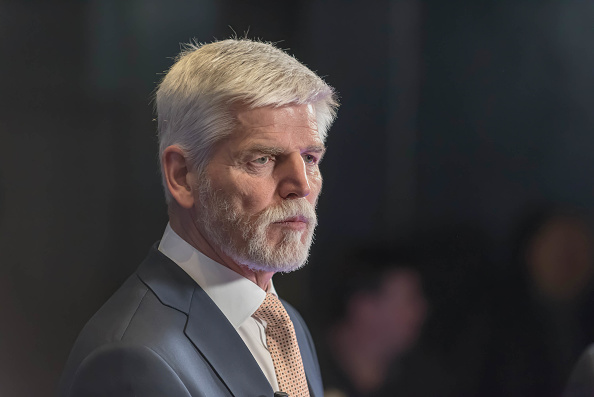
Czech President Petr Pavel has acknowledged that there is “an interest in a coalition government of three parties” following the first round of post-election consultations with leaders of the political movements that entered the Chamber of Deputies.
Speaking after two days of meetings at Prague Castle, Pavel said discussions have so far been “open, factual, and fair,” and that further talks will depend on program and personnel agreements between the parties, iDNES reported.
“It is clear that there is an interest in the coalition government of three parties,” said Pavel, who on Monday received right-wing SPD leader Tomio Okamura and anti-establishment Motorists chairman Petr Macinka, both of whom are in active talks with Andrej Babiš, the chairman of the victorious ANO movement.
According to the president, the process of forming a government will proceed in parallel with the establishment of the new Chamber of Deputies. “The distribution of forces in the Chamber — how the individual political parties will be represented in its bodies — will naturally also influence the composition of the government,” he said, adding that there was no attempt to rush the process.
Okamura confirmed that the SPD is seeking direct participation in the new government, with ambitions for “at least one, ideally two or three ministerial positions.” He said that talks with ANO are ongoing, with the next round of meetings expected this week.
“Specific ministries are still a matter of negotiation, it depends on the winner of the elections and what constellation he will choose,” Okamura said, emphasizing that his party’s main goal is to “implement a program so that people have more money.”
Echo24 reported the SPD’s negotiating team, led by deputy chairman Radim Fiala, is coordinating daily with ANO officials, while the newly elected SPD parliamentary group — 15 deputies, including representatives of allied parties such as Trikolóra and PRO — will meet for the first time on Tuesday.
Babiš, who won the election with a strong mandate but fell short of an overall majority, has said his preference remains a single-party minority government supported by ad-hoc agreements with other factions. However, several senior ANO officials have signaled that forming a coalition may be unavoidable.
ANO vice-chairman Robert Králíček told Echo Prime Time that while a “single-color government” remains the goal, political realities require flexibility. “Negotiations are at the beginning — it is premature to talk about any specific outlines now,” he said. “Andrej Babiš has a clear mandate from the movement’s presidency to negotiate a single-party government, which is our priority, but politics is the art of the possible.”
Králíček added that ANO is more politically aligned with the Motorists party than with the SPD, citing previous cooperation in the European Parliament and shared economic objectives. However, he warned that the SPD’s proposal for a referendum on leaving NATO and the EU remains a “red line” for ANO. “Each party wants to push through its program, but there are limits we will not cross,” he said.
Motorists leader Petr Macinka has already signaled his readiness to join a governing coalition, calling for a balanced budget within four years — an idea Babiš has called “nonsense” — while agreeing on tax and investment reforms to boost state revenues.
President Pavel said his role at this stage is to ensure a constructive and transparent process, not to set deadlines. “If there is a consensus on programmatic intersections and personnel, I am ready to give the election winner the mandate to form the government,” he said.