Twenty-three years ago, Imre Kertész won the Nobel Prize in Literature. And today, yet another Hungarian, László Krasznahorkai, has been named the recipient of the coveted prize.
Hungary boasts a long history of Nobel laureates, with the most recent before Krasznahorkai going to Katalin Karikó, who took home the Nobel Prize in Physiology and Medicine in 2023 (shared with Drew Weissman) for her work on mRNA vaccines to fight Covid, and Ferenc Kraus, who won the 2023 Nobel Prize in Physics (shared with Pierre Agostini and Anne L’Huillier) for his work on attosecond light pulses.
László Krasznahorkai was born in Gyula in 1954. His father, György Krasznahorkai, was a lawyer, and his mother, Júlia Pálinkás, was a health insurance administrator. He attended primary school in Gyula between 1960 and 1968, and then the Latin department of Erkel Ferenc High School in Gyula between 1968 and 1972. He then studied law in Szeged andn in Budapest between 1974 and 1976. He earned a Hungarian-Folk Culture degree from the Faculty of Humanities at ELTE between 1977 and 1983,” reads a bio from Magyar Nemzet.
He worked as a documentarian at Gondolat Publishing House between 1977 and 1982, and since 1982 has been a freelance writer. His first novel, “Sátántangó” (“Satan’s Tango”), was published in 1985, in which he explored his vision of universal destruction. The book, which was highly acclaimed by critics, was followed by his first collection of short stories, “Kegyelmi vaszójok” (“Mercy’s Vassal”), in 1986.
He was first able to leave Kádár’s Hungary in 1987, spending a year in West Berlin as a guest of the DAAD. Since the collapse of the Eastern Bloc, he has been constantly changing his residences, almost constantly “on the road,” the portal writes. He often returns to Germany and Hungary, but he has spent and continues to spend longer and shorter periods in France, Spain, the United States, England, the Netherlands, Italy, Greece, China and Japan.
Since his 1989 novel “The Melancholy of Resistance,” he has published a new book almost every year.
His artistic writings include a volume titled “Evening at Six: Some Free Exhibition-Opening Speeches,” published in 2001. In 2010, his book “Animal Inside” was published, inspired by a painting by the artist Max Neumann. His 2012 book, “He Neither Answers Nor Questions: Twenty-five Conversations on the Same Subject,” offers a selection of interviews he has given to Hungarian and foreign newspapers over the past 20 years.
His work, “Chasing Homer,” published in 2019, was illustrated by Max Neumann and came with a score accessible via QR codes by Miklós Szilveszter. His most recent work is the satirical novel “Zsömle odavan,” published in January last year.
His works have been acclaimed by critics from the United States to Japan. Susan Sontag called Krasznahorkai “the contemporary Hungarian master of apocalypse who inspires comparison with Gogol and Melville,” while WG Sebald wrote of him, “The universality of Krasznahorkai’s vision is akin to that of Gogol, who wrote Dead Souls, and dispels all our doubts about contemporary literature.”
An American critic (said to be Richard Powers) cited by MN stated: “Reading him is a bit like looking at people standing in a circle in a city square, seemingly warming their hands, and then, as you get closer, realizing that there is no fire and they have gathered around nothing.”
“While writing his novel War & War, he traveled extensively throughout Europe for several years. His greatest help in writing the work was Allen Ginsberg, in whose New York apartment he lived for a long time, and whose friendly advice greatly helped the book to come into being. In 1990, he spent his first extended period of time in East Asia, reporting on his experiences in Mongolia and China in his novels The Prisoner of Urga and Destruction and Sorrow Under the Sky. Since then, he has returned to China several times. In 1996, 2000, and 2005, he spent 6 months each in Kyoto, Japan,” MN writes.
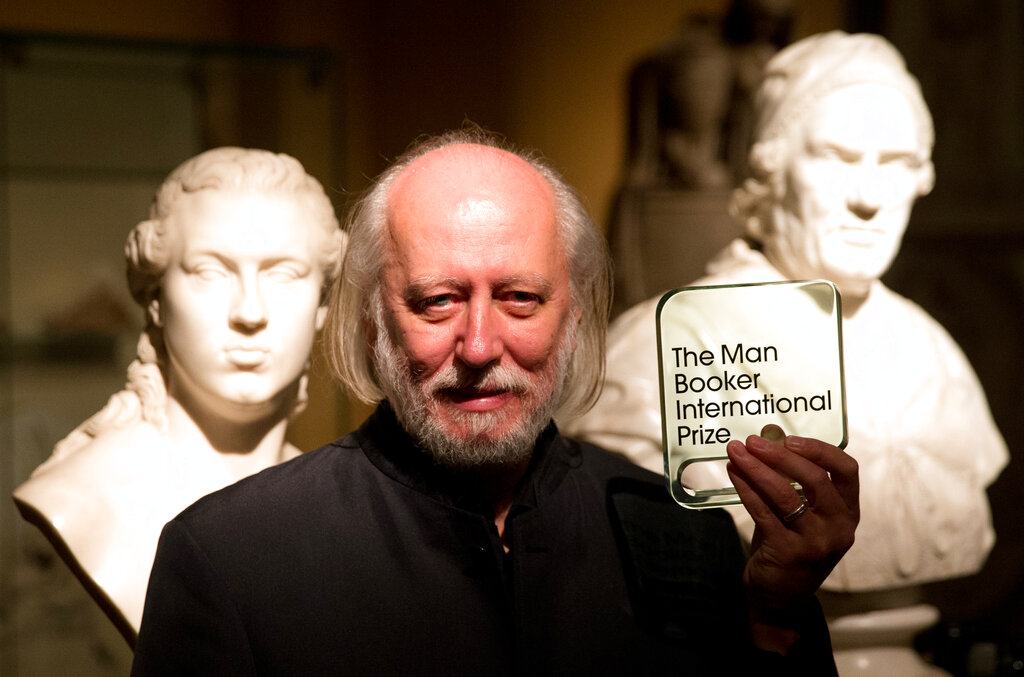
His numerous prestigious domestic and international awards include the Attila József Prize in 1987, the Gyula Krúdy Prize in 1993, the Sándor Márai Prize in 1998, the Kossuth Prize in 2004, the Brücke Berlin Prize in 2010, the Prima Primissima Prize in 2012, the America Award for Lifetime Achievement in Literature in 2014, the Man Booker International Prize in 2015. In 2019, the English-language edition of his novel Báró Wenckheim hazatér won the U.S. National Book Award (works translated from a foreign language) in 2019, and the Austrian State Prize for European Literature in 2021.
László Krasznahorkai became a member of the Digital Literature Academy in 2004 and of the Széchenyi Academy of Literature and Arts in 2010.