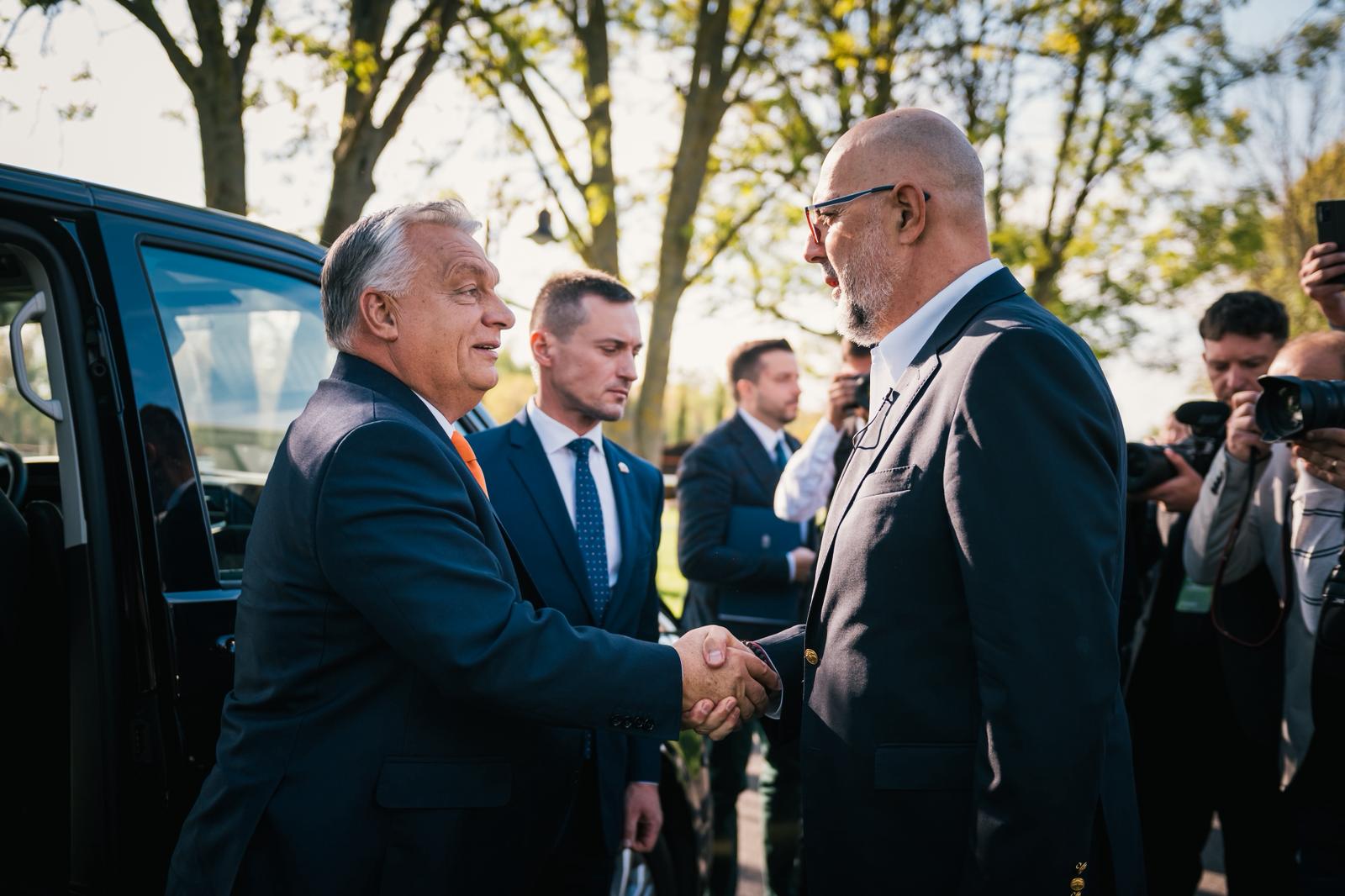
Speaking at the Democratic Alliance of Hungarians in Romania (RMDSZ) congress in Cluj-Napoca, Hungarian Prime Minister Viktor Orbán applauded the work of the RMDSZ over the past 35 years and spoke openly of the vital importance of the ethnic Hungarian community in Romania in next year’s parliamentary election in Budapest.
“The RMDSZ is also 35 years old. God bless it! It has proven that it is not size, but determination that gives the weight of a community. The question is not how big the dog is, but how big the fight is in the dog,” Orbán said, thanking the party for its continued support.
“The RMDSZ is stability and common sense in Bucharest. The reliable partner in Budapest. The representative of Hungarian interests in Brussels.”
“That is why I tell you that the RMDSZ is not a minority organization, but a national strategic factor,” he said, as reported by Magyar Nemzet.
“We in Budapest see it as a common interest of Romania and Hungary to have stability in the Danube basin. The peoples living here should not trample each other, but cooperate. If our neighbors are strong and free, we will be stronger and freer,” he continued.
“That is why we are interested in Romania’s development, and we are also interested in the success of the prime minister and his government,” said Orbán, then turning to the 2026 election in Hungary.
“Next year, we will decide not only about the next Hungarian government, but also about the future of the nation, the freedom and sovereignty of our homeland. And in April 2026, the homeland will need the Hungarians of Transylvania,” Orbán told those gathered.
A major issue pertaining to Hungarian sovereignty has been the country’s energy security. Long criticized for relying solely on Russian oil coming through the Friendship pipeline, which crosses through Ukraine and has been continuously targeted by Zelensky, Hungary has been working to diversify to other routes.
Just last week, it signed its largest-ever contract for the purchase of LNG with the French company Engie. However, at the time, FM Szijjártó made clear that “diversification does not mean replacing existing, well-functioning supply relationships with others.”
This week, Szijjártó has announced that U.S. sanctions against Hungary’s Paks II nuclear power plant have been waived and the project is moving forward. Hungary cannot meet its electricity demand without this plant, according to a ministry statement cited by Vasarnap. It will also save the environment from some 17 million tons of carbon dioxide emissions annually.
Hungary has also reached an agreement with the U.S. to exclusively use American technologies for small modular reactors (SMRs), which, according to Szijjártó, will eventually be a part of Hungary’s energy mix as well.