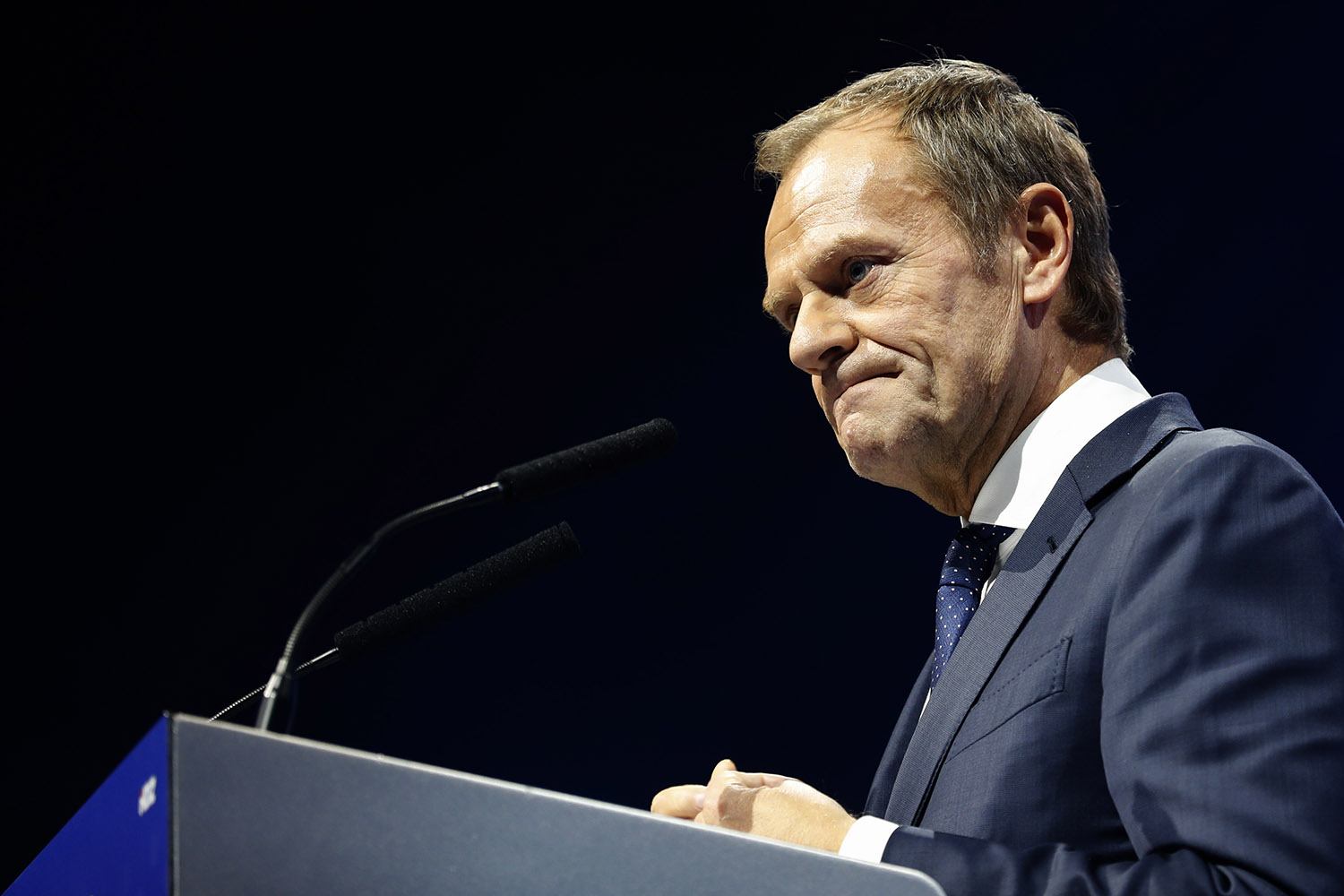
Polish Prime Minister Donald Tusk’s government is showing more cracks, as the latest survey betrays just how many Poles are not happy with the government. Meanwhile, another survey indicates that only a PiS-Confederation alliance would have a majority in the Sejm.
According to a recent poll conducted by United Surveys for Wirtualna Polska, 29.8 percent of respondents would vote for the Civic Coalition (KO) in the Sejm elections, and 28.9 percent of respondents would vote for Law and Justice (PiS). The figures represent minor shifts of less than a half percent for both parties (down .2 for KO and up .4 for PiS) compared to the last survey, writes wPolityce.
Confederation came in third in the poll, with 13.9 percent of respondents supporting it, a drop of 0.8 percent in support versus the last poll. And fourth place went to the Left, with 7.3 percent of respondents voting (up 0.3 percent).
The only somewhat larger change was seen with Confederation of the Polish Crown, which garnered 6.2 percent support, an increase of 2.1 percent.
The remaining places were occupied by the following parties — none of which made the 5 percent threshold to enter parliament: Polish People’s Party – 3.9 percent (0.8 percent drop), Razem Party – 2.4 percent (0.2 percent increase) and Poland 2050 – 1.6 percent (0.4 percent drop).
Based on the above results, the Wirtualna Polska portal also revealed what the distribution of seats in the Sejm would be. The Civic Coalition would receive 174 seats, Law and Justice 168, the Confederation could count on 70 seats, the Left 27, and the Confederation of the Polish Crown 20.
This clearly indicates that the current ruling coalition has no chance of winning power, as the Civic Coalition and the Left would have a combined 201 seats. A potential coalition of Law and Justice (PiS) and Confederation (Konfederacja), on the other hand, would win the majority, with a combined 238 seats.
Meanwhile, after two years in power, PM Donald Tusk’s government, made up of the Civic Coalition (KO), the Polish People’s Party (PSL), Poland 2050, and the New Left, is not looking great.
According to an IBRIS poll for “Rzeczpospolita,” reported on by wPolityce, 65.4 percent of respondents admit that the ruling coalition is governing worse than they expected, and 27.7 percent of respondents said the current coalition is governing in line with their expectations. Another 3.3 percent said power is being exercised better than they expected, and 3.5 percent had no opinion.
The survey also shows that among the coalition’s own voters, 43 percent believe that it is doing worse than they expected.
Among voters of the parties that make up the current ruling coalition, the Civic Coalition’s voters rate it the highest (42 percent dissatisfied), while voters of the Third Way (83 percent dissatisfied) and the New Left (74 percent) rate the ruling coalition much lower.
“Only slightly more than half of KO voters (51 percent) believe that the current coalition ‘governs in line with my expectations,’ while voters of the New Left (21 percent) and the Third Way (11 percent) are much less satisfied,” writes “Rz”.
Among those who voted for Confederation and Law and Justice, 84 percent and 86 percent of respondents, respectively, believe that the current coalition is governing contrary to their expectations.
As Rzeczpospolita reports, 47 percent of voters for Rafał Trzaskowski (KO), the mayor of Warsaw, believe that the current government has failed to meet their expectations, while 48 percent disagree. Voters for Poland 2050’s Szymon Hołownia are more critical of the government, with 53 percent believing it has disappointed and 27 percent saying they are not disappointed.
“Of course, the current ruling coalition fares worst among the right-wing presidential candidates,” the portal added, with 84 percent of Karol Nawrocki’s voters saying the government is doing poorly, along with 63 percent of Sławomir Mentzen’s voters, and 100 percent of Grzegorz Braun’s voters.
“The voters of left-wing candidates Adrian Zandberg (92 percent) and Magdalena Biejat (70 percent) are also deeply disappointed,” it wrote.