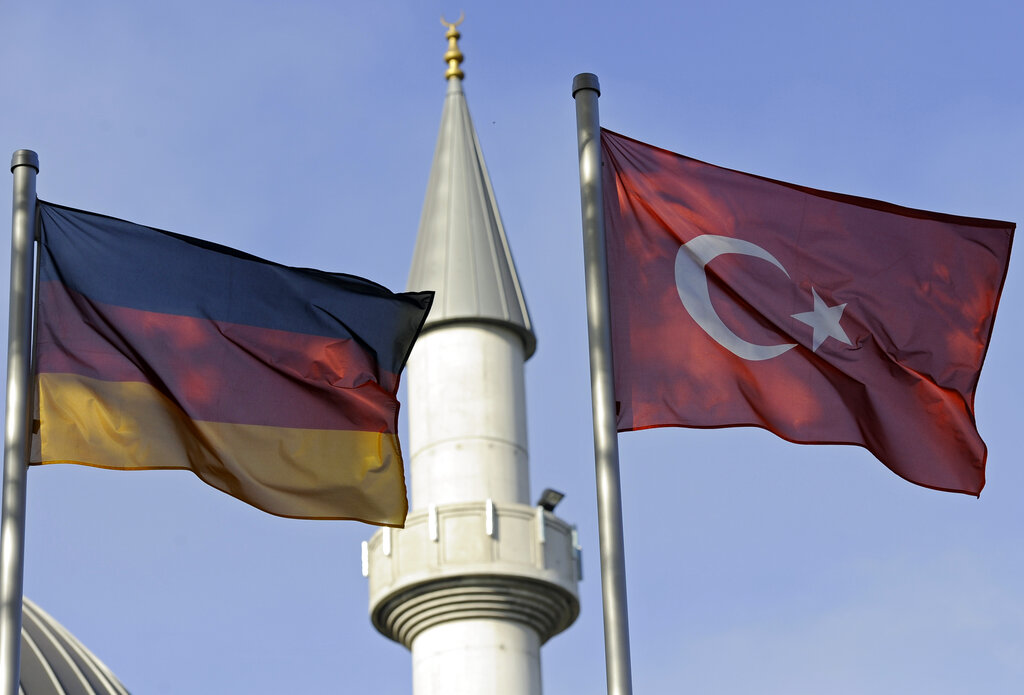
Following a statement by German Foreign Minister Johann Wadephul to the Turkish newspaper Hürriyet, in which he claimed that Turkish migrants were behind Germany’s “economic miracle,” he has been sharply debunked. In fact, the Welt newspaper’s senior history editor not only lambastes Wadephul but the entire foreign ministry.
“The CDU politician is spreading economic-historical nonsense in the Turkish newspaper Hürriyet,” writes Sven-Felix Kellerhoff, the Welt’s senior history editor.

Here is what Wadephul had to say about Turks building Germany.
“It was crucially important that women and men from Turkey made the so-called economic miracle possible through hard work under sometimes very difficult circumstances – they helped build the modern industrial nation of Germany,” said the foreign minister.
However, the Welt historian editor notes that the CDU politician is experienced enough about the history of international relations and should know about the real significance of the 1961 recruitment agreement between Germany and Turkey.
“From a historical perspective, this is utter nonsense. Is the Federal Foreign Office, with its current workforce of more than 13,000 employees worldwide, really incapable of protecting its own minister from such false statements in a prepared, by no means spontaneous, press conference?” slams the Welt history editor.
Kellerhoff then goes on to write that it only takes “a few seconds” to correct the record on this piece of misinformation.
He notes that the Bundestag Printed Paper IV/859 of December 21, 1962, entitled Foreign Workers in the Federal Republic details how Germany had increased the number of foreign workers in the country from 0.4 percent in 1954 to 3.1 percent by June 30, 1962.
Based on this data, he then examines when the peak period of Germany’s “economic miracle” was, when the country experienced annual growth rates between 5 and 11 percent. During that time period, the Welt history editor writes that 99.6 to 96.9 percent of the workforce were native Germans.
Of the remaining workers, Turks hardly factored in. As of mid-1962, there were exactly 265,978 workers from Italy. Italy was the first nation with which Germany entered into a recruitment program. In addition, 87,327 were recruited from Spain, 69,146 were from Greece, and 47,427 came from Austria.
Remarkably, there has been much propaganda about Turks building modern Germany, but in fact, there were only 15,318 Turks in the country during that period.
Kellerhoff is not done embarrassing the foreign ministry either. Germans are known for keeping data, statistics, and records of nearly everything, and Kellerhoff uses this data, which is all available freely online, to further blow up the narrative being presented by the federal government.
“It takes only a minimal amount of effort to look up the official Statistical Yearbooks for the Federal Republic of Germany,” writes Kellherhof. He then goes into the data from the 1950s and 1960s.
“For example, the number of Turks employed in the Federal Republic of Germany increased sharply from mid-1962 to June 30, 1969, ultimately reaching 212,951. However, this group of foreign workers still ranked third behind Italians with 340,234 and Yugoslavs (who were only officially recruited since 1968) with 226,290,” writes the history editor.

“At this time, the much-vaunted ‘economic miracle’ had already come to an end, following the first economic slowdown in 1963/64 and the first crisis in 1967. And Turks still made up significantly less than one percent of the total workforce in West Germany: Turks certainly hadn’t played a ‘decisive’ role in the upswing of the West German economy. Such a false claim would have caused any history student to fail their intermediate exams in the 1990s – which doesn’t reflect well on the qualifications of today’s German diplomats,” Kellerhoff writes in what looks like an indictment on the entire foreign ministry.
The historian points out that the extremely low unemployment rate in Germany was part of the recruitment drive in foreign countries. Most of these countries were located in Europe, but Turkey was an exception. Still, Turkey’s workers played a minuscule role in Germany’s economic miracle. If Turks were the driving force, then perhaps Turkey itself would have been a global economic powerhouse, but that was never the case.
In 1968, the unemployment rate was only 1.5 percent, and in fact, unemployment remained below 1 percent until 1972 when the oil crisis began. In November 1973, a recruitment ban was imposed, which ended foreign workers coming to Germany.
Kellerhoff then further notes the dramatically different mindset behind this immigration in the past, which emphasized that workers should return home at the end of their work. The deal was that they make money, and eventually, they return home.
“In any case, it was actually intended that the employees would return to their home countries after the agreed period and be replaced by other compatriots. This ‘rotation principle’ was intended to discourage permanent immigration. However, this changed at the end of 1973: Because no new guest workers could come, the existing ones stayed – and brought their families from their homeland to Germany. At that time, in the economically difficult 1970s, the proportion of Turks among foreigners in the Federal Republic rose to more than 1.5 million,” Kellerhoff wrote.
The historian then ends his article by slamming the false claims from the foreign ministry.
“One could write off Wadephul’s false statement as a minor error, one that at most reflects poorly on his own ministry. If, indeed, it weren’t for the reaction of all sorts of semi-reputable to dubious online services and blogs. Here, the foreign minister’s claim is widely seen as evidence of the allegedly planned ‘repopulation’ of Germany, an attack on a central achievement of the Germans after 1945. Since the statement in the Hürriyet interview is truly beyond salvage and simply remains inaccurate, Johann Wadephul has made it quite difficult to counter such absurd conspiracy theories,” he writes.
However, this claim about Turks is not limited to Wadephul. It remains a piece of standard propaganda and misinformation widely claimed by the German federal government for years now.
In fact, in 2022, German President Frank-Walter Steinmeier claimed during a visit to one of the traditional industrial zones in the Ruhr area that Germany is a country with an immigrant background, and its wealth and prosperity would not have been possible without immigrants.
“I always say that it is not the people who have an immigrant background, but Germany, the country itself, that has an immigrant background,” the federal president said in a speech to the workers of the Friedrich Wilhelm Ironworks in Mülheim an der Ruhr, where 45 percent of the factory workers are of foreign descent.
Referencing the guest worker deal with Turkey, he said that “the guest workers came to help build a fast-growing economy. Without their work, much of the prosperity experienced in our country would be impossible.”
Notably, as the Welt historian noted, it was mostly Germans who were responsible for the economic miracle of the 1950s and 1960s, but guest workers played a minor role. Most of them were also supposed to go back home.
Turks, in particular, are considered the worst-integrated of all immigrant groups despite their long track record in the country, according to a report from the Berlin-based Institute for Population and Development.
The report found that immigrants of Turkish origin were the “least successful of all immigrant groups in the labor market and they are often jobless, the percentage of housewives is high and many are dependent on welfare… The state of Saarland was found to have the worst record — 45 percent of its Turks had no educational qualification of any kind.”
Even second- and third-generation Turks struggle to integrate into German society despite having decades-long roots in the country. They feature some of the highest rates of welfare of any immigrant group and high crime rates, including a large organized crime network. As Der Spiegel wrote, many young Turks have failed to integrate into German society, and some of them openly state there is “nothing” good about the country. In terms of work prospects, severe challenges remain, as Spiegel writes:
“Almost a third of all men and women with foreign roots between the ages of 25 and 35 have no professional qualifications. The data is especially alarming for the roughly three million Turkish immigrants, Germany’s largest minority. The share of young Turks with no professional qualifications rose from 44 to 57 percent between 2001 and 2006. This figure alone — 57 percent — perfectly illustrates the sheer magnitude of the failure on both sides.
A research report by the Federal Office for Migration and Refugees concludes that four out of five Turks in Germany between the ages of 38 and 64 have no more than a junior high school education, while only a little more than a quarter have at least five years of schooling.”
The Remix News report continues to detail the various integration challenges presented by Turks. That is not to say that none integrated into Germany, but to say they built Germany or even contributed significantly to the German economic miracle is a gross overstatement.
The West’s founding myths are no longer grounded in reality
So, why does the German government partake in such narratives? The reason is that there needs to be a myth built around the “immigrant,” and even if this myth does not correspond to reality, it must be promoted, almost as a religious mantra.
This is why the German government is building monuments to foreigners and spending millions to open museums celebrating foreigners in Germany, with one such museum costing at least €44 million in Cologne.
These are temples to a new religion of open borders, just as Cologne once raised the famed Cologne Cathedral to the heavens, they are now raising new cathedrals to their new ideals.
Just as doubt is death for any religion, the dissenters and the naysayers will be persecuted who challenge this new religion — just as Galileo stood before the Roman Catholic Church, punished for puncturing the myth that the Earth was the center of the universe.
The German government will also continue to promote misinformation on this topic, or at the very least, not provide the full picture, including all all the benefits and all the costs. That would encompass the complete story of mass immigration in Germany, but that presents far too messy a picture for the myth — and the religion — to survive.
It is nearly the same myth promoted in the United States, where Americans are all told that Black slaves built the country, despite slaves being involved in labor-intensive agricultural industries, mainly cotton, which did not play a key role in America’s technological advancement and industrial development. Technology and organization were, in fact, the key factors that fueled America’s growth into a global superpower.
It is not worth going into all the misinformation on this topic, but most of America’s rise to power was built in the industrial north, where patents, inventions, and industrial might were the key players in the rise of the country. Cheap manual labor, while important for any nation, has not played a key role in the rise of any country. In fact, slavery was banned far later in South America, in countries such as Brazil, yet Brazil never rose to be a prominent industrial or technological player in the history of mankind.
In fact, far more slaves were sent to South America and the Caribbean than were ever sent to North America, and in general, slaves faced vastly better conditions in the United States.
These founding myths, both in Germany and the U.S., have not only become dogmatic, but it is becoming close to illegal to challenge them. Yet, for any semblance of truth to exist, historians like Kellerhoff need to challenge them everywhere, regardless of how powerful the preachers are.