
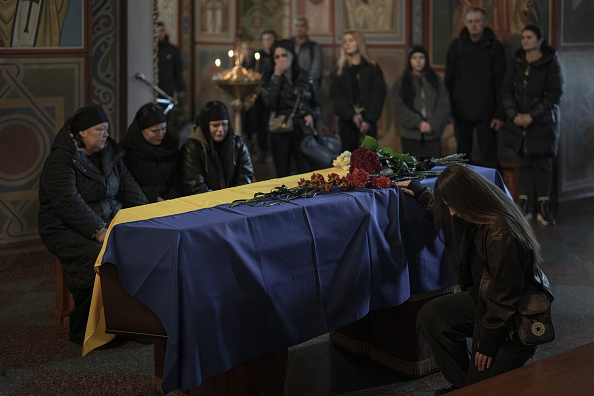
A new report from French newspaper Le Monde details the gruesome and corrupt business of “body hunting” in Ukraine, which involves the “funeral Mafia” using corrupt tactics to locate and collect dead soldiers and civilians for profit.
“We hunt for bodies,” is how one person involved in the trade put it in the Le Monde report. The new report indicates that corruption in Ukraine reportedly extends even to the dead, with the French paper exposing the massive mafia-controlled funeral business in Zelensky’s Ukraine.
The report indicates that the whole process starts with fierce competition for the dead.
One employee of market leader Anubis says that multiple parties offering their services will rush to a bombing site, often fighting amongst themselves in front of grieving families.
“Competition is fierce. To be first, funeral companies have to make informal agreements with police, hospitals, and morgues. These organizations and authorities are the first to notify us if a death occurs, in exchange for financial compensation,” he says, adding, “This is not corruption, but the purchase of information,” Magyar Nemzet reports.
“It’s a chaotic market where everyone grabs what they can. If I don’t adopt these methods, my plate will be empty. The funeral business is like prostitution, drug dealing, and gambling, but no one talks about it openly.”
With an annual turnover of more than 2.1 billion hryvnia (€43 million), more than 3,000 enterprises, mostly private, are competing to bury the dead.
Employees are paid on a commission basis. The general market trend is for the mediator to receive 11 percent of the amount paid by the families for each funeral. The average monthly income in the industry ranges between $1,000 and $1,500.
Funerals are also more expensive.
Before February 2022, a funeral cost an average of $200, according to official figures. At Anubis, the employee who spoke to Le Monde said a funeral today costs $500-$1,000, but the price of a coffin can rise to $2,500, and the most expensive ones to $10,000.
In Ukraine, people want funerals to be as short as possible due to their fear of bombings. Previously, the coffin was taken to the church to say goodbye there. Now, it is taken directly to the cemetery.
In the Kyiv region, the liberated areas are still cluttered with mines, so many people choose cremation. In the Kherson and Zaporizhia regions, people are asking deminers to clear the space reserved for coffins in the cemetery.
According to a paramedic working in Odessa, each reported death brings in between “70 and 120 dollars” for the paramedic who notifies the funeral home, although that figure may have been before they were forced to first contact their employer, who would then call the funeral home themselves to take a cut.
The families of dead soldiers are also often forced to choose private funeral companies with which local authorities, who bear the costs, have agreements.
Mykola Storozsuk, deputy head of the Odessa-based Veterans Hub, an NGO that helps veterans and their relatives, said: “Corruption cases continue to occur across Ukraine, in which local government officials pressure soldiers’ families to choose certain private businesses.”
Muhaylo Serebryakov, head of the NGO Ensemble contre la corruption (Together against Corruption), is well aware of these practices, which were widespread throughout the country even before the Russian invasion in February 2022, but no one talked about them.
“Employees of funeral homes receive a notification for money and arrive at the scene before the ambulance or police,” explains the anti-corruption activist, emphasizing that the war further exacerbated these abuses, creating “fertile ground for all kinds of corruption.”
According to Le Monde’s reporting, the Ukrainian Ministry of Communities and Territorial Development has stated that “corruption and abuse in the field of funeral services remain one of the most important and complex problems for the development of territorial communities.”
This anti-corruption action plan highlights that secret agreements between companies and members of law enforcement forces and medical personnel are “frequent,” which “violate the rights of families” and “provide an unjustified advantage to certain market players.”
The document also reveals several other abuses, such as “morgue staff sometimes performing unnecessary autopsies solely to force families to pay for a mandatory service. In contrast, some families are forced to pay to avoid an autopsy.”
The war brought no changes to such practices. Companies also charge random prices. “The more affluent they look, the higher the price,” says Serebryakov.
The ministry’s action plan was supposed to tighten legislation to combat abuses in the funeral industry, but the bill has gone nowhere. Meanwhile, these practices seem to go unnoticed and unmentioned in discussions about corruption in Ukraine.
“The law was not passed because this black market benefits many people,” says Oleksandr Skorik, deputy director of the state funeral company Spetskombinat.