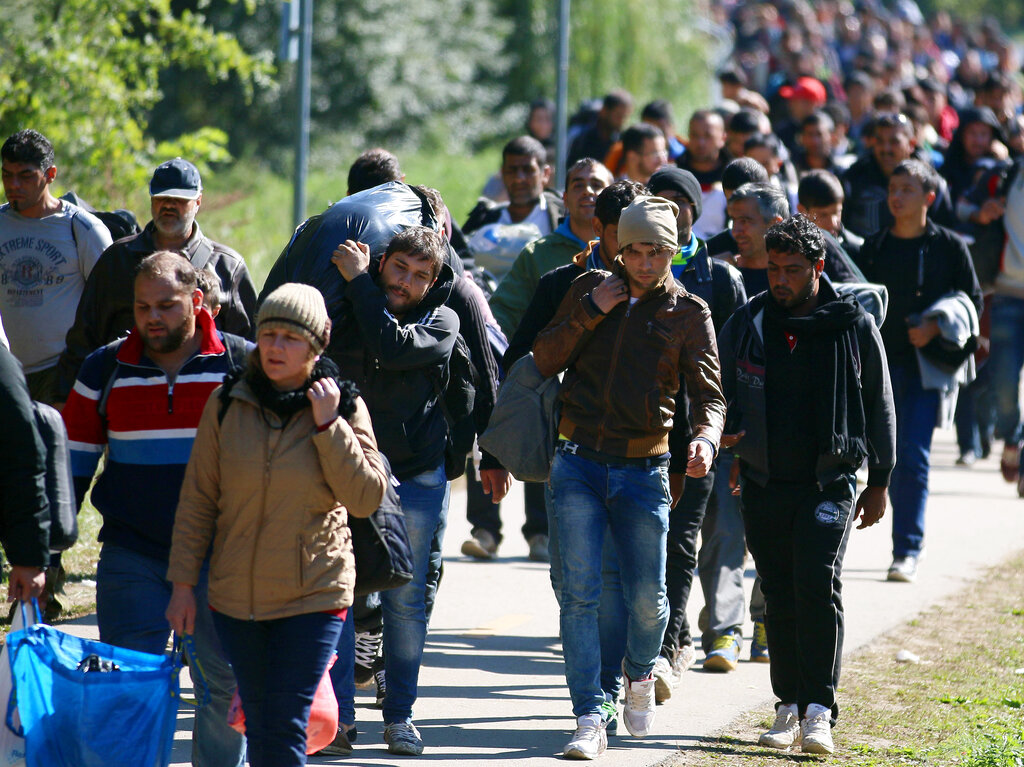
Dutch migration researcher and social scientist Ruud Koopmans has described the current rapid naturalizations as a “demographic time bomb” that could lead to 7 million Syrians in Germany within 50 years. Koopmans says that family reunification is the main factor, and with many relatives of these newly naturalized migrants having the right to reunification, it could transform Germany.
Koopmans criticizes Germany’s rapid naturalization of migrants, which was initiated under the last far-left German government of Chancellor Olaf Scholz.
“One must consider whether refugees should be given access to German citizenship so quickly. If they are German nationals, there is no limit on family migration. Then any possibility of managing these migration flows is gone,“ he said in an interview with Cicero.
“This rapid naturalization can be considered a demographic time bomb in the long run,” he added.
He stated that the so-called “turbo naturalization“ after three years was removed by the current ruling government. The reality is that this option for receiving German citizenship after three years applied to very few people, sometimes numbering less than 10 people in certain German states.
However, standard naturalization is still possible after five years.
“I see a problem with naturalization. This limitation on family reunification only applies to those granted subsidiary protection as long as they don’t yet have German citizenship. While the federal government’s reform abolished accelerated naturalization after three years, standard naturalization after five years—even for people who came as refugees—remains,” he said.
Foreigners in Germany can receive citizenship after five years if they prove legal residence and an independent economic livelihood, have no criminal record, and have sufficient knowledge of German. However, there have also been widespread reports of cheating on the German-language tests.
Many of these new citizens are men, and they will want to bring their families to Germany.
“It is essential to consider the consequences this will have for the future. These (approx.) one million people are heavily overrepresented by men. They will largely seek their marriage partners in their country of origin. This is highly likely because marriage in these countries is typically within extended families. Marriage in these societies is also an economic transaction between families, and the ticket to Europe is an important means of exchange,” said Koopmans.
He then cited the rapid growth of previous immigrant populations, who used family reunification to grow their numbers by millions. Turks are a good case study, who are now over 6 million in number in Germany. They also remain extremely poorly integrated, and in fact, the recent gang war in Berlin, which has helped fuel a record number of shootings in the capital city this year, is due in large part to a feud between Turkish Mafia gangs.
“We only need to look at the past: How much has the population of guest workers from Turkey or Morocco grown over time through family reunification and reproduction? From 1973, the year recruitment was halted, to the present day, this group has increased sixfold or sevenfold. If we assume the same for the Syrians—and there is no reason not to—then in 50 years we will have seven million Syrians or citizens of Syrian origin in Germany. And I’m only talking about Syrians, but the same applies to people from Afghanistan, Iraq, Somalia, and so on,” the researcher added.
🇩🇪🔴German police say members of an extended Syrian clan family are said to have committed at least 160 crimes in Stuttgart.
They have cost Germany nearly €500,000 in prison detention fees alone, and that is just for 5 of the highly criminal family.
Now, Germany was so… pic.twitter.com/At9ZKozb5U
— Remix News & Views (@RMXnews) December 23, 2025Koopmans then claims that after 10 years, people should be allowed to stay in Germany, but five years is too soon.
“If that’s still the case after 10 years, at some point you have to say: Okay, people have been here so long now that we have to offer them a lasting perspective,” says Koopmans. “But I think it’s wrong to do this after just five years.”
Koopmans makes a distinction between immigrants, however.
“These problems, both regarding integration into the labor market and high crime rates, affect very specific immigrant groups. They are a consequence of the fact that we don’t have truly controlled migration. It’s not the case that all immigrants are significantly overrepresented in crime statistics. Many migrants in Germany come from other EU member states. These are not significantly overrepresented in crime statistics. In terms of labor market participation, migrants from other member states are even better off,” he said.
However, given demographic trends, any number of naturalizations may present a serious demographic crisis for the German population moving forward due to the sheer number of people who arrived over the last few decades.
Notably, a majority of Germans now support an immigration moratorium, according to a new YouGov poll. The poll shows just how deeply Germans have turned against mass immigration in the past 10 years.
In addition, Syrians have an extremely high crime rate in relation to Germans, committing 135,000 crimes against Germans in the last nine years.