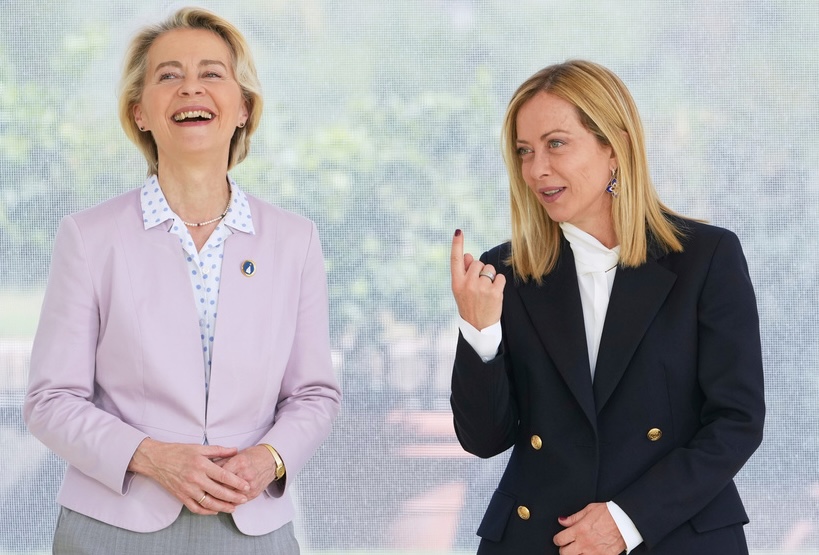
The ambassadors of the European Union member states are moving forward with the Mercosur free trade agreement. Following years of complex negotiations, the agreement is now set for signature, marking a major defeat for Europe’s farmers and food security across the continent. For conservatives across Europe, Italian Prime Minister Giorgia Meloni’s role in helping pass the agreement will be remembered as a bitter betrayal.
The European Commission is not passing it with any real semblance of democracy either, and as with many other topics, it is bypassing the democratically elected European Parliament entirely. The commission intends to “omit the European Parliament from the further procedure,” which grants European Commission President Ursula von der Leyen the authority to sign the deal directly.
While a significant coalition of nations opposed the move—specifically Poland, France, Ireland, Hungary, and Austria, with Belgium abstaining—they failed to reach the required “blocking minority.” Italy, despite previous signals that it might join the opposition. Italian Prime Minister Giorgia Meloni gave earlier signals she would not back the deal but ultimately aligned with von der Leyen despite mass protests by farmers.
🇪🇺🔴The true face of the EU.
Protesting farmers from across the EU are hit with water cannons and tear gas, all while the elite inside the European Commission surround their HQ with barbed wire.
Rule of law has abandoned Brussels.
Notably, these farmers are protesting a… pic.twitter.com/scm7rTMF5O
— Remix News & Views (@RMXnews) December 18, 2025What is the EU–Mercosur agreement?
The deal creates a massive trade zone between the EU and the Mercosur nations of Brazil, Argentina, Paraguay, and Uruguay. The primary goal is to facilitate economic exchange by slashing or abolishing customs duties.
This creates a reciprocal trade dynamic: European industrial giants gain access to South American markets, while Mercosur countries gain a pathway to export agricultural products into the EU at scale.
However, the deal is going to be a major catastrophe for European farmers and for food safety.
Europeans will be exposed to pesticides, farmers will go bankrupt
Now that Mercosur is almost certain to go into effect, food containing massive amounts of pesticides banned in Europe will flow into Europe. A documentary on the subject produced by a French-German team had been deleted from its website, but clips from the documentary have been circulating on social media. The film highlights the various threats.
The documentary reveals that in 2018, European companies sold over 80,000 tons of pesticides banned in Europe. Ninety percent of the products originate from European factories in the U.K., Italy, the Netherlands, Germany, France, Belgium, and Spain. It notes that banned chemicals such as atrazine and metolachlor are used.
The film, which at the time of publication has a copy available on DailyMotion, is one of a number of news reports raising the alarm to no effect in recent years, including from Matador, which is a program from the German public broadcaster ARD. A link in auto-translated English is also available here.
In the run-up to the deal, Polish MEP Ewa Zajączkowska-Hernik wrote that the deal is being rushed through and that very important clauses are not included, including balancing regulations and standards between Europe and Mercosur.
“And now a very important piece of information for all our health – the package of clauses that is to go to the vote tomorrow does not include the extremely important element known as reciprocity, which would force Mercosur countries to meet the same standards as EU farmers, in terms of pesticide and antibiotic use! This agreement will directly harm consumer health!” she wrote.
Another MEP, Anna Bryłka, wrote that the deal is incredibly dangerous.
“It’s not safe because no safeguard clauses will protect against mass imports from South America. The safeguard clauses, which the prime minister largely invokes, have been significantly weakened. This means that the conditions that must be met to even initiate an investigation, regarding disruptions in the agricultural market, are, in my opinion, virtually impossible to meet,” she said.
Bryłka has also outlined how the pesticide use in South America also represents not only a health risk, but also a competitive risk for Polish farmers.
Bryłka argues that “farmers from Mercosur countries produce food according to standards that are banned in the EU: other plant protection products, growth hormones, lack of real environmental standards.” This forces European farmers to compete with cheaper production that is legally prohibited within their own borders. She further characterizes the import of food with unknown standards as a “risk to the health of millions of Europeans.”
The risks are enormous. Brazil alone allows the use of as many as 3,669 pesticides. Europe’s emphasis on “eating local” to reduce carbon emissions associated with transportation will become a joke, as food from halfway around the world will often be cheaper than locally produced goods. European chemical companies will reap massive profits.
The documentary cited earlier shows how one Brazilian state features the most “agrotoxicity” in the world. Soon, this food will be on Europeans’ plates.
“Mato Grosso. This Brazilian state is the kingdom of the agricultural industry. Cotton, rice, sugarcane, corn, massive production of transgenic soybeans, and record pesticide use. Mato Grosso wins every global competition in the field of agrotoxicity. That’s the term used by those who condemn the chemical empire. Brazil allows the use of 3,669 pesticides. It’s a veritable Eldorado for corporations, primarily European ones. Products banned on the Old Continent are sold here,” said the narrator in the film.
“The poisoned kingdom is primarily a market of international corporations, including three European giants: the Swiss company Syngenta, and the German companies BASF and Bayer, which absorbed Monsanto in 2018,” the film states.
Loss of food security
The deal is also viewed by many as a threat to national security. Bryłka warns that becoming dependent on imports risks a “loss of food sovereignty,” leaving nations unable to recreate local production during a crisis. Economic reports, such as “Geopolitics on a Plate” by Pekao SA, suggest that the Polish agri-food sector will suffer the “greatest losses in the entire EU.” In this context, agriculture is seen as the “tender currency” in Brussels’ broader trade strategy.
So much for climate change protection
The MEP also points to a contradiction in EU policy: while Brussels imposes “increasingly stringent climate and environmental requirements” on its own citizens, it is simultaneously opening markets to countries where such standards are nearly non-existent. Ultimately, the deal is framed as a trade-off favoring large industrial economies.
As Bryłka concludes, “For Germany and the largest EU economies, this is a new market and space for economic expansion. For Poland, liquidation of farms and decline of villages.”