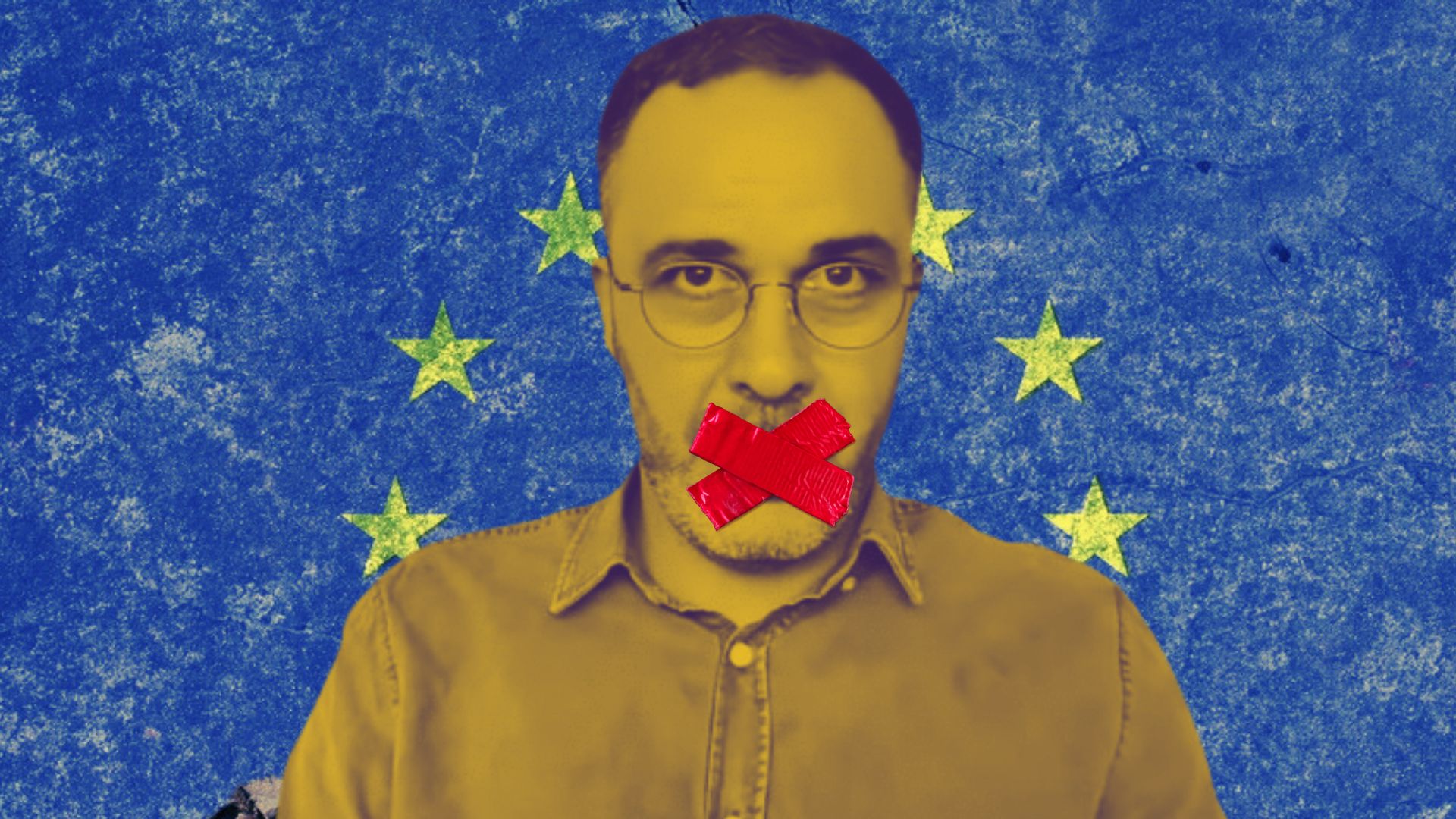
In an extraordinary case that could decide the future of press rights in Europe, Berlin-based German-Turkish journalist Hüseyin Doğru is currently under European Union sanctions for his reporting, which left him completely unable to access his bank account for months. Under orders from the EU, his assets were frozen, and these sanctions were dispensed with no trial or appeal. Currently, Doğru says he is not even allowed to leave Germany.
As Berliner Zeitung reports, Doğru completely exhausted all financial means, telling the paper that his bank has completely blocked access to his previously approved minimum subsistence allowance of €506. He stated that he can no longer support his family or even buy food for his two newborn children.
“Not only I, but also my wife and my three children are effectively being sanctioned,” Doğru, a left-wing journalist, said in the interview.
“The sanctions themselves stipulate that I am entitled to access to essential funds. The fact that my bank is nevertheless blocking these funds violates applicable law in my view,” he told the Berlin newspaper.
Since then, he has won some reprieve and regained access to his account on Jan. 22 through the actions of his lawyer, but a legal battle over the sanctions is continuing.
UPDATE: Comdirect finally (and unwillingly) restored my account access—only after public and media pressure. Thank you ALL for supporting me. Next goal: lift the sanctions, not just against me, but against all punished for expressing their opinions. https://t.co/P6rdkNhCC8
— Hüseyin Dogru (@hussedogru) January 22, 2026There are now fears that the extraordinary case may be a sign of where the future is headed, where an authoritarian EU can censor and financially ruin dissidents and journalists with no oversight or judicial review. Notably, similar sanctions could also be deployed against others, such as Roger Köppel, the Swiss editor-in-chief of the weekly Die Weltwoche.
Doğru has been on an EU sanctions list since May 2025, with Brussels arguing that his pro-Palestinian journalistic work incites “ethnic, political, and religious discord” and therefore, he allegedly supports “destabilizing activities by Russia.” Notably, he filmed a number of the occupations of Berlin universities by pro-Palestinian activists.
The basis for the sanctions was his alleged connections to Russia, but the Berliner Zeitung indicates that so far, no proof has been presented to confirm this accusation, and more importantly, there was no trial or evidence provided to support this accusation.
“Brussels justifies the measures by saying that he is using his pro-Palestinian journalistic work to stir up ‘ethnic, political and religious discord’ and thus allegedly ‘destabilizing activities
that support Russia.’ The EU has not yet publicly provided any concrete evidence of a connection to Moscow,” wrote the paper.
Germany couldn’t do it, but the EU could
In a recent interview on Youtube, which included the Greek progressive Yanis Varoufakis, Doğru provided further details about his case, including why these sanctions came from the EU and not Germany.
“And this now all applied to me the first time in the form of a sanction, but the German government did not do it directly with me. They, as Yanis said, pass it over to the European Union because in Germany, they could not do that in a legal way, because the backlash is still there in this bourgeois democracy. The little backlash, if it comes to their own citizens, which I am, even though they don’t maybe accept me as such. But if a journalist is in court here, he has a lot of rights.
But if you go through the European Union, the European Commission, there is no judge, there is no hearing, there is no evidence. It’s an extrajudicial act of… and the EU says sanctions are not punishment, they are punitive to change your behavior for the benefit of the European Union, which is not a punishment. So, it’s an extrajudicial execution of a journalist.
But now coming back to the beginning, why is that happening? They’re all laid that out and they’re testing it with me for the first time. And what makes the whole situation unique is that the first time, if they can get away with it, this is going to soon happen to you guys as well, or even those who attacked us.”
The sanctions had a devastating effect on Doğru and illustrate how they could be used to silence nearly any journalist, whether on the left or the right.
“I’m not allowed to pay my lawyer. I’m not allowed to buy water. I’m not allowed to provide my child with food. I’m not allowed to work. I’m not allowed to buy medicine. Every single monetary transaction with me is forbidden. Technically, you’re not even allowed to give me a basket of food because I could turn that technically into money. And this is forbidden.
And if I violate or you do, I don’t know about you, but if I were to violate one of these things, I could face like five years of prison time by avoiding sanctions technically, but they went further. I’m sanctioned, I’m on that list, but they also technically sanctioned my wife and our unborn twins because they froze older accounts. She is not allowed to receive her salary right now.
So in this moment, we technically have no money that we can access to go and buy something. There is also the problem because a lot of activists, journalists, colleagues, politicians and family members even said, ‘Should we send you money?’ We said, ‘Don’t do that. Don’t do that because you would be maybe categorized as avoiding sanctions.’ And this is the problem here. Sanction, as the European Union describes on their website, is a tool that is aligned with humanitarian law, which is not deemed to punish, but rather to change your behavior.”
Notably, this is tool is being used on a journalist in Europe during a time when EU Commission President Ursula von der Leyen is claiming that Europe is a place where freedom of speech is valued, a point that Doğru is more than willing to point out.
You literally sanctioned me for exercising my freedom of speech. https://t.co/tgP9kMiJIu pic.twitter.com/56Cb7vq0Jz
— Hüseyin Dogru (@hussedogru) December 24, 2025The German-Turkish journalist stated during the interview that he does not understand what “behavior” is supposed to be changed by the sanctions, saying:
“To change behavior, what kind of behavior do they want to change? My behavior to use my rights as a citizen of Europe or of the world to express my opinion on certain events. Also, the right to survive because all my existential grounds are taken away from me. To be a bit more specific, maybe that sounds a bit crude, but just to make the point that I don’t want anyone to misunderstand me, someone in a prison currently technically has more rights than I have, because they can, in custody, buy something which I can’t even.”
The Russian accusations
For those on the right who dismiss this case because of Doğru’s pro-Palestinian coverage or maybe even dislike him because he’s a Muslim, it is clear that this is only a test case. Many of his views or the views of Varoufakis, such as their claims about European colonialism, can be contested, but that is besides the point. Conservatives, libertarians, and the right will all be targeted in the future, not only with this type of method, but other similar methods that are already being deployed.
Doğru indicates that the argument, as far as he can see, is not that he has any direct connection to Russia, but that the EU can interpret his reporting as beneficial to Russia, and therefore, it can legally use these extrajudicial sanctions. Notably, Doğru said he was openly criticizing Russia and its war in Ukraine long before these sanctions hit him.
“And I think this is unique as Yanis said at the beginning with my case, because for the first time ever, Europe sanctioned a journalist in the context of the Russian sanction packages and laws and regulations, who was criticizing Russian policies publicly, which I did, who was criticizing the war in Ukraine,” he said.
He added that he was targeted for “covering protests across Europe, which meant for the European Union that covering that, covering protests, covering violent protests, means for the European Union that only Russia can benefit from that because I’m creating social discord. I’m focusing on that, apparently, and Russia can benefit from that. Therefore, that makes me a Russian news outlet or pro-Russian journalist, which is, I can’t see you’re rolling your eyes. It’s exactly what happened to me as well.”
It is important to note that a report from German newspaper Tagesspiegel indicated that Doğru previously worked for Russian-linked news source Redfish Media. After the war in Ukraine broke out, Redfish closed down, and Doğru began a new outlet called Red, which included a number of former Redfish employees. Doğru indicated that the Red outlet, founded in Istanbul, was independent and received support from private individuals and organizations, without providing further details.
Even if this outlet, however, is connected to Russia in some manner, and so far no evidence has been presented in that direction, the EU’s ability to implement such powerful sanctions against an individual without due process should raise concerns for journalists everywhere.
Concerns expressed from many corners
It is not just the far left complaining about these sanctions against Doğru, but a broad political spectrum is taking issue with how they have been implemented. Here is what Berliner Zeitung wrote:
The Doğru case has been causing a stir for months. Critics see the sanctioning of a German journalist as a dangerous precedent for press freedom in the European Union. The criticism is particularly harsh in a legal opinion prepared by former European Court of Justice judge Ninon Colneric and international law professor Alina Miron. The opinion was presented to the European Parliament in the fall and addresses the new EU sanctions regime against so-called disinformation.
The authors conclude that the sanctions constitute a profound infringement of fundamental rights. The measures act like a “civil death” (“mort civile”): assets are frozen, access to banking services is effectively blocked, and the economic capacity of those affected is almost completely eliminated. This not only affects the sanctioned individuals themselves but also has a direct impact on their professional and private lives.
The report states that it is particularly problematic that sanctions are imposed without prior judicial review. Denying the right to a hearing before being placed on a sanctions list is disproportionate and violates European fundamental rights. The damage to freedom of expression and of the press is completely out of proportion to the stated goal of combating disinformation.
In short, the EU took a sledgehammer to this case, and with the other issues such as Central Bank Digital Currencies (CBDCs) and efforts to fight so-called “disinformation,” it is clear that these tools and terms can be weaponied within the EU establishment against any reporting they do not agree with or find to be a threat.
The history of these sanctions
While the main points of this text has been addressed, some readers may be interested in how these sanctions were implemented and their background.
Doğru addresses the history of these sanctions in his interview with Varoufakis.
“How did we come to this point? It’s going to be a little bit technical, like using technical words, but I think for the audience it is very, very important because that did not just happen from nowhere. It technically started with the annexation of Crimea by Russia. So that’s when the European Union created the European External Action Service (EEAS), which was tasked to combat disinformation and Russian influence in Europe.
After around 2018, that body was extended with more rights, which created a kind of like an action plan against this information. And then we first heard like these words, and I think everyone knows that now. It’s like undermining European democracy, the European values, the European project and about strategic threats, and at some point about disinformation.”
He goes on to address terms like “disinformation” and “hybrid threat,” saying these terms were first coined around 2020. He said that disinformation, in particular, does not have to be a lie, but simply information that is categorized as a threat by the EU.
“That means technically information is now categorized by the EU as a threat, as long as it does not serve their benefit. In that case, as long as a journalist does not report on behalf of or for the benefit of the European Union. This might be a protest, that might be, if I criticize in the context of the Ukraine war, Russia and Europe, for example. So it’s kind of militarizing and criminalizing information, and by fighting disinformation and shutting down information, the EU started to use this (term),” he said.
He then delves further into the history of these sanctions and how the Digital Service Act (DSA) raised the stakes because it allows the EU to punish and sanction individuals, including journalists.
So what happened after that is also like the EAS created or introduced the FIMA, I think it is called, the foreign information manipulation and interference. This was very, very unique and very, very important because that gives the EEAS the right to punish, sanction everyone who is also, how should I work that now, involved in, this is very important: non-illegal suspicious behavior. So they say you have maybe a suspicious behavior and it is no illegal but we judge that as a threat to us, and we can’t punish you. That’s what the FIMA says. So this is very important. The only evidence is look at EEAS, look at FIMA. That’s the template for that…And that brings us to the last point, the Digital Service Act.
The Digital Service act says that in a state of emergency, whatever that is, they don’t announce that or explain that, that they technically can sanction, punish or whatever punishment they have in their mind, journalists and information.
Varoufakis closes by addressing how dangerous this threat now is for European citizens and journalists.
“And we need to emphasize this. I’m glad we have Hüseyin (Doğru) here because this innovation by the German government on the one hand and of course the European Commission on the other is a vile and dangerous precedent, as Hüseyin said. Today, they choose to use anti-Russian or Russian related decrees in order to stop a journalist, a German citizen, from writing about Palestine.
Tomorrow, they can do exactly the same thing regarding any issue, any topic that they do not want people to talk about. It could be anything from the investigation of an accident, a railway accident, an airplane crash. Once we have allowed them to use extrajudicial cancellation methods of European citizens, then that is the thin edge of the wedge. And we go back to really before Magna Carta, before Magna Carta. We’re not talking about democracy now in big domains. We’re going, no, we are digging ourselves into a hole, a wormhole that brings us out like a time machine before the time of Magna Carta.”