
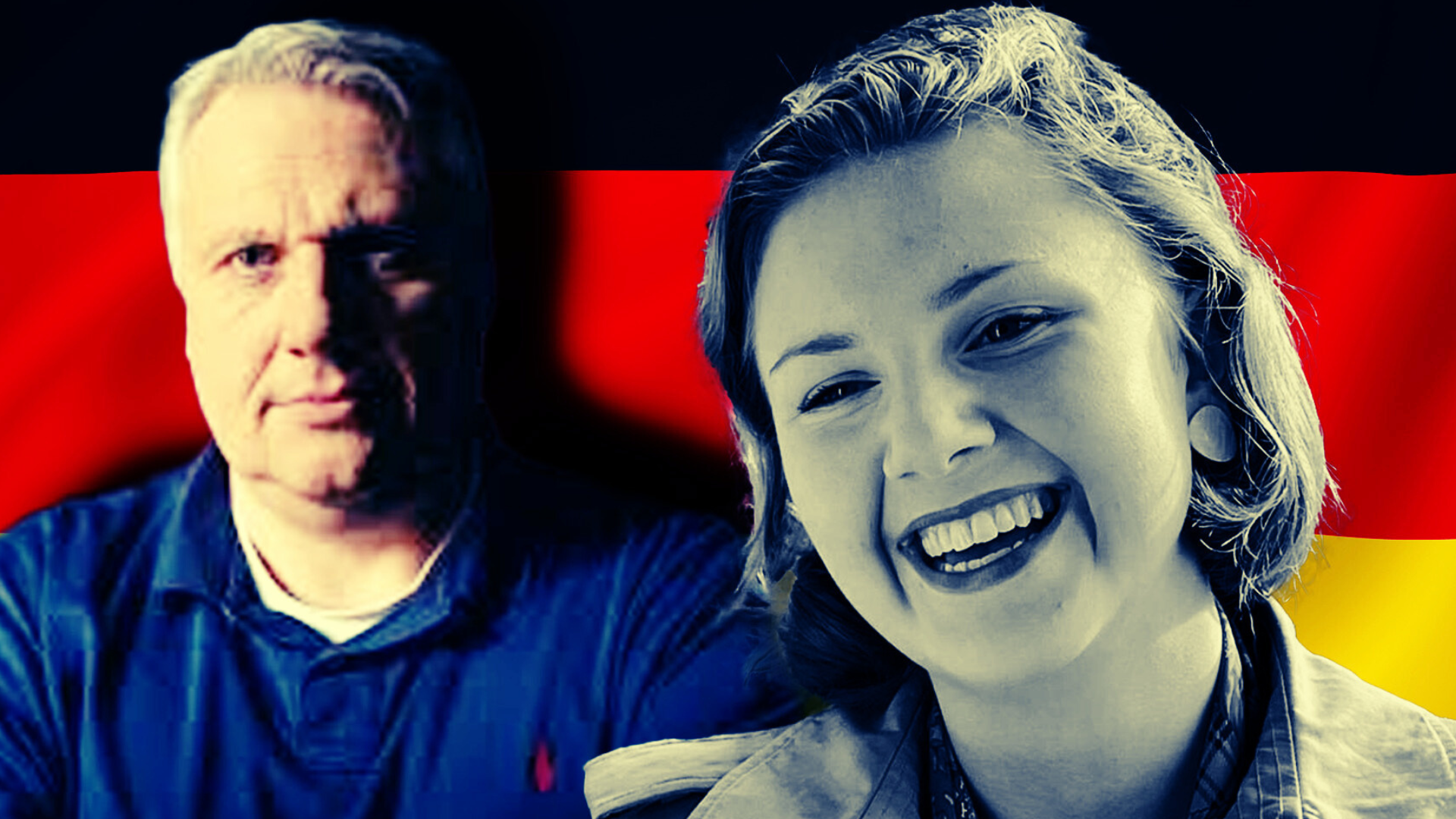
On Jan. 25, 2023, the life of Michael Kyrath was irrevocably shattered. A police officer arrived at his practice to deliver the unthinkable news: his 17-year-old daughter, Ann-Marie, had been stabbed to death on a regional train near Brokstedt. She was killed alongside her 19-year-old boyfriend, Danny, by a stateless Palestinian man who had been released from custody just days prior, despite a history of violent crime.
Since that day, Kyrath has emerged as a hauntingly articulate voice in the German political landscape — not as a partisan ideologue, but as a father demanding accountability for a system he believes is failing its citizens, including on immigration.
“People always talk about these as regrettable isolated incidents. But we’re in contact with more than 1,000 families who have lost loved ones to violent crimes in recent years. It’s always the same perpetrator profile. It’s almost always the same weapon. It’s nearly always the same sequence of events. It’s always the same motives. And it’s always the same platitudes from the same politicians, who, after such an act, tearfully cry into the cameras. Then nothing happens,” he told FAZ newspaper in a new interview.
His daughter was murdered by an illegal Palestinian migrant, stabbed 38 times, along with her boyfriend.
17-year-old Ann-Marie is gone, but her father won't let her memory die. He delivered a message to Olaf Scholz's face:
"There are parents standing at the grave or coffin of… pic.twitter.com/JDslDGKFA4
— Remix News & Views (@RMXnews) October 16, 2024At the same time, he has become a voice for thousands of victims, making regular appearances on German television and speaking with media outlets. He says he is in contact with over 1,000 families, and he says it is always the same perpetrators and always the same weapon, and then over the same empty promises from politicians again and again.
A systemic failure
Kyrath’s criticism of German migration policy is rooted in the specific failures that led to his daughter’s death. The perpetrator, Ibrahim A., had a criminal record dating back to 2016, including multiple knife attacks. Due to bureaucratic lapses, these crimes were never properly reported to the Federal Office for Migration and Refugees (BAMF).
According to FAZ:
“In 2014, he came to Germany via Turkey. His asylum application was rejected, but he received subsidiary protection. He used drugs and became involved in crime. In 2016, he injured a man with a sharp object in Bad Münstereifel. The Bonn public prosecutor’s office subsequently failed to report the crime to the Federal Office for Migration and Refugees (BAMF). In 2022, Ibrahim A. stabbed a man in Hamburg, and two days later, he struck another victim on the back of the head with the handle of a knife.
He was remanded in custody, compared himself to the Breitscheidplatz attacker, and again, the Federal Office for Migration and Refugees (BAMF) was kept in the dark. On January 19, 2023, he was released from custody, despite exhibiting extreme psychological disturbances. A few days later, he stabbed people indiscriminately on the train near Brokstedt. In 2024, he was sentenced to life imprisonment, and the court determined that the crime was particularly heinous.”
However, Kyrath rejects the government’s tendency to categorize such violence as statistical anomalies or so-called “isolated cases.” Through his advocacy, he has connected with over 1,000 families who have suffered similar fates.
NEW: 🇩🇪🔪 Knife crime in the German state of North Rhine-Westphalia soared last year by 28 percent, and non-Germans were responsible for more than half the offenses.
Syrians, Turks, and Iraqis were the worst foreign offenders.
Among suspects classified as "German" through… pic.twitter.com/pqZimUBPjF
— Remix News & Views (@RMXnews) May 8, 2025He is especially critical of politicians who keep “repeating their mantras” after another murder.
“Then nothing happens. Two, three, four weeks later, with the next incident, the politicians are back again, reciting the same mantra. Anyone out there who works knows the burden of proof placed on us,” said Kyrath.
Kyrath’s frustration extends to the very philosophy of German integration. He argues that the current approach—housing migrants in container villages with allowances but little oversight or cultural education—is a moral failure for both the newcomers and the host society.
🇩🇪🔴 A young German teen ponders what Germany would be like if Merkel had not welcomed over 1 million migrants.
She was only 4 when the former chancellor made her decision, but life has dramatically changed.
"I can hardly recognize the Germany you tell me about today. And since… pic.twitter.com/uHRFov08z1
— Remix News & Views (@RMXnews) September 3, 2025“There are people running around in this country whose origins we don’t even know. We don’t know if they’re willing to accept our way of life. And then we cram them into some container villages, hand them a monthly allowance, and think that’s integration,” Kyrath says. “This has nothing to do with Christianity or integration, but solely satisfies the moral self-esteem of a spoiled, ideologically driven, and out-of-touch caste.”
He uses a simple domestic analogy to explain the strain on German infrastructure: “I can perhaps accommodate one or two in my house. If suddenly 30 people are standing in my living room, I have a serious problem.”
The changing “cityscape”
Kyrath also addresses the shifting reality of German public life, noting that the freedom he enjoyed as a youth in the 1980s has vanished behind security checkpoints and concrete bollards at Christmas markets. He defends politicians like Chancellor Friedrich Merz who have pointed out these changes, despite the backlash such comments often receive.
Regarding the political climate, Kyrath is particularly critical of the “firewall” (Brandmauer) strategy used by mainstream parties to exclude right-wing voices from discourse, namely the Alternative for Germany (AfD).
🇩🇪🚨 "I can no longer go out alone. I need a bodyguard."
A German woman is sexually harassed in Bad Dürrenberg.
"This happens to me so often. I have contact with people like that every day when I go out."
"Really, there was a time when you could even go out at night." pic.twitter.com/ahz4kAkQcn
— Remix News & Views (@RMXnews) September 21, 2025“I think there’s a lot of cosmetic work being done, but many problems aren’t being properly addressed. A clean break is needed when it comes to migration. But nobody’s taking the initiative. I’m a democrat through and through. I talk to all parties, without exception. That’s why I believe a firewall is something for stupid people who can’t defend themselves with arguments. We are a democracy, and arguments are what count here. But in recent years, we’ve forgotten how to have a good, hearty debate. All that’s left is stigmatization, polemics, and taking everything personally,” he said.
Kyrath also said that the population would be attracted to more and more parties that are deemed “radical” because establishment politicians appear unable to address the core issues. Those who do bring them up are politically and socially ostracized.
BREAKING: This is German girl Lena (14) along with her mother (32).
Lena was brutally beaten by a gang of migrant girls.
When Lisa Steude came into the school office, her daughter Lena was cryingin a chair.
"Her hair was torn, her whole body was covered in footprints." pic.twitter.com/aIwS91ip7B
— Remix News & Views (@RMXnews) January 29, 2025“Fundamentally, we’ve noticed in recent years that things haven’t improved for us citizens, regardless of who’s in power. Everything is getting more expensive, and the formerly pacifist parties are driving us toward war. And anyone who dares to speak out is immediately stigmatized and shouted down, thus eliminating any democratic discourse that might be desperately needed.”
No organization or NGO for murder victims
Beyond political critique, Kyrath is focused on building a support network for victims. He highlights the “bubble” of trauma that follows a murder, where families are buried under legal paperwork and funeral costs—often exceeding €25,000—without state assistance.
“When your child is murdered, you’re in a bubble for the first four weeks. You have absolutely no idea what’s happening,” he says. He wants to create a system where victims are shielded from the press and guided through the financial and emotional wreckage of the first year.
🇩🇪 Germans will "perish" due to mass immigration, says German-Turkish TikToker "Based Girl 2.0."
"You wanted diversity, you have diversity."
"Call me whatever you want, I don't care. But this diversity will eventually drag you to the ground."
"At some point it will be so… pic.twitter.com/LnBNsB4bxf
— Remix News & Views (@RMXnews) July 8, 2025For Michael Kyrath, the goal is simple but profound: to ensure that the “morning silence” experienced by families like his is not ignored by the people who have the power to prevent it.
For the Kyrath family, the tragedy resulted in a house that is simultaneously too quiet and unexpectedly full. Ann-Marie was their only child, and Kyrath describes the “morning silence” as the hardest part of his day. However, every Wednesday, their home fills with Ann-Marie’s friends, whom they now call their “stepchildren.”
“Some are still in school, some are in vocational training… We play games, watch movies, go mini-golfing, or visit Ann-Marie’s grave,” Kyrath explains. “Julian, who was Ann-Marie’s best friend, once said, ‘There are many things you unfortunately won’t experience with Ann-Marie anymore, but we’ll make sure you get to experience them with us.’ I thought that was wonderful; it really touched me.”