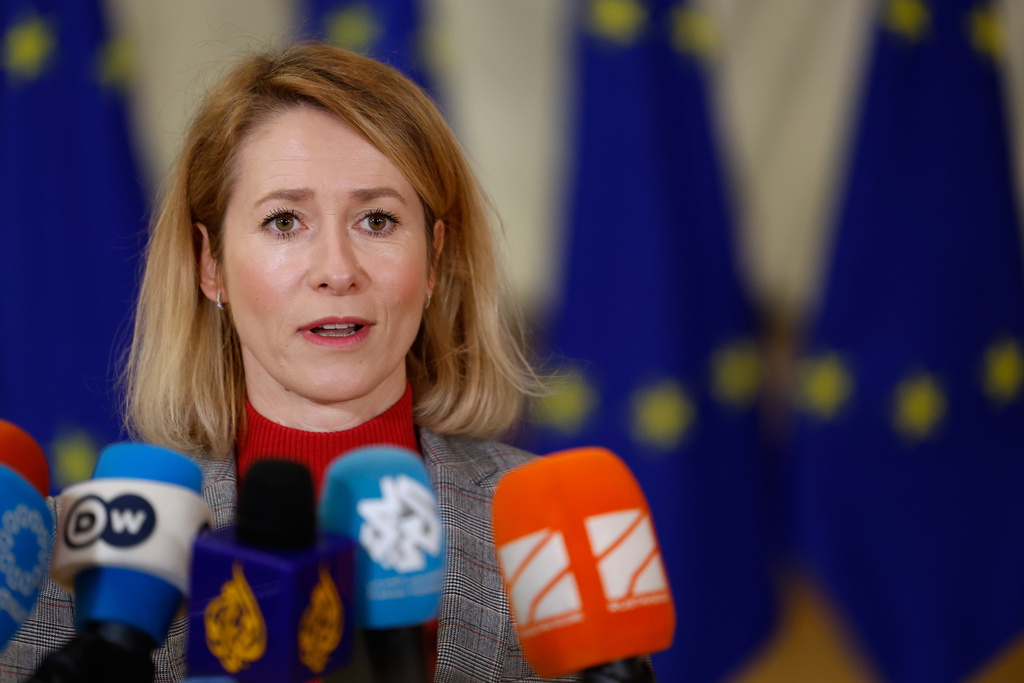
The long-standing debate over a unified European military has met a sharp new critic from within the EU’s top ranks. EU Foreign Policy Chief Kaja Kallas has issued a stern warning against the establishment of independent EU armed forces, citing significant risks to regional security policy.
Speaking at a security conference in Norway, Kallas argued that a separate military structure would create chaotic overlaps with existing alliances.
“And if you have, like the European army, and then you have the NATO (one), then, you know, the ball just falls between the chairs. And this is extremely, extremely dangerous,” she said.
“Those who say we need a European army may not have really thought this through in practical terms,” Kallas stated. “If you’re already part of NATO, you can’t create a separate army.”
While the Estonian politician voices deep skepticism, the sentiment across the continent remains divided, with leaders in Poland and the Baltics offering vastly different visions for Europe’s defense future.
Her primary concern lies in the logistical nightmare of a dual hierarchy, while emphasizing that the most critical element in any military crisis is a clear chain of command.
Currently, NATO operations are overseen by U.S. military leadership, specifically Lieutenant General Alexus Grynkewich. This sentiment was echoed by Norwegian Prime Minister Jonas Gahr Støre, who noted that while NATO’s decision-making is complex, it is a proven system. He dismissed the push for an EU army, stating it is “not a path we should take.”
These voices from the top are in sharp contrast to many other establishment EU policymakers and politicians, who have long called for a unified EU army. Critics of the proposal have also cited a loss of sovereignty for EU nation states, especially on issues where there remain sharp divisions. Notably, the EU could end up dragging other nations into war against their will.
NATO Secretary General Mark Rutte recently reminded MEPs in Brussels that European defense remains inextricably linked to American support. He suggested that Europe would need to more than double its current spending to even consider independence.
“If anyone here believes that the European Union or Europe as a whole can defend itself without the USA, then keep dreaming. That is not possible,” Rutte warned.
Despite these warnings, Polish Foreign Minister Radosław Sikorski is pitching a middle-ground solution: a “European Legion.” Rather than a full-scale merger of national forces—which he dismissed as “pointless and unrealistic,” Sikorski envisions a brigade-sized unit of volunteers funded by the EU budget.
“It would not be a force that could deter Putin, but there are lower-level threats, such as in North Africa or the Balkans, where we should have the opportunity to act together,” Sikorski explained.
This view is in sharp contrast to the previous Polish government, which was extremely opposed to an EU army. The previous conservative government viewed such an army as a potential threat, also in part due to the leading role Germany would likely play in any such force.
Contrasting Kallas’s caution, EU Defense Commissioner Andrius Kubilius is pushing for a more robust 100,000-strong force. He argues that the current fragmented approach to European defense is inefficient compared to a federalized model.
“Would the United States be militarily stronger if it had 50 armies at the state level instead of a single federal army?” Kubilius asked, advocating for a total redesign of the continent’s defense architecture in the face of Russian aggression.