
A German non-governmental organization that receives substantial funding from the European Union, as well as the German and Dutch governments, has filed a lawsuit seeking access to social media platform X’s data related to Hungary’s upcoming parliamentary elections.
Berlin-based Democracy Reporting International (DRI) has taken legal action in Germany against the social media giant, demanding access to platform data under the EU’s Digital Services Act (DSA). The group says the data is necessary to study potential disinformation and interference surrounding Hungary’s parliamentary elections scheduled for April 12.
Another German NGO, the Society for Civil Rights (Gesellschaft für Freiheitsrechte, GFF), and law firm Hausfeld Rechtsanwälte are also parties to the lawsuit.
According to court filings reported by EUObserver, this is the second legal action brought by the same plaintiffs against X in Germany, after a previous case seeking access to platform data around Germany’s 2025 snap federal election.
With campaigning intensifying ahead of Hungary’s April vote, the legal battle over platform data now adds another layer to an already charged political environment, one in which the question of who defines and defends democratic legitimacy remains deeply contested across Europe.
Under the DSA, very large online platforms are required to provide researchers access to data when studies concern systemic risks to the European Union, including election integrity. DRI argues that X has failed to comply with that obligation, saying repeated requests for data access have been rejected.
Critics, however, argue that the DSA is being used as a vehicle by the European Commission and those it funds to control the narrative during critical election cycles, a claim amplified by the U.S. House Judiciary Committee in its bombshell report published on Feb. 3.
X has previously argued that broad data access risks infringing user privacy and free expression, and has also challenged whether German courts have jurisdiction over disputes involving the platform, whose European headquarters are located in Ireland.
The new lawsuit comes as Hungary prepares for what analysts describe as one of the most competitive elections in recent years, with Prime Minister Viktor Orbán facing a consolidated opposition campaign amid continuing tensions between Budapest and Brussels over rule-of-law disputes, migration policy, and EU governance.
Orbán has repeatedly accused EU institutions of attempting to influence domestic Hungarian politics. Responding to criticism over election conditions earlier this week, he wrote on social media, “Keep your hands off our elections! Decisions about Hungary’s future belong to Hungarians alone. Foreign meddling will not be tolerated.”
🚨The EU Censorship Files, Part II
For more than a year, the Committee has been warning that European censorship laws threaten U.S. free speech online.
Now, we have proof: Big Tech is censoring Americans’ speech in the U.S., including true information, to comply with Europe’s… pic.twitter.com/Fg0gxzoTxD
— House Judiciary GOP 🇺🇸🇺🇸🇺🇸 (@JudiciaryGOP) February 3, 2026His remarks followed a recent report by the U.S. House Judiciary Committee, which argued that European authorities have used regulatory pressure and cooperation with digital platforms in ways that affected political debate in at least eight EU member states since the introduction of the DSA in 2023.
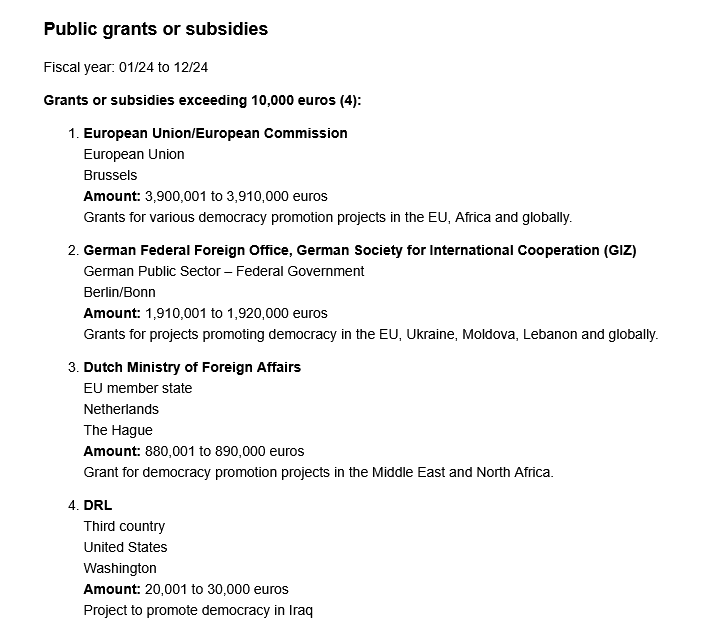
Entries in Germany’s Bundestag Lobby Register reveal that DRI received substantial public grants during the 2024 fiscal year, including funding from the European Commission totaling approximately €3.9 million, as well as roughly €1.9 million from Germany’s Federal Foreign Office and associated agencies, and approximately €880,000 from the Dutch Ministry of Foreign Affairs for “democracy-related projects” abroad.
GFF, DRI’s co-plaintiff, has also received support from EU-funded initiatives and participates in projects financed under various European civil society and rights programs, according to a written response by the European Commission to a parliamentary question in 2025.
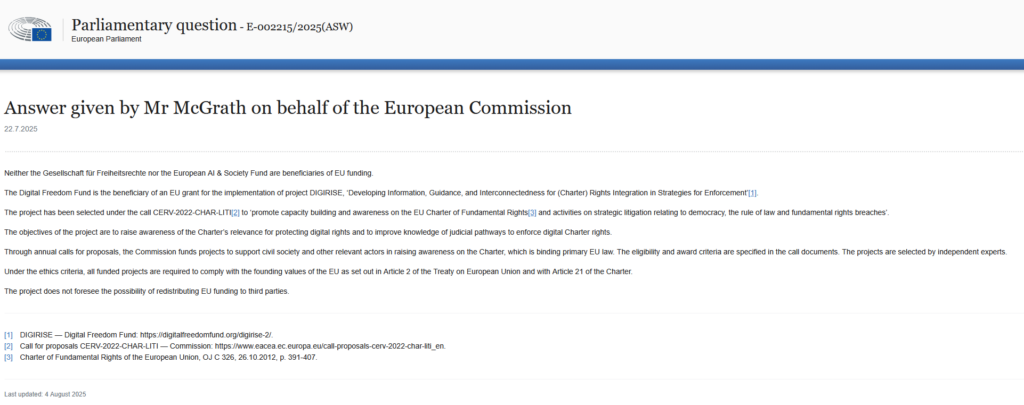
“The Digital Freedom Fund is the beneficiary of an EU grant for the implementation of project DIGIRISE, ‘Developing Information, Guidance, and Interconnectedness for (Charter) Rights Integration in Strategies for Enforcement,” it wrote. The funding amount was not disclosed.
Critics argue that litigation seeking access to election-related data by organizations financed in part by European institutions risks creating the perception of external supervision over national political processes, particularly in countries already engaged in disputes with Brussels.