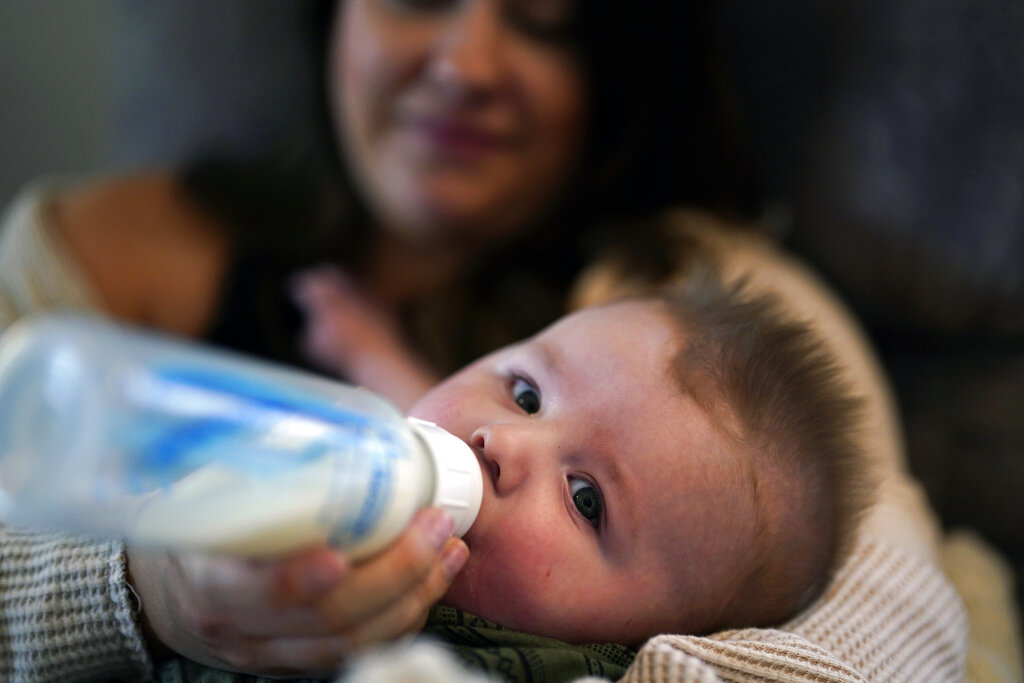
Europe’s current crisis surrounding contaminated infant formula has become one of the largest recalls in the history of the European food industry. and the scandal has exposed a terrifying reality for all Europeans: if Europe cannot even trace and identify lethal toxins in the food supply of its most vulnerable citizens, it is in no position to open its gates to the massive, under-regulated agricultural markets of South America with the new Mercosur free trade deal.
Major brands like Nestlé, Danone, and Lactalis pulling baby formula products across 60 countries, The tragedy centers on the bacterial toxin cereulide, which has already been linked to the suspected deaths of two infants in France. While the trail for this specific contamination leads back to a supplier in China, the structural failures revealed by the investigation provide a grim preview of what awaits Europe under the Mercosur agreement.
While it is true that there is virtually no stopping Mercosur at this point, which was already passed by the European Commission without even a formal vote from the European Parliament, it is still worth noting how incredibly incompetent the European Union is and why it now represents a threat to Europeans’ food safety.
European food law strictly mandates that companies must enable the traceability of their products at every individual production step. Yet, consumer advocates like Foodwatch note that even global giants like Nestlé took weeks to determine the source of the toxin.
This raises a fundamental question of sovereignty and safety: If European authorities struggle to police existing global supply chains, how can they possibly monitor the vast agricultural plains of Brazil and Argentina, along with their various poorly regulated food processors and producers? The Mercosur pact will flood the European market with beef, poultry, and soy from countries where monitoring systems are notoriously opaque.
If the European Union cannot manage a “silent recall” of baby milk produced partly in the Netherlands and Germany, Europe cannot rely on overseas regulators to ensure that South American imports meet the supposedly rigorous “Farm to Fork” standards Europeans expect.
The scandal has also highlighted the danger of relying on corporate self-regulation, especially when dealing with countries outside the EU bloc. Relying on China for baby formula ingredients, given the country’s own questionable history with baby formula saw six deaths and 58,000 infants hospitalized in 2008, should be a wake-up call to Europeans who believe they can obtain cheap food products overseas without any public health costs.
Nestlé detected traces of cereulide as early as November 2025, yet a comprehensive public warning did not follow until January 5, 2026. This “transparency gap” demonstrates that corporations—whether European or South American—prioritize brand protection and the avoidance of damage claims over immediate public safety. It also shows that even the biggest producers inside Europe cannot be trusted. Foreign corporations, which cannot truly be held accountable, can be trusted even less to ensure poorly tested and poorly regulated products are not shipped into European markets.
🇫🇷🇪🇺 26-year-old French organic farmer, Anaïs Foulquier, says that the EU's new Mercosur free trade deal with South America will destroy her farm.
"We are young organic farmers. We rear our own goats, dairy cows and laying hens. We respect everything, the standards, the… pic.twitter.com/UyJjN0cWY8
— Remix News & Views (@RMXnews) January 20, 2026Under the Mercosur agreement, this lack of transparency would be magnified. Brazil, the largest player in the Mercosur bloc, currently uses more harmful pesticides than almost anywhere else on Earth. Many of these chemicals are banned within the EU due to their carcinogenic and environmental impacts. Opening the market further invites a “race to the bottom” where European farmers, who are bound by strict environmental laws, must compete with South American mega-corporations that utilize chemical shortcuts with little to no oversight from the EU’s overstretched food inspectors.
The German Association of Food Inspectors (BVLK) has already sounded the alarm, noting that they can currently “only manage half of the planned controls” due to staff bottlenecks. In Germany alone, food supervision is fragmented across 430 regional offices.
While immediate acute cases of poisoning and outright death — as seen in the latest EU scandal involving baby formula — might be rare, pesticides are being fingered as a part of the Western world’s fertility crisis, along with rising rates of cancer.
Adding the complexity of the Mercosur agreement to this strained system is a recipe for disaster. If 430 monitoring offices and health departments in Germany, responsible for the actual “boots on the ground” work of food safety, cannot seamlessly coordinate a recall for baby formula manufactured in the Allgäu region, they cannot be expected to verify the pesticide residues or bacterial safety of tons of meat and produce arriving from South America.
The baby formula recall should prove definitively that Europe’s highly globalized food industry is already dangerously vulnerable. The fact that the EU food authority (EFSA) only just established a guideline for cereulide in February 2026 shows that regulators are constantly playing catch-up with industrial risks.
The Mercosur agreement represents an intentional decision to increase this vulnerability. It asks Europeans to trust in the regulatory rigor of distant nations and the “goodwill” of global corporations—two things that the current scandal has proven do not exist. If Europeans cannot protect the infants in our own nurseries from contaminated ingredients sourced abroad, Brussels has no business signing away European food standards for the sake of a trade deal that will financially ruin European farmers.
This crisis reinforces the investment thesis for “sovereign” and “traceable” infrastructure. While traditional food giants suffer massive hits to their image, the shift toward localized or highly scrutinized “closed-loop” production should be accelerating. Instead, Europe has taken a major step backwards.
As Remix News already noted in our extensive coverage of the Mercosur agreement, this criticism comes on top of the fact that Mercosur will be a disaster in terms of carbon emissions and the destruction of the Amazon rainforest. Incredibly, Germany’s Green Party supports this agreement, which will ship food from halfway across the world and almost certainly worsen climate change.