

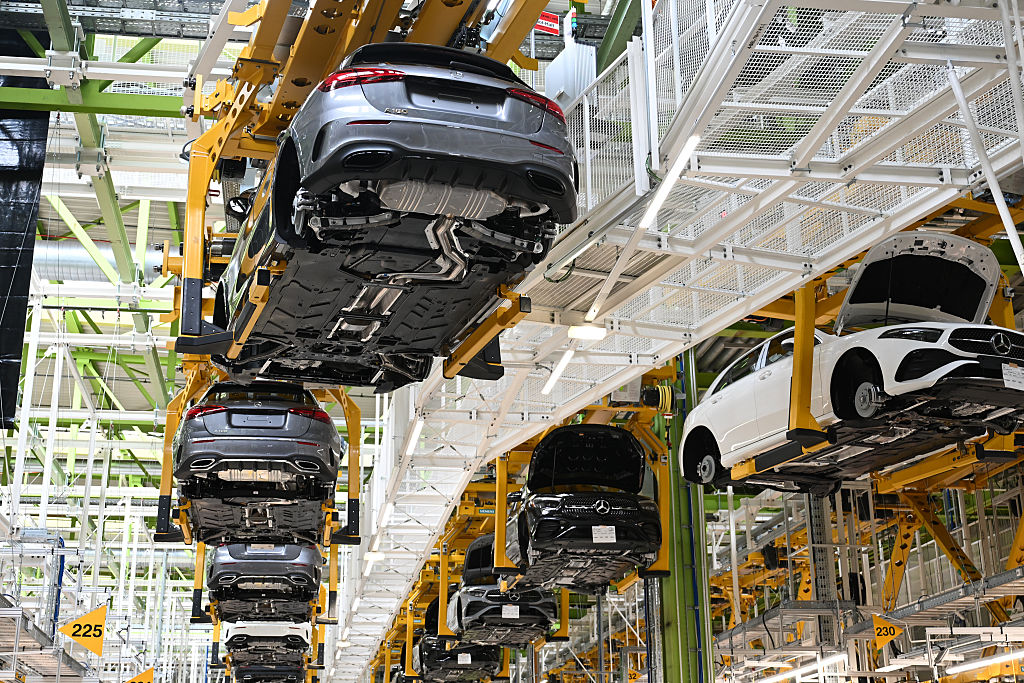
The economic landscape in Germany grew increasingly bleak in 2025 as the nation’s industrial sector accelerated its workforce reductions. According to a recent analysis by EY Consulting, which synthesized figures from the Federal Statistical Office, approximately 124,000 jobs were eliminated over the 12-month period — a 2.3 percent contraction.
This trend represents a doubling of job losses when compared to the 2024 data, leaving the total industrial workforce at roughly 5.38 million by year-end.
Jan Brorhilker, one of EY Consulting’s managing directors in Germany, highlighted the severity of the situation by labeling it a “deep crisis.”
Despite Chancellor Friedrich Merz’s promise of an industrial and economic turnaround, the reality of the German economy shows that, so far, the country’s economic and employment crisis has only worsened.
The primary driver behind these cuts is a sustained erosion of revenue. Since 2023, industrial sales have contracted by nearly five percent, forcing firms to reconcile their payrolls with a shrinking market.
Despite the high number of layoffs, Brorhilker suggested the reduction has actually been conservative relative to the plummeting sales. He warned that “it would take a real and significant upswing to prevent further employment from melting down.”
Overall industrial sales dipped by 1.1 percent in 2025, marking the tenth consecutive year of declines by the final quarter. While the automotive, paper, and textile sectors recorded heavy losses, the metal and electrical industries managed to report increases.
The impact of the crisis has been unevenly distributed across the industrial landscape. The automotive sector was the primary casualty of 2025, accounting for 50,000 lost positions. Companies like Mercedes, which have seen falling profits while moving operations to other countries, have been special sore spots for the German economy.
Last month, Mercedes confirmed it will relocate production of its A-Class from Rastatt, Germany, to Kecskemét, Hungary. Hungary’s foreign minister, Péter Szijjártó, confirmed the move and attributed it to what he described as a stable, investment-friendly economic policy. “An economic policy based on sound common sense and a stable government that continually attracts new investment projects from global companies in America, Asia, and even Germany,” he said.
The right-wing Alternative for Germany party blamed the move on Germany’s “green climate and energy policies,” and argued for ending the energy transition, lifting the combustion engine ban, abolishing fleet emission limits, and rolling back reporting requirements.
Textiles and paper also faced aggressive declines. Conversely, electronics and metalwork provided a rare bright spot by recording growth. The chemical and pharmaceutical sectors proved resilient as well, with a negligible loss of only 2,000 jobs.
As Remix News reported last month, Andrea Nahles, head of Germany’s Federal Employment Agency, said that the labor market has been “stagnant for months,” with “no momentum” returning. In an interview with Web.de, Nahles said the number of vacancies has fallen for seven consecutive quarters and that the likelihood of unemployed people finding work has dropped to a record low.
“We have an indicator that shows how likely unemployed people are to find a job again. The value is usually around seven, but is now at 5.7 – the lowest it has ever been,” she said.
When evaluating the industrial sector’s health since the last pre-pandemic year in 2019, the long-term damage becomes even more evident. In total, the sector has shed 266,000 jobs, a decline of just under 5 percent in half a decade.
The most alarming statistics over the last year remain tied to the automotive world, which has seen its workforce shrink by 13 percent, or 111,000 jobs, since 2019. Similarly, the textile industry shrank by 16 percent and the metal industry by 13 percent. Only the chemical and pharmaceutical industries, up 3 percent, and the electrical industry, up 2 percent, have expanded their headcount over this period.
The outlook for the current year remains grim. EY anticipates that the combination of stagnant order books, fierce competition from China, and a wave of supplier bankruptcies will trigger further downsizing.
A significant concern is the industrial flight as major automotive players shift their core operations abroad to countries such as Hungary, but also India and elsewhere. Brorhilker cautioned that the relocation of manufacturing and research and development “comes at the expense of jobs in Germany.” While some analysts hope for a marginal recovery this year, the Leibniz Institute for Economic Research Halle suggests that a meaningful reversal is not yet on the horizon.
An Insa poll from two months ago, in December of 2025, found that Germans are deeply pessimistic about the economy.
Overall, the Insa poll showed that a substantial 65 percent of respondents agree with the statement that the German economy is currently experiencing a significant decline. Only 21 percent disagree. This economic anxiety crosses party lines, with even half of Green and SPD voters acknowledging a downturn.
In the same poll, Germans also pointed out that despite economic woes, Germans are even more concerned about migration. The poll showed that 50 percent of respondents agreed that migration is Germany’s biggest problem, while 38 percent reject this position.