
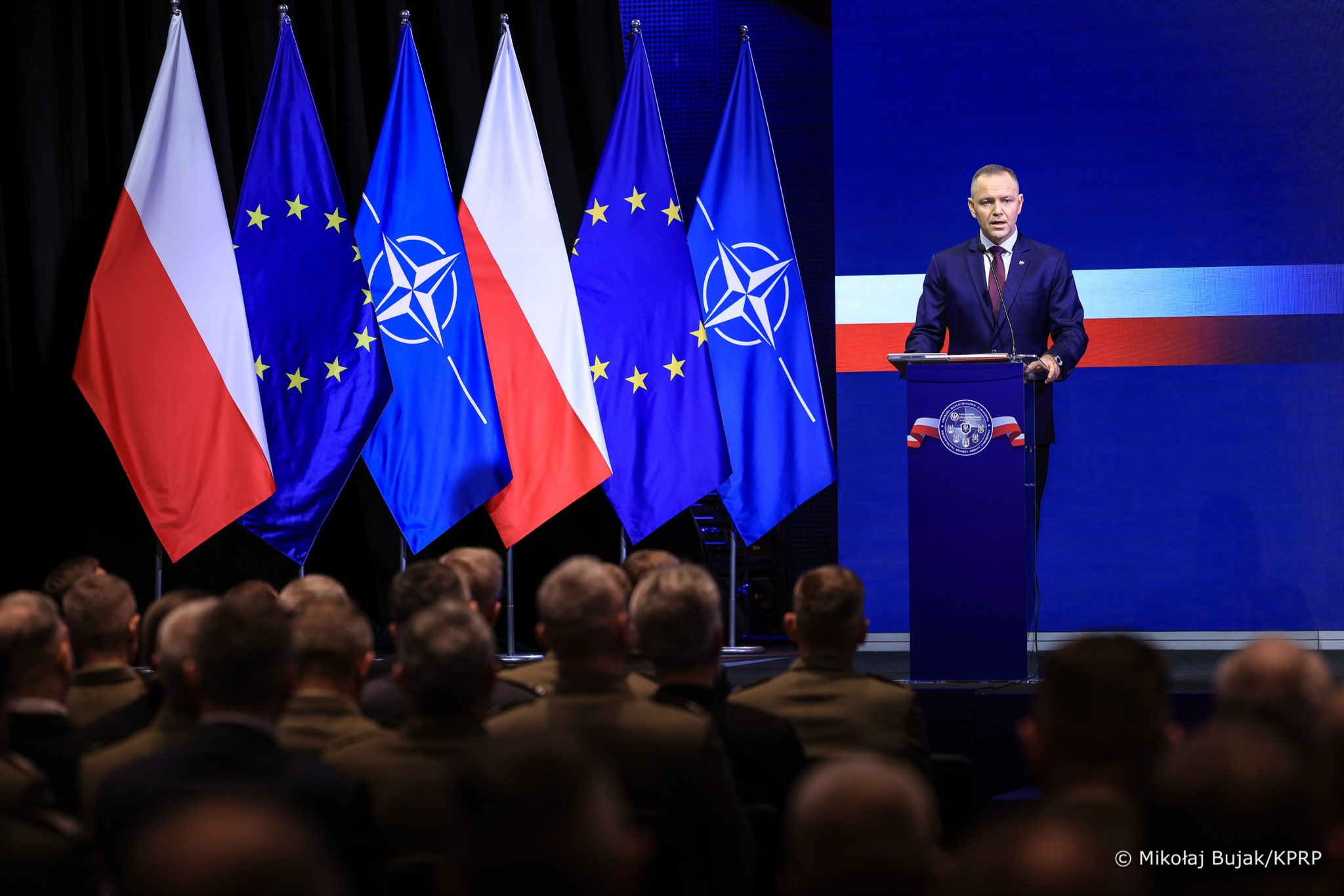
Polish President Karol Nawrocki spoke at a briefing at the Polish Army Museum at the Warsaw Citadel, outlining clear goals for the development and mobilization of the Polish Armed Forces. As commander-in-chief of Poland’s military, he emphasized that Poland must modernize to tackle current and future threats, contribute more to NATO (along with all other European Allies), and be ready for Moscow to pursue its ambitions, which do not stop at Ukraine. Nawrocki also furthered the notion that the China-Russia axis is real and growing.
“As we know, Russia is increasingly cooperating with China, creating a broader bloc of states challenging the Western model of international order. Unfortunately, Europe is becoming one of the key theaters of this rivalry. Therefore, today I clearly see this trend, seeing the real prospect of continued negative impact on the security environment, of the situation developing in a negative direction for Poland, towards confrontation,” he said.
During the briefing, Nawrocki announced that he plans to hold similar briefings on a regular basis with the Ministry of National Defense, including both management staff and generals, writes wPolityce.
“To develop the best solutions that will serve Poland, a pro-state consensus is essential. I do not rule out that, within my legislative powers, I may propose an initiative to add a new dimension to the Enhanced Defense Cooperation Agreement, aligned with the assumptions of the Polish National Security Strategy, the Polish Constitution, as well as the American National Security Strategy and the National Defense Strategy,” he said, adding that increasing American troops is also envisioned as “crucial.”
Nawrocki also addressed the country’s NATO contributions, stating that Poland will increase defense expenses “to maintain the government’s defense spending at 5 percent of GDP.”
“Just like we in Poland, our partners must be aware that the era of cheap security within NATO, guaranteed solely by the United States, has definitively ended. Americans expect their European allies to shoulder a significant share of the responsibilities arising from collective defense,” he told those gathered.
The president also welcomed a greater U.S. troop presence. “Today’s security situation indicates that it is necessary to consider increasing the presence of U.S. forces in Poland. I see that there is still room for expanding military cooperation in the context of my arrangements last year with President Trump and subsequent consultations conducted by the presidential ministers. I consider the involvement of the Ministry of National Defense in negotiations regarding increasing the U.S. military presence in Poland, especially on a permanent basis, to be crucial.”
Emphasizing the need for greater use of drones in the military, he stressed, “The urgency and importance of developing this field are confirmed by ongoing armed conflicts.”
Addressing the EU’s controversial SAFE loan, Nawrocki expressed clear concerns regarding Poland’s sovereignty. “Yes, the Polish army needs the substantial funds provided by the SAFE loan. However, the sovereignty aspect, which is particularly important to me as the President of Poland, raises doubts. To what extent does the SAFE program allow us to freely spend money in the context of the principle of conditionality? The fundamental principle of building security is certainty. We must be certain that these funds will not be withheld or suspended.”
“Certainty is security, uncertainty is danger,” he added. “This is a huge debt that will be repaid by the Polish state for decades. Therefore, Poles have the right to know the true cost of the debt incurred and the terms on which it will be granted.”
Calling the continued development of the Polish Armed Forces a priority, Nawrocki focused on Russia as the primary threat, on both a regional and global level.
“Today’s security environment, both globally and regionally, clearly indicates that Russia still poses and will continue to pose a real threat to the world and to Europe in the near future. This threat is both structural and multi-vector. This is because for centuries, Russia’s strategic aspiration has been to subordinate other states to its interests, impose its anti-values on them, and destabilize the international order. Today’s Russia, like all its previous incarnations, often at the expense of its neighbors, ruthlessly strives to rebuild and expand its sphere of influence.”
Turning to the immediate conflict in Ukraine, Nawrocki told those gathered, “The war against Ukraine is a clear element of a return to imperial policy. However, this is not a regional incident. For Russia, it serves, in its view, to secure its interests in the long term, while generating negative consequences for us for many years, perhaps decades, to come.”
NATO is Putin’s primary enemy, and the goal is sow chaos and destabilize the Alliance.
“Russia sees NATO as its main enemy in the civilizational war it is waging against the West. This is how it continues to perceive Poland and NATO as a whole. To weaken the Alliance, it is taking actions aimed at undermining the credibility of the Article 5 mechanism and will continue to intimidate countries across the eastern flank. This is accompanied by a large-scale hybrid operation and influence operations across Europe. Their goal, of course, is to further polarize societies, strengthen anti-establishment parties and those skeptical of democracy, aimed at undermining the purposefulness of mutual support and the protection of values.”
Although this cooperation is seen most clearly in the war in Ukraine, Nawrocki warns that “the entire eastern flank” of NATO is in Moscow’s crosshairs, and Putin will continue to play games to weaken Western allies. “In such a scenario, even if the conflict in Ukraine changes in intensity, we will have to face its consequences across the entire eastern flank. We must reckon with the need to respond to a series of events, incidents below the threshold of war, which will test our resilience. Their aim will also be to attempt to break NATO cohesion. A false de-escalation, a freeze in the conflict, and a partial recognition of the current course of the front as a state of control over eastern Ukraine could lead to a permanent dividing line in Europe. In such a scenario, Russia will remain even more revisionist, seemingly weakened, but in reality, unfortunately, still ready for war.”
Against this backdrop, the Polish head of state called for the Polish Armed Forces to not serve any political group or ideology but instead serve as “an instrument of policy of the Polish state, the Republic of Poland.”
Detailing some of Poland’s new national security strategy, to be submiited to the government soon, Nawrocki stated: “The assumptions and plans for the use of armed forces must include the defense of every part of the territory of the Republic of Poland. The prospect of shifting defense deep into the country is, in my opinion, unacceptable. This must be achieved through organizational and dislocation changes, the creation of new military units east of the Vistula River in garrisons, from which the mobilized deployment of armed forces will ensure a timely, appropriate response to threats.”
Nawrocki highlighted the need for “technologically advanced armed forces with high combat capabilities,” with the goal of military capabilities “that will give our army an advantage on the modern battlefield even in five or 15 years.”
As commander-in-chief of the armed forces, he emphasized the need for “modern solutions, artificial intelligence, breakthrough technologies in the cyber and space domains, command, reconnaissance, and strike systems, as well as unmanned systems.” Development on all fronts, he said, “must be made more realistic, practical, and accelerated to ensure the ability to conduct deterrence operations in all operational domains.”