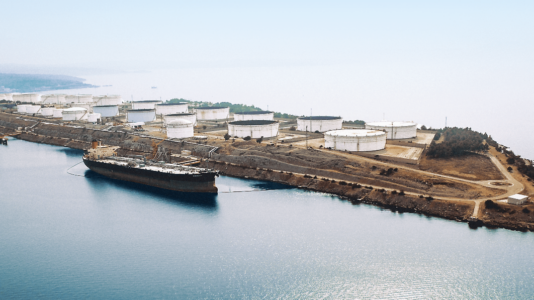

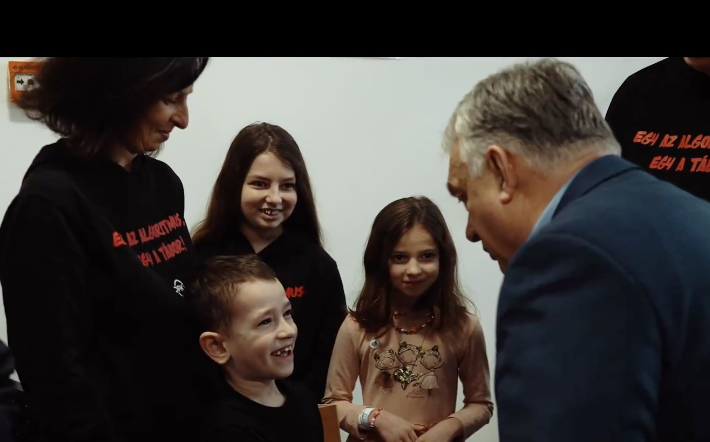
During an interview at the Megafon Center in Budapest, Prime Minister Viktor Orbán said he never expected Ukraine to threaten Hungary with an oil crisis by disrupting the Friendship pipeline and refusing to reopen it. He had thought the attacks ahead of the April election would remain in the territory of “dirty talk” and other personal attacks.
Nevertheless, any attempts by Kyiv to put Hungary at a disadvantage in terms of energy have failed, Orbán told the audience, as cited by Hirado, since the country “has accumulated sufficient reserves.”
“The Ukrainians cannot achieve the goal of having a gasoline price of 1,000 forints or chaos and supply uncertainty in Hungary, so that it can be said: the government cannot protect the interests of the country, cannot ensure the normal functioning of the economy,” Orbán noted.
When asked whether the Ukrainians could take further, tougher steps than they have taken so far, in the future, according to his information, this was a possibility, but he could not reveal anything further about this for now.
The Hungarian prime minister did reveal that the Defense Council had to be convened on Wednesday morning to take further measures to protect Hungarian energy facilities. “Don’t be surprised if you see more police patrolling (…) or if military units appear near energy facilities,” he said.
“The situation is not easy. The Ukrainians can put pressure on us, but we can also put pressure on them.”
He said that what is coming is European soldiers in Ukraine, and said this was already a deal signed between the French and the British. According to him, in the next one to two years, “the European war will knock on our door” and there will be a situation when the Europeans will send real, equipped, fully armed military units to the territory of Ukraine.
The government that will be elected in upcoming national elections will decide whether Hungary wants and can stay out of a European-Russian war.
“I believe that the election before us now will be the last election before the war between the Europeans and the Russians,” the prime minister added. He said that the government Hungarians elect now and the parliamentary majority created will now decide whether Hungary wants to and can survive in such a situation.
In his opinion, during the past four years of the Russian-Ukrainian war, “we have never been as close to war as we are now.”
He continued that the United States had withdrawn from the operational part of the war, and “if something miraculous doesn’t happen here, the Americans will withdraw from the diplomatic settlement of the matter as well.”
The prime minister noted that “somehow it is not settled in Hungarian minds that Ukraine’s membership in the European Union immediately means mandatory military actions for Hungary as well.” He highlighted that the European Union (EU) Charter “speaks very clearly” that if a third country attacks an EU member state, military support and assistance must be provided there.
“In the risky situation that has arisen, in a war situation, many things influence whether there will be a war. And in a war situation, the Hungarian prime minister must decide on the issue of war and peace, on whether his nation will participate in this war or stay out of it, on whether he has enough strength to resist pressure, which is often blackmail. This situation has arisen,” he said.
“Security is at stake in this election, because there will be situations where the direction of Hungary’s fate and future depends on the decision of Hungary’s leader, government, and parliamentary majority. The most important thing is security,” the prime minister emphasized.
“If there is no peace, if our money is taken to Ukraine, if utility bills skyrocket, then everyone will be worse off,” added Orbán.
The prime minister also spoke about how high energy bills are dooming European industry, as it “does not have the efficiency or management skills to compensate for the three to four times difference in energy prices.”
According to his assessment, Europe is condemning its own industry to death. He noted that 140,000 to 150,000 industrial jobs have been lost in Poland, and 124,000 in Germany, and entire industries have collapsed, while “the European aluminum industry has run its course, the European chemical industry is coming to an end.”
He stressed that high energy prices would bring the economy of a country stronger than Hungary to its knees, and if this energy price were to enter the country and the government were unable to protect companies and households from it, then the elimination of jobs would also begin in the Hungarian economy.
Orbán highlighted that the Hungarian government had protected these jobs in the recent period, creating more jobs during the four years of the war than were lost. According to him, this was only possible because the government was able to maintain a cheap energy supply, “if we don’t have that, then we will stumble into the same river as the Western Europeans.”
Orbán said he would not like to see his country in the situation that many Western European countries are in. They are “busy managing the decline,” without a plan to reverse the trends, and they only care that it does not get much worse.
“No matter how we look at it, in the end everything leads us to security, which is why the decision for Fidesz to go into the election with the slogan ‘Secure Election’ was the right one,” said Viktor Orbán.
When asked by viewers whether Hungarians would vote for a calm construction process in April or for an authorization that would continue to keep the country on the front lines, he replied: “There are three options, the first is to fight with hope, the second is to assume that there is a force greater than us and continuously, with varying success, defend our interests, and the third is to say, ‘We win, they lose.'”
The prime minister emphasized that there is a clear plan for how conservatives will win in Brussels, the Patriots of Europe group in the European Parliament was established, which has built a strong alliance.
“If one of the candidates from the patriotic forces wins the 2027 French election, at that moment, there will be a complete turnaround because the Americans are with us in transatlantic relations, the V4 has been restored in Central Europe, and the Italian government has not been overthrown,” he said.
When asked whether Hungary should go to war as a NATO member, he replied: “NATO is a military defense alliance, so its members have no obligation to participate in any military action outside the territory of the member states. Therefore, Hungary does not have to go to a Ukrainian-Russian war, but if Ukraine becomes a NATO member, it must go. This is why the government is also fighting against Ukraine’s NATO and European Union membership.”
When asked whether a possible change of government would jeopardize the achievements of the past 16 years, he replied that war and “disconnection” from cheap energy were an immediate threat, because the Tisza Party “made a pact with Brussels and Zelensky that it would accept support in order to establish a pro-Ukrainian government, and promise to let Ukrainians into the EU and disconnect Hungary from Russian energy.”
Orbán said that, according to his interpretation, there are two systems in Europe, the Hungarian and the Brussels system, and a Brussels system would enact desired changes in Hungary if the opposition were to win.