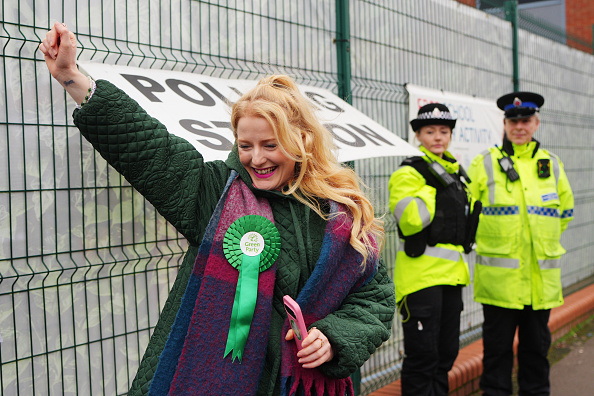
What was billed as a tight three-way contest in the Gorton and Denton by-election ended in a decisive win for the Green Party, which captured the seat from Labour with a majority of around 4,500 votes.
The result marks the first time in decades that Labour has lost territory in this part of Greater Manchester. Before recent boundary changes, the party had held the predecessor seats stretching back generations — Manchester Gorton since 1910 and Denton and Reddish since its inception in 1979. The defeat adds to unease within Labour’s parliamentary ranks, where some MPs have already voiced concerns about the party’s direction under Sir Keir Starmer.
For Reform UK, the by-election was an opportunity to entrench itself as Labour’s principal challenger in northern seats with a significant ethnic minority electorate. Instead, it was the Greens who made the breakthrough, securing their first seat in the north of England and reshaping the political conversation.
Gorton and Denton by-election result:
GRN: 40.7% (+27.5)
REF: 28.7% (+14.7)
LAB: 25.4% (-25.3)
CON: 1.9% (-6.0)
LDEM: 1.8% (-2.1)
Green GAIN from Labour.
— Britain Elects (@BritainElects) February 27, 2026Demographics played a central role in the campaign. The constituency, on the outskirts of Manchester, has a Muslim population of roughly 30 percent, with wards such as Levenshulme and Longsight significantly higher at 51 percent and 60 percent, respectively. That reality posed a strategic dilemma for Reform candidate Matt Goodwin: attempt to appeal to parts of that vote and risk alienating his core supporters, or consolidate backing among traditionally Labour-voting White working-class communities. In the end, he failed to fully achieve either.
Reform’s campaign unfolded under intense scrutiny, particularly amid the emergence of former Reform MP Rupert Lowe’s Restore Britain movement — though it did not stand in this election. With the national spotlight fixed on the party, any overt repositioning risked accusations of ideological retreat from its populist base.
The U.K. Green Party is posting campaign videos entirely in Urdu. pic.twitter.com/PErkQsJPOj
— Remix News & Views (@RMXnews) February 23, 2026The Greens, by contrast, focused heavily on issues resonating with Muslim voters, particularly Gaza. Campaign materials were circulated in Urdu, the national language of Pakistan, and the party leaned into its outspoken stance on the Israel-Palestine conflict. In September 2024, the Greens became the first major UK party to describe Israel as an “apartheid” state and to formally accuse it of genocide in Palestine — positions that appear to have paid dividends by strengthening their appeal in constituencies with large Muslim electorates.
The candidate herself — Hannah Spencer, ironically, a White female plumber — was almost incidental to the broader message. The campaign suggested that party positioning, rather than personal profile, was decisive. Previous election results for the Greens in the region emphasize the scale of the shift: in 2019, the party secured just 2.5 percent of the vote in the area; in 2024, 13.2 percent. This time, they won outright.
👀The Electoral Commission give Democracy Volunteers access to polling stations at election time. Only they and the police can go inside. They’ve just issued this report about “family voting” in Gorton and Denton:
Democracy Volunteers deployed four accredited election observers…
— Sam Coates Sky (@SamCoatesSky) February 26, 2026Polling day was not without controversy. Democracy Volunteers, an accredited election observation group, deployed teams to 22 of the constituency’s 45 polling stations. According to its director, John Ault, observers recorded what he described as the highest levels of “family voting” the organization had seen in its history
Of 545 voters observed, 12 percent were involved in or affected by family voting — a practice in which individuals accompany others into polling booths and potentially influence their choice, in breach of ballot secrecy rules. Observers reported instances in 15 of the 22 polling stations visited, with nine cases recorded at one station alone.
Ault said the data was sufficiently concerning that the group issued a report on election night — an unusual step. By comparison, in a recent by-election in Runcorn and Helsby, family voting had been observed in 12 percent of polling stations and affected around 1 percent of voters.
Other irregularities noted included voters photographing ballot papers and one case in which a person was authorized to vote despite having already been marked as having done so earlier in the day. Democracy Volunteers said it had informed Manchester City Council of its findings.
An impressive result for @reformparty_uk today. We more than doubled our vote and beat Labour in their own backyard. Huge credit to @GoodwinMJ and the thousands of volunteers.
The wider campaign, however, should be a wake up call.
South Asian men instructing women how to vote…
— Robert Jenrick (@RobertJenrick) February 27, 2026Reform figures reacted angrily to the outcome. Robert Jenrick, the party’s economic spokesman, described the result as “an impressive” performance for Reform, claiming it had more than doubled its vote and overtaken Labour in parts of the constituency. But he also warned of what he called “appalling sectarianism,” citing reports of men instructing women how to vote and accusing the Greens of campaigning “under a foreign flag and in foreign languages to exploit a foreign conflict.”
This election was a victory for sectarian voting and cheating.
Matt Goodwin was a great candidate for us.
Roll on the elections on May 7th.
It will be goodbye Starmer and goodbye to the Tory party.
— Nigel Farage MP (@Nigel_Farage) February 27, 2026Leader Nigel Farage was blunter, calling the contest “a victory for sectarian voting and cheating.”
🚨MATT GOODWIN IMMEDIATELY DISOWNED BY REFORM CHAIR DAVID BULL
Matt said the British population is being replaced
David Bull says ANYONE CAN BE BRITISH, you just need a passport
"Are you disowning what he said?"
"YES I AM ABSOLUTELY. It's not Reform Party Policy"
REFORM WILL… pic.twitter.com/1y0OneGPXh
— Basil the Great (@BasilTheGreat) February 27, 2026Yet tensions within Reform quickly surfaced. Appearing on Sky News, party chairman David Bull distanced the leadership from comments Goodwin had made about British identity. When asked about Goodwin’s remark that “being British is more than a piece of paper,” Bull responded that the statement was “not Reform Party policy.” Pressed further, he said he “completely” disowned it, insisting that “anyone born in Britain or holding a British passport is British.”
That exchange hints at a broader strategic question confronting Reform. To win seats in demographically diverse constituencies, should it soften its rhetoric on identity and immigration? Any such recalibration risks alienating core supporters — some of whom may be drawn to harder-line alternatives such as Restore Britain.
The reality is that a victory for Reform in this by-election would have been a seismic result. Gorton and Denton won’t even be in the top half of target seats for Farage’s party when the next general election is called.
However, there exists a paradox facing right-wing challengers under Britain’s first-past-the-post system. To secure majorities, they may feel compelled to broaden their appeal beyond a committed base, even if that means tempering language or softening policy, at least publicly. Nationalists argue that such a move would be a sell-out of its principles and would fuel further accusations of the party becoming Tory 2.0.
Instead, they would much rather Reform stay true to its principles, cut its losses in seats like Gorton and Denton, and campaign with its chest across the rest of the country.
For now, the Greens have demonstrated a willingness to pivot from traditional environmental campaigning toward highly targeted cultural and foreign policy messaging. If that strategy continues to deliver results in urban seats with significant Muslim populations, they may prove a more immediate electoral threat to Labour in ethnic minority areas than Reform at the next general election.
British politics is splintering from its long-standing two-party system, and its electoral system of first-past-the-post is yet to catch up. The next general election could see three and even four-horse races in many areas, with MPs elected on under 30 percent of the vote.
Many would call this a democratic deficit, but it will certainly make for a fascinating election night.