

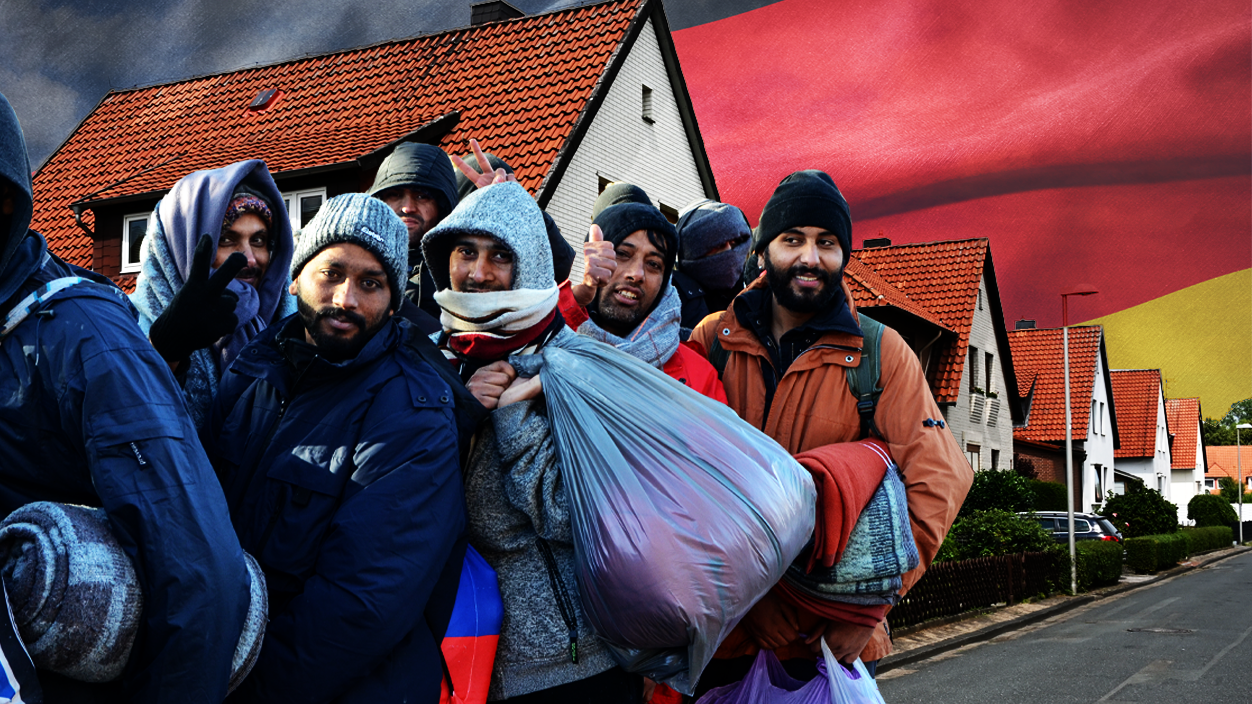
In 2025, more than 370,000 individuals from non-EU nations arrived in Germany via the asylum process, family reunification initiatives, and various admission schemes, according to official government data. The Alternative for Germany (AfD) is sharply criticizing this development, indicating it amounts to the equivalent of a major German city in terms of population.
Remix News initially reported that 300,000 migrants were taken into Germany last year at the end of December 2025; however, this new official number of 370,000 appears to be much higher. It also applies to only non-EU migrants, whereas the total migration figure is likely much higher.
Critiquing these figures, AfD MP Sebastian Münzenmaier told German outlet Nius: “(Interior Minister Alexander) Dobrindt’s alleged asylum policy turnaround turns out, upon closer inspection, to be nothing more than a sleight of hand.”
“At least 300,000 social migrants and so-called refugees, more like 400,000, in one year: that’s equivalent to a major German city. Anyone who fantasizes about a turnaround in view of this magnitude wants to deceive the citizens.“
He added that there will only be a real turnaround “when more migrants leave than arrive.”
Regarding how people came, initial asylum requests for the previous year totaled 113,236. This represents the lowest volume since 2020, when 102,581 applications were recorded, and is less than half of the 229,751 applications seen the year prior.
For context, 329,120 people sought asylum for the first time in 2023. The government is touting this figure while ignoring that the overall numbers are still extremely high, mainly due to legal migration.
Federal Interior Minister Alexander Dobrindt (CSU) stated: “We are managing migration with clarity and consistency. Those who have no right to protection should not come – those who commit crimes must leave. The clear signal from Germany that migration policy in Europe has changed has been received worldwide.”
EU-wide decline in asylum seekers
This downturn in asylum seekers is not unique to Germany; it reflects a broader trend across the European Union. During the first nine months of 2025, EU-wide applications dropped by roughly 27 percent compared to the same timeframe in 2024. Certain nations, including Bulgaria and Cyprus, saw even steeper declines exceeding 60 percent.
Meanwhile, immigration for the purpose of family reunification remains at steady levels.
Diplomatic outposts under the German Foreign Office, led by Johann Wadephul (CDU), processed 110,400 visas for family reunification. When asked for comment, the Foreign Ministry informed NIUS that: “The most frequently represented countries were Turkey, Syria, India, Kosovo, and Albania.”
In 2024, family reunification accounted for 123,675 arrivals, meaning last year’s levels were nearly maintained. A June parliamentary decision to pause family reunification for individuals with subsidiary protection for two years, effective July 24, 2025, had a negligible impact on these figures. To qualify for these visas, sponsors must typically possess a valid residency permit, adequate housing, and independent financial means.
Looking at the broader historical context since 2015, approximately 2.8 million individuals have applied for asylum, while 1.2 million have arrived through family channels, totaling 4 million migrants.
Notably, the polling now shows that Germans are increasingly wary of more migration after a decade of millions coming. A majority of Germans say that they would support an immigration moratorium and also believe that too many legal migrants have arrived, according to a YouGov poll conducted last month.
A majority of Germans, 57 percent, believe that too many people have entered the country legally, with only a quarter of respondents considering the numbers appropriate.
When it comes to illegal immigrants, Germans are even more likely to be opposed. The poll showed that 81 percent of Germans state that illegal immigration was “far too high” or “rather too high” over the last 10 years. Only 5 percent view the levels as appropriate.
Another 75 percent say illegal migration has been bad for Germany.
Resettlement and humanitarian initiatives
Beyond the standard asylum and family paths, other entry routes are also playing a role in Germany’s immigration system.
In response to a query from AfD deputy Sebastian Münzenmaier, the government noted that: “As part of the Federal Reception Program for Afghanistan, a total of 1,137 people entered Germany between January 1 and December 31, 2025.”
Additionally, “a total of 1,093 people entered Germany in 2025 through the resettlement procedure (pursuant to Section 23 Paragraph 4 of the Residence Act).”
The arrival of people fleeing the conflict in Ukraine also persisted throughout 2025. The Federal Office for Migration and Refugees (BAMF) confirmed to Nius that 145,222 individuals entered the country under Section 24 of the Residence Act between January and December.
Nius tallied the various figures, including 113,236 asylum seekers, 110,400 family visas, 1,137 Afghan arrivals, 1,093 resettlement participants, and at least 145,222 Ukrainian refugees. The total immigration from third countries reached at least 371,088 people.
Furthermore, roughly 50,000 people enter Germany annually via the Western Balkans Regulation. This specific pathway allows citizens from Albania, Bosnia and Herzegovina, Kosovo, North Macedonia, Montenegro, and Serbia to obtain residency based on a job offer, regardless of formal qualifications. According to the Federal Employment Agency: “Due to high demand, the quota for 2025 has already been fully exhausted.”