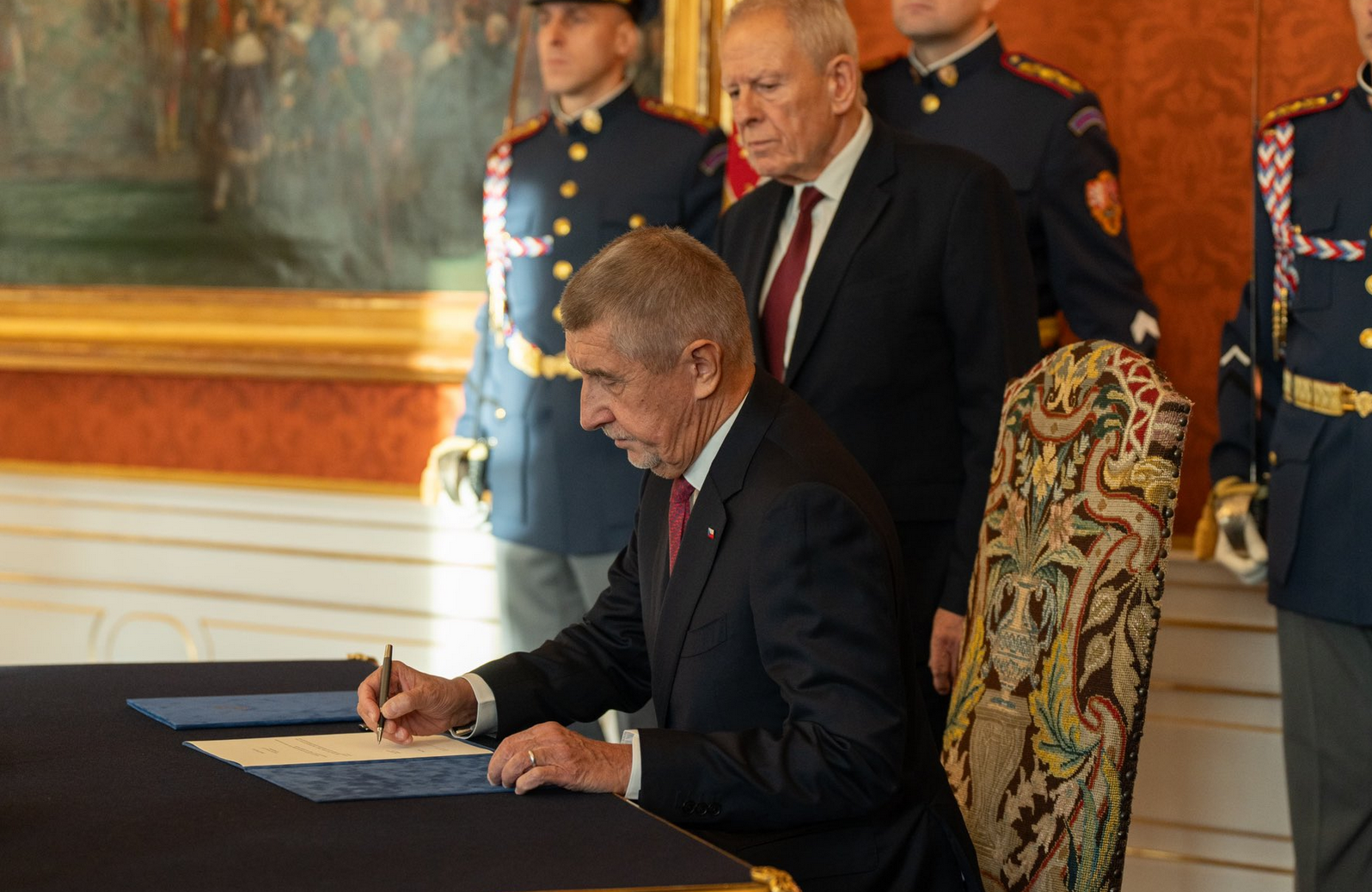
Czech President Petr Pavel appointed ANO leader Andrej Babiš as prime minister on Tuesday at Prague Castle, returning the billionaire-turned-politician to the helm of government less than four years after he left office.
It is his third time leading a Czech administration. Pavel is expected to appoint the remaining ministers early next week, drawn from ANO, the Freedom and Direct Democracy (SPD) movement, and the Motorists party, after the trio agreed to a coalition government following October’s elections.
Shortly after receiving the mandate, Babiš took to social media to express his gratitude. “I have been appointed prime minister. I value this greatly, as well as the trust of the citizens, which they gave us in the elections,” he wrote. “I promise to do everything to ensure we do not betray that trust and fulfill the programmatic declaration of our government. I promise to be a prime minister who defends the interests of all our citizens at home and in the world, and a prime minister who will work to make the Czech Republic the best place to live on the entire planet.”
Byl jsem jmenován premiérem. Velmi si toho vážím, stejně jako důvěry občanů, kterou nám ve volbách dali. Slibuji, že udělám vše pro to, abychom tu důvěru nezklamali a plnili programové prohlášení naší vlády. Slibuji, že budu premiérem, který hájí zájmy všech našich občanů doma i… pic.twitter.com/303u0rasLp
— Andrej Babiš (@AndrejBabis) December 9, 2025President Pavel, in turn, warned of a difficult term ahead. He said the Czech Republic faces “a security and economic context that is not easy,” with problems that “will not be pleasant to the public.” He added that the country would need “vision” and “courage,” while stressing that Prague must not question its commitments to the European Union and NATO.
Pavel also welcomed Babiš’s public declaration of how he plans to resolve his longstanding conflict-of-interest issue linked to ownership structures around Agrofert, the huge Czech conglomerate involved in agriculture, chemicals, food production, and media. Czech and EU conflict-of-interest rules say a prime minister cannot control companies that receive state or EU subsidies because they would be in a position to influence decisions that financially benefit their own business. Pavel said he expects the matter to be settled within 30 days.
Among the notable figures present at Tuesday’s ceremony was Tünde Bartha, a former close associate of Babiš who previously headed the Government Office and assisted in his presidential campaign. According to Echo24, Bartha is expected to return to her former senior role.
Babiš also submitted to the Czech president the proposed list of cabinet ministers. The only missing name was Motorists MP Filip Turk, whom Babiš said was currently unable to serve due to health reasons. Officials working for the president will confirm the final date of the cabinet’s formal appointment, with Babiš noting that the timeline is being expedited ahead of an important EU summit at the end of next week.
“In December, Brussels will be very active, and we would like to take part in it,” he said.
Babiš’s return is widely expected to unsettle relations with EU institutions. He has repeatedly vowed that his government will resist the EU Migration Pact, challenge the Green Deal’s climate and energy measures, and oppose continued large-scale financial support for Ukraine. His new coalition partners from SPD and Motorists share similar positions, setting up renewed clashes with Brussels just as the EU prepares major decisions on budget, energy, and migration policy for 2026 and beyond.
He is likely to find allies in fellow Visegrád nations, with both Hungarian Prime Minister Viktor Orbán and his Slovak counterpart, Robert Fico, having long been at loggerheads with the European Commission on the aforementioned issues.