

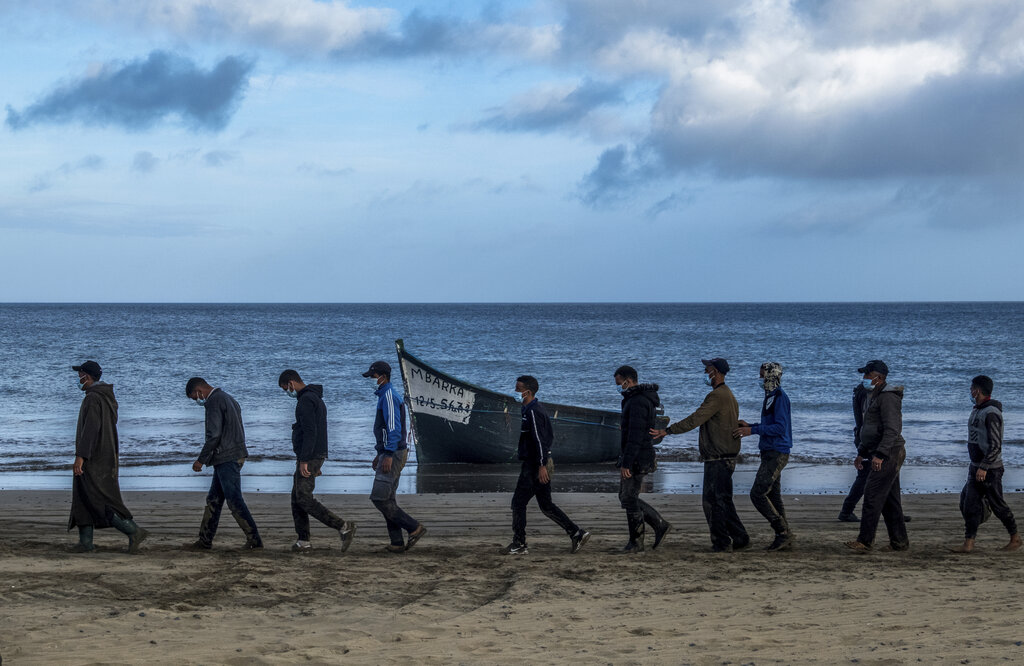
A European Parliament fact-finding mission to the Canary Islands has revealed that around half of migrants who claimed to be unaccompanied minors upon arrival were ultimately determined to be adults.
The Committee on Petitions conducted the visit in September 2025 to assess the impact of illegal immigration on the Spanish archipelago. According to a draft report from earlier this month, prosecutors informed MEPs that “among approximately 1,500 unaccompanied minors whose age was not clear and who were subjected to age-assessment procedures at their arrival to the adult reception centers, around half of them were ultimately determined to be adults.”
The report also acknowledged systemic weaknesses in the initial screening process, stating that “initial assessments by police are often inaccurate, leading to some being misplaced in the wrong center before their age is confirmed.”
The scale of arrivals remains significant. By Aug. 31, 2025, 201 boats had reached the Canary Islands in that year carrying 12,249 migrants, including 9,955 men, 782 women, 192 minors traveling with parents, and 1,320 unaccompanied minors. Authorities recorded 629 individuals whose age was in doubt, and officials noted that 92 percent of arrivals were male.
This aligns with the findings from across Europe. In 2023, Frontex data indicated that exactly 92 percent of illegal migrants were males, with that number being remarkably stable over the years.
Crime and public safety were repeatedly raised during the mission. MEP Sebastian Kruis questioned why migrants appear statistically overrepresented in prison figures, asking “the reasons why, in proportionate terms, an immigrant has a 1.5 times higher chance of being in prison,” as in the Canary Islands, migrants represent 31 percent of inmates but they only account for 22 percent of the total population.
“There has been an increase in criminality following the arrival of unaccompanied minors, with offenses committed mainly against them,” the report states. However, it continues to explain that these offenses are predominantly “fights, insults, and sexual assaults, occurring mainly within reception centers,” meaning that while offenses may be committed against migrants, they are also being committed by them.
Neighborhood representatives in La Isleta, near the Canarias 50 reception center in Las Palmas, told MEPs they had experienced a growing “feeling of insecurity.”
The report also detailed the difficulty of prosecuting smuggling networks. In 2024, 282 preliminary investigations were opened in relation to boat arrivals, yet 97 percent were provisionally suspended due to a lack of identified perpetrators.
On returns, authorities said expulsions to Morocco are limited because many arrivals lack documentation, and Morocco does not process papers for undocumented nationals. It was noted that 92 percent of repatriation requests by Spain are rejected by Rabat.
Maritime Rescue representatives stated they “did not carry out interceptions of vessels” and were limited to search-and-rescue operations within Spain’s area of responsibility, which often results in migrants being brought ashore in Spain even when their point of departure is known.
In the report, Dutch MEP Sebastian Kruis of the Patriots for Europe (PfE) group argued that he had experienced a “big difference between the presentations given by official representatives and NGOs and what the people from the districts close to the reception centers and the news are saying about incidents concerning migrants.”