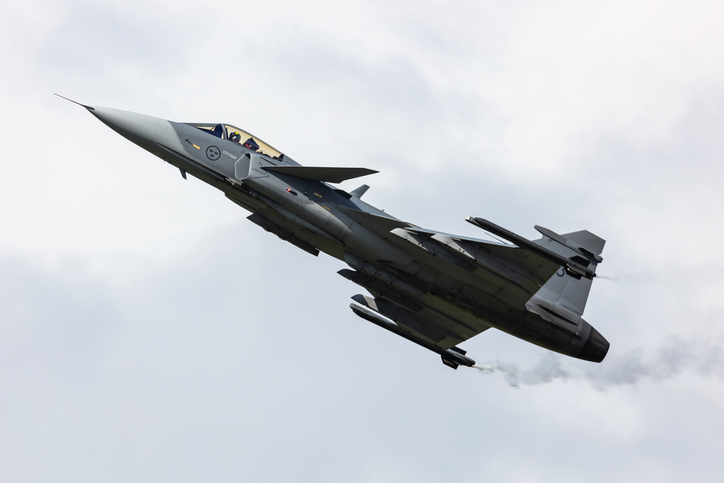
Sweden has presented a fresh proposal to Czechia to extend the lease of JAS 39 Gripen fighter jets, offering what Czech officials describe as a “significantly more advantageous” deal after months of tough negotiations.
Under the new terms, the Czech military would continue operating the Swedish-made Gripens until 2035 with a slightly reduced fleet of 12 aircraft — down from the current 14.
The package, valued at CZK 16.65 billion (€662.4 million), covers the cost of leasing, maintenance, and pilot training.
Lubor Koudelka, director general of the armaments and acquisitions section at the Czech Ministry of Defense, noted that negotiations over the cost of the lease secured a roughly 25 percent discount compared to initial offers. “This is an option that is significantly more advantageous for the Czech Republic,” Koudelka stated.
According to Echo24, the Czech Air Force currently operates 12 single-seat and 2 two-seat Gripens. The new agreement would retain the two-seat configuration but adjust the single-seat count to 10. The ageing fleet’s maintenance demands have driven up expenses associated with the lease, however. The aircraft have been in service for nearly two decades and require increasingly complex upkeep to remain operational.
The defense ministry noted that rising global labor and material costs in military aviation have also influenced the offer. “The contract reflects price developments over the past years, which have significantly exceeded the long-term average,” the ministry added, clarifying that Sweden extended similar terms to Czechia as it does to its own air force.
“Even with a lower number of aircraft, we will be able to perform the tasks of protecting the airspace of the Czech Republic,” said Commander of the Czech Air Force, Petr Čepelka, as cited by the Czech news outlet.
Defense officials are seeking to finalize the agreement before obtaining full government approval to proceed.
The Gripens are considered to be a stop-gap arrangement and are set to remain in service until they are gradually phased out by the U.S.-made F-35 Lightning II aircraft procured by the Czech government in September 2023.
Prague committed to purchasing 24 F-35s in a €4.2 billion deal, which includes the aircraft, equipment, training, and lifetime support. Including base upgrades and additional infrastructure, the total cost is projected to reach nearly €6 billion — the largest military procurement in the country’s history.
“This is a fundamental technological leap for the development of the army and also for the Czech economy and the academic and technological sphere,” said Prime Minister Petr Fiala when announcing their procurement.
The first F-35s are expected to be ready for delivery by 2029, with full deployment anticipated by 2035.
Fiala has recently emphasized the need for NATO members to ramp up defense budgets beyond the current 2 percent of GDP expected from members of the alliance due to increasing global security challenges.
In 2024, the country allocated 166.8 billion crowns (€6.6 billion) for defense, representing 2.09 percent of GDP, according to the Ministry of Defense.
“Two percent is the minimum today, but not all states even meet that. We need to discuss whether higher spending is necessary and feasible,” Fiala said back in January.
The Czech prime minister may not be around for much longer to oversee the budget, however, with elections taking place later this year and the opposition ANO movement, led by former prime minister Andrej Babiš, in pole position to resume in office.