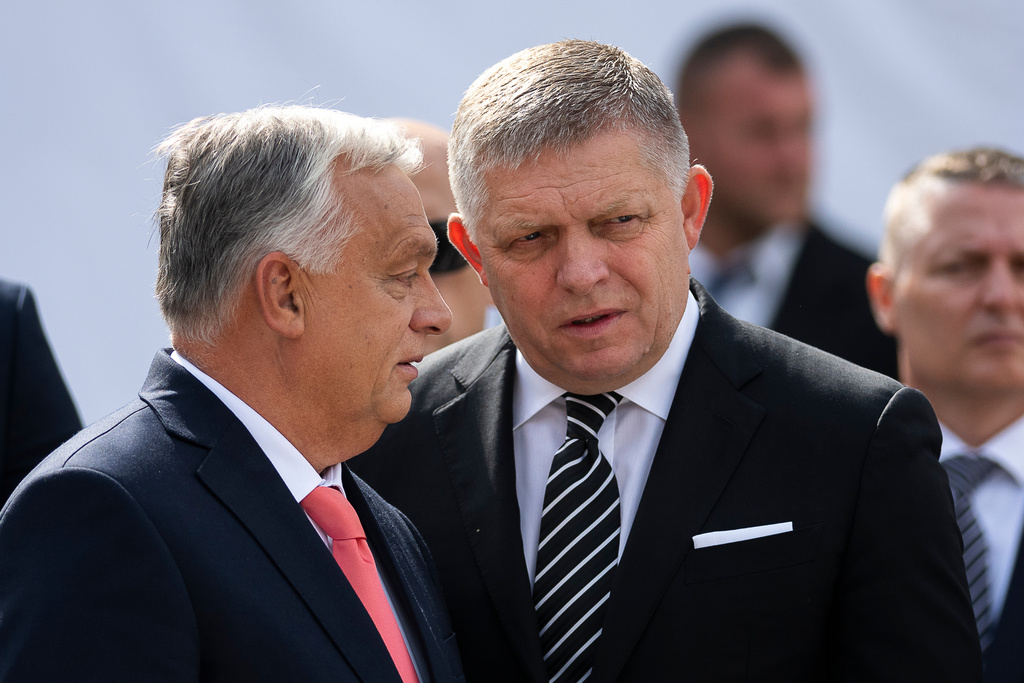
Slovakia is obliged to stop taking over Russian gas by Nov. 1, 2027, at the latest, and according to Slovak Prime Minister Robert Fico, the EU decision to ban all gas from member states amounts to “energy suicide.” As a result, Bratislava will file a lawsuit at the Court of Justice of the European Union (ECJ) against the newly adopted regulations.
On Monday, the Council of the European Union and the European Parliament formally adopted the new legislation on the gradual phase-out of Russian gas and oil imports. The move is part of the REPowerEU plan, which aims to become independent from Russian energy carriers.
Fico immediately criticized the move, calling it “energy suicide,” and said that “when the military conflict ends, everyone will be breaking their legs, rushing to go to Russia to do business.”
Fico announced that Slovakia will file a lawsuit against the adopted regulation at the Court of Justice of the European Union based in Luxembourg, writes Hlavnespravy.sk.
According to Fico, the country will argue that the regulation violates the principles of subsidiarity and proportionality. He added that the Slovak Ministry of Justice, together with the portfolio responsible for foreign and European affairs, had prepared a “very professional document” and that they would be asking for the regulation to be declared contrary to the basic principles of the EU.
Fico also announced that Hungary, which voted against the legislation together with Slovakia, is also filing a lawsuit. It is not possible to file a joint action, but the argument is coordinated with the Hungarian side.
Fico says the war in Ukraine will be over by Nov. 1, 2027, “and everyone comes to their sense.” He believed that detaching from Russian energy in this way was suicide, and that not only he, but also German economists, politicians, and other EU politicians see it that way. According to his claim, the decision was made on a meaningless, ideological basis, due to hatred towards the Russian Federation.
Fico has long called for a ceasefire in the war, leading some to criticize his position in the conflict. However, his point about Russian energy has been echoed across the political spectrum in Europe, especially during a time when European nations feel threatened by the U.S.’s increasingly dominant position in supplying Europe’s energy needs. If the U.S. were to decide to curtail liquified natural gas (LNG) deliveries, for instance, it could be disastrous for Europe.
Fico also criticized the fact that the decree was adopted by a qualified majority. According to him, the European Commission has circumvented the principle of unanimity, which should be applied in the event of sanctions. The Slovak prime minister assessed this as a violation of the basic principles of the EU treaties. Increasingly, decisions on immigration, foreign policy, and a range of other issues are being taken by “qualified majority,” but since the EU cannot reach this, it is now violating the founding treaties to pass through its agenda.
He also warned that Slovakia could find itself in a situation where the energy carrier concerned would not be sufficient due to the regulation. As he puts it, “one dependency will be replaced by another”, and Europe will have to obtain even higher quantities of liquefied gas from the United States.
According to Fico, Slovakia has already suffered significant damage when the transit of Russian gas on the territory of the country stopped. According to him, this was caused by the decision of the Ukrainian president and meant a loss of up to €500 million per year due to the lack of transit fees.
As reported in Hungarian outlet Hirado.hu, the situation of European gas supply continues to deteriorate after the Arctic cold in the United States significantly reduced LNG production. Due to the extreme frosts, American gas production decreased by about 11 percent, and prices more than doubled, while domestic consumption increased sharply. There is fear that exports, including shipments to Europe, may also decline.
The European market is particularly vulnerable, as the filling of gas reservoirs has already fallen below 45 percent and is in danger of falling below 25 percent.
In Germany, reservoirs are already under 41 percent filled and incoming LNG is used immediately, which means that strategic reserves are barely formed. All of this means price increases are coming at a time when the EU is urging complete separation from Russian natural gas.
The development of the situation depends crucially on how long the extreme cold lasts in the United States and when LNG plants can return to normal operation.