

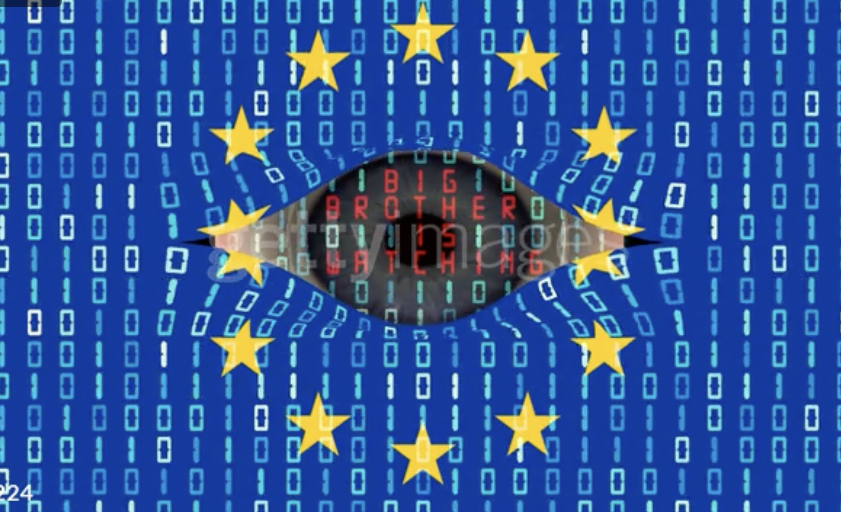
It is odd that in the face of Brussels going after Hungary and refusing the country funds owed to it due to measures it has taken to protect children, the EU has now decided to push legislation that would give it the power to view and seize your private online conversations — in the name of protecting children.
Denmark is leading the charge, as it is the presiding EU president, but it is Germany’s veto that will be needed to push “chat control” through, come the vote on Oct. 14, writes Welt.
So will Berlin heed the warnings from multiple fronts regarding the threat such a law would pose to data privacy, not to mention efforts to secure the ever-expanding cyberspace?
As pointed out by Welt, the chat histories of police officers, soldiers, and intelligence agents would be exempt from this law, exacerbating concerns that chat control will be abused by those in power to spy on civilians and create a Big Brother scenario.
The idea for such a measure started with EU Home Affairs Commissioner Ylva Johansson. She tabled the law to combat the proliferation of child pornography online back in 2022 by essentially allowing authorities to look at all private conversations. “A noble intention, one that nevertheless met with considerable resistance from internet companies, civil rights activists, and digital experts,” writes Welt.
Device manufacturers and chat service providers have been ardent objectors, as they would be required to allow authorities “backdoor” access to view chats that people trust feature end-to-end encryption.
Johansson had brushed aside any concerns over what she dismissed as nothing more than a “spam filter.”
Here’s the problem: To allow such a “backdoor,” i.e., a way to break into and view encrypted messages to uncover child abusers, would expose EU civilians to other third parties with truly nefarious intentions. In other words, people could far more easily fall victim to financial fraud, personal data theft, blackmail, be spied on by foreign agencies, or simply become the target of their own government for political purposes.
A version of this project has been tried before — with disappointing results, according to Welt. “Client-side scanning” allowed chat providers to perform automated checks to flag anything suspicious. Only then would a message be sent for human review at a reporting center.
The result was a deluge of reports, with as many as 90 percent unrelated to any criminal activity, while actual red flags (situations where children could have been in real danger) were often overlooked.
As the law is now up for a vote this month, a warning from a group of 478 digital researchers from across the EU is pertinent: “It is simply not possible to detect known and emerging abuse images among hundreds of millions of users with an acceptable level of accuracy, regardless of the respective filter.”
The current proposal, they say, would “create unprecedented opportunities for surveillance, control, and censorship and carries an inherent risk of abuse by less democratic regimes.”
Will Cathcart, the CEO of WhatsApp, trusted by over 3 billion users for its default end-to-end encryption, posted his own warning on X on Oct 3: “The latest EU Presidency proposal still breaks end-to-end encryption, risking everyone’s privacy and security — a view shared by experts from over 30 countries. We continue to urge EU countries to stand up for stronger security for their citizens and reject this proposal.”
He followed up on Oct. 6 by stating: “The current EU presidency proposal that leaked today would do away with end-to-end encryption as we know it, leading to a major compromise of people’s privacy. We urge everyone working on this issue to reject the latest proposal and stand up for people’s privacy.”
Meanwhile, Signal has threatened to leave the EU, with Signal CEO Meredith Whitacker releasing a letter on Oct. 3 stating: “We are alarmed by reports that Germany is on the verge of a catastrophic about-face, reversing its longstanding and principled opposition to the EU’s Chat Control proposal.”
“In a very real way it could spell the end of the right to privacy in Europe,” Whitacker warns, then sends a stern message to Germany.
“Germany has long been a champion for privacy; drawing on its own history of the terrible harm that can be facilitated by mass surveillance and standing firm to safeguard this right for all of Europe. To capitulate now, at a time of great geopolitical uncertainty where the cybersecurity of our core infrastructures matters more than ever, would be an incomprehensible strategic blunder, and a fundamental betrayal of Europe’s commitment to learn from history.”
“Under the guise of protecting children, the latest Chat Control proposals would require mass scanning of every message, photo, and video on a person’s device, assessing these via a government-mandated database or AI model to determine whether they are permissible content or not,” she writes.
Proper encryption, i.e., data privacy, has been a massive selling point for app/software makers, creating a huge ecosystem of B2B and B2D cybersecurity solutions for both the enterprise and consumer markets. Thus, during a live interview with Tesla Owners of Silicon Valley last summer, when updating users on X DMs, Elon Musk boasted about the new X Chat, emphasizing, “Even if somebody puts a gun to my head, I still can’t read your messages.”
In the end, the decision on chat users in the EU losing the right to private online communication all comes down to Germany, Welt reiterates, and how Chancellor Merz decides to position his government.
The German Federal Office for Information Security (BSI) has been blunt in its criticism: “Every breach of E2E encryption increases the attack surface and carries high risks,” they warn.
Unfortunately, as Welt points out, the BSI stance is in direct contradiction to the Interior Ministry, to which the BSI reports, while the Justice Ministry opposes it.