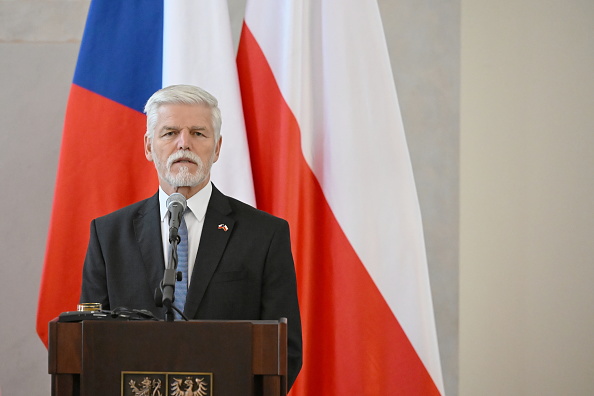
Europe will inevitably need a new security arrangement with Russia after the Ukraine war — but only once Moscow accepts peace on terms that respect sovereignty, Czech President Petr Pavel has said in a recent interview with The Sunday Times.
“If we are to think about any future relations with Russia, they can only start after there is a peace agreement and during a process that would lead to a new security arrangement in Europe,” Pavel said. “I believe we cannot avoid it. There will be a moment where we will have to negotiate with Russia a new arrangement.”
Pavel said the recent U.S.-Russia peace talks proposing territorial concessions in Ukraine reminded him of the Munich Agreement that helped dismantle pre-war Czechoslovakia, drawing parallels with the appeasement strategy adopted at the time by the West. “If we allow Russia to come out of this conflict as a victor, we have all lost,” he warned, adding that Russian President Vladimir Putin’s justification for the invasion echoed the Nazi use of the Sudeten German minority as a pretext in 1938.
“For Czechoslovakia, the German minority was used as a pretext. The same narrative is being used by Vladimir Putin.”
He rejected the idea that the West was betraying Ukraine outright, but accused it of faltering in its commitment to its own principles. “What we are doing now, I wouldn’t call it a betrayal of Ukraine,” he said. “I would call it reluctance — reluctance to protect the principles we all claim to protect.”
His position appears to have changed somewhat since August, when the Czech president told the CTK news agency that Ukraine would probably have to give up territory.
“The surrender of territory would reflect the situation on the battlefield and represent the lesser evil, as opposed to continuing the war, which would result in numerous new casualties and material losses,” Pavel said at the time.
A former chair of NATO’s military committee, Pavel told The Sunday Times that Russian aircraft and drones repeatedly violating allied airspace were part of a deliberate campaign to assess NATO’s willingness to act. He argued that the alliance may soon need to respond more forcefully.
“I believe there will be a moment, if these violations continue, where we will have to use stronger measures, including potentially shooting down a Russian airplane or drones,” he said. “Russia wouldn’t allow repeated violations of its airspace. And we have to do the same.”
“These violations are deliberate, well-planned, and focused on several objectives,” he added. “One of them is to show that Russia can do it. Another is to test our air-defense system. But it is also testing our resolve to act in self-defense.”
Concerned about President Trump’s shifts in U.S. policy, Pavel said Europe must be ready to defend itself if Washington redirects resources elsewhere. “We shouldn’t dissolve in any way the power of NATO and its deterrent effect,” he said. “But if there is a situation where the United States would be busy elsewhere, Asia-Pacific, for example, and they wouldn’t have enough will or resources to support European allies … we in Europe should be able to do it on our own.”
Rather than duplicating U.S. capabilities, he proposed strengthening the “European pillar” within NATO, including shared command structures that could transfer leadership to European officers if needed. Larger states such as Germany, he said, should form the backbone of these forces, with smaller countries contributing specialized units “to create European capabilities that can replace those of the United States in Europe, which would make us finally an equal partner to the United States.”
“Democratic countries are based on the same values,” Pavel said, arguing that backing Ukraine was not transactional but essential to European security. “Not closing our eyes and ears to what is going on in Ukraine.”
He warned that allowing Russia to prevail would embolden its use of hybrid attacks, including sabotage and arson, which he said Europe is already facing. “We simply cannot let Ukraine lose this conflict,” he said. “The threat of violence, airspace violations, arson, or other hybrid attacks would only increase.”
Pavel said any post-war settlement should resemble an updated version of the 1975 Helsinki Accords, requiring Russia to recognize territorial sovereignty and abide by enforceable limits on its behavior. “Such a negotiation will have to be led with two equal sides,” he said. “Not Russia imposing on us, but rather coming to an agreement that will recreate, somehow, the situation which we had in the late 70s.”