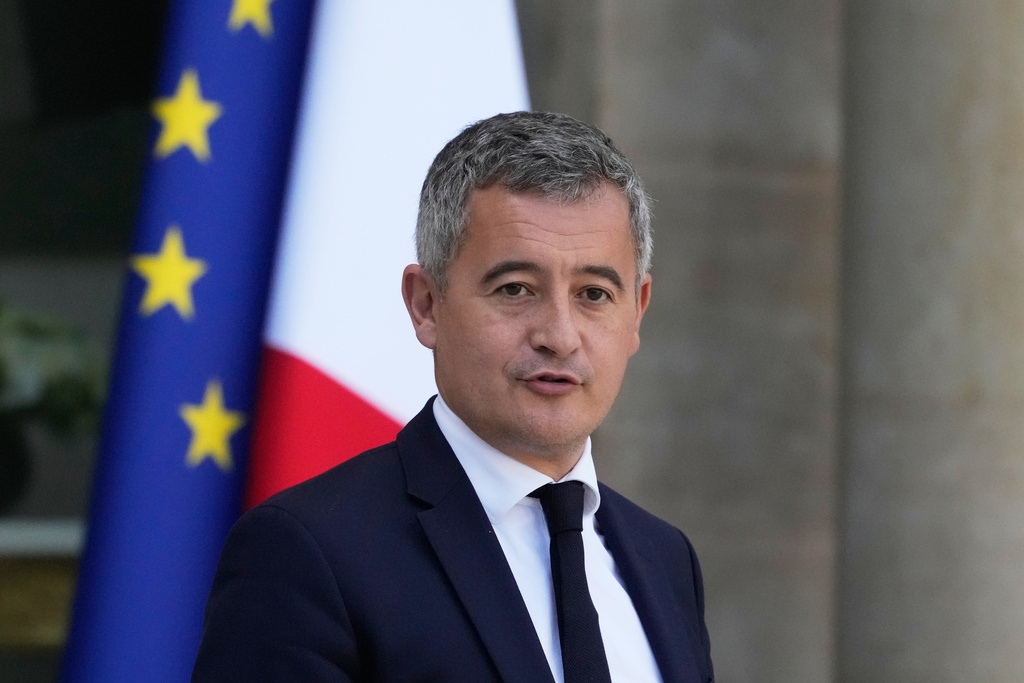
As the French presidential election approaches, current Minister of Justice Gerald Darmanin is proposing a suspension of immigration for two to three years. Widely seen as a politician close to the establishment and French President Emmanuel Macron, his proposal is being viewed with skepticism but also as a sign of where the wind is blowing across Europe on the issue of migration.
Let’s imagine a suspension of immigration for 2-3 years,” he said, which would involve
“legal immigration, therefore family reunification, and work immigration.” The minister adds that this measure would not apply to everyone, and “we can find some exceptions, notably for doctors, for researchers, for some students.”
Following this immigratioon suspension, France would establish an immigration quota policy, the volume of which would be defined in a French referendum.
The move has already been met with a certain level of cynicism given the context of upcoming elections. Poland’s Confederation party leader, Krzysztof Bosak, analyzed the proposal on X.
We Francji polityk głębokiego mainstreamu, minister sprawiedliwości Gérald Darmanin, proponuje zatrzymanie legalnej imigracji na 2–3 lata, a następnie ustalania w referendum jej skali. Taka propozycja pokazuje dwie kwestie.
Po pierwsze, skala problemu migracyjnego stała się tak…
— Krzysztof Bosak 🇵🇱 (@krzysztofbosak) January 27, 2026
“In France, a politician from the deep mainstream, Minister of Justice Gérald Darmanin, proposes halting legal immigration for 2–3 years, and then determining its scale through a referendum.
Such a proposal highlights two issues. First, the scale of the migration problem has become so obvious that even establishment politicians are no longer able to ignore it, especially under the constant pressure from political forces opposing mass immigration. As we can see, this pressure makes sense and is shifting the public discourse closer to the positions of national and sovereigntist circles. The fact that such ideas are being voiced by a member of the current government shows the extent of the shift in the previous narrative.
Second, this kind of proposal from a French minister is certainly a shock to the Brussels establishment and the Eurocratic consensus, which for years has remained far removed from any restrictions on immigration.
These are solutions that no one expected from mainstream politicians loyal to the dominant line in the EU. In the end, it’s worth keeping some distance. Most likely, this is a tactical proposal, calculated to build his position ahead of the 2027 presidential election, rather than a genuine intention to implement it. But it is also worth noting because in Poland, apart from Confederation, politicians from other parties cannot even imagine articulating such solutions in public debate, let alone attempting to put them into practice.”
French news outlet Europe1 also ran a column looking at Darmanin’s proposal also pointing out that this remains a mere proposal, one that is being made in mind with looming elections ahead.
“Even if he insists on a central bloc primary, Gérald Darmanin proposes stopping immigration for two or three years. How to interpret this exit of the former Minister of the Interior? The 2027 presidential election, Gerald Darmanin is thinking about it,” writes the paper.
The outlet adds that “If he is not officially a candidate, if he does not yet have a program, he has many proposals. A debate which consists of saying, for example, let’s imagine a suspension of immigration for two or three years. One could imagine that. It’s one more point for Gérald Darmanin who seeks to differentiate himself from Édouard Philippe and of Gabriel Attal, 15 months before the next presidential election.”
However, Macron also promised to reduce immigration, with numbers reaching records year after year.
Last year, demographic researcher and data analyst Marc Vanguard reported that “the foreign population in France is growing FOUR times faster than the population of French nationality.”
The rapid demographic change has led academics, researchers, literary figures, and politicians to dub this trend the Great Replacement.
In 2022, famed French author Michel Houellebecq came out and said the Great Replacement is a “fact” during a wide-ranging discussion with influential French philosopher Michel Onfray.
“The Great Replacement, I was shocked it’s called a theory. It’s not a theory, it’s a fact,” said Houellebecq. “When it comes to immigration, nobody controls anything; that’s the whole problem. Europe will be swept away by this cataclysm.”
Notably, the vast majority of the French want serious immigration restrictions put in place, while a tremendous 53 percent of women want zero immigration into the country, according to polling.