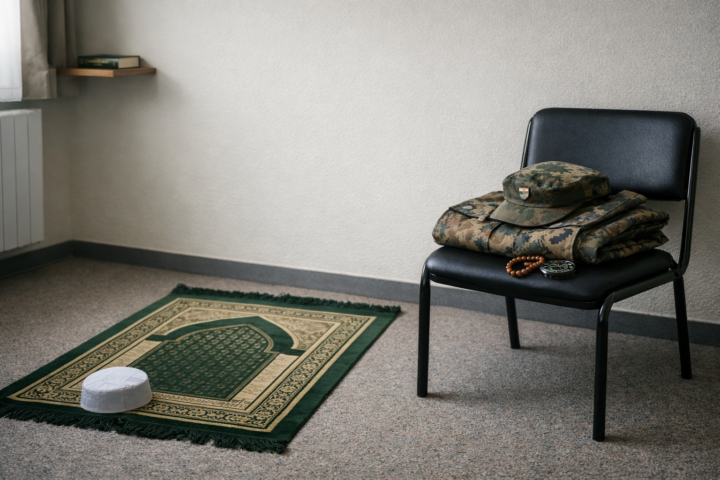
The German Armed Forces are preparing to deploy their first Muslim chaplains under a pilot project scheduled to begin in early 2026, according to reporting by NDR.
Under the plan, the Ministry of Defense will issue a public tender to recruit the first military imams, who will initially work only within Germany. The chaplains would be distributed across different regions and provide pastoral support to Muslim soldiers as required.
“With the 3,000 Muslim soldiers we now have, it is also important for us to acknowledge this diversity and to create a dedicated pastoral care service for Muslim soldiers,” said Colonel Thorsten Weber from the Ministry of Defense last month. He said the initial focus would be on gaining experience domestically before any consideration of overseas deployments.
The figure of 3,000 Muslim soldiers employed in the Bundeswehr is an estimate, with personnel not obliged to reveal their religious affiliation. This represents about 1.64 percent of its 182,667 active personnel as of 2025. While Christian and Jewish chaplaincies are fully institutionalized through state treaties that allow access to barracks and overseas missions, no equivalent arrangement exists for Muslims.
Although the pilot project is described as open-ended, it stops short of fully institutionalizing Muslim military chaplaincy. Some legal experts argue that this caution is unnecessary. Benedikt Plesker, a lawyer at the law firm Lenz and Johlen, told NDR, “I do think that a permanent military chaplaincy can be offered on a contractual basis. In my opinion, a state treaty isn’t necessary for that. It’s really more a question of political will and funding. Because it’s also clear that without proper funding, all attempts will remain stuck in the pilot project phase.”
The debate has gained renewed urgency amid broader discussions about manpower and the reintroduction of compulsory military service. In December last year, the Frankfurter Allgemeine Zeitung reported comments by Ali Mete, spokesperson for the Coordination Council of Muslims, who addressed the question of Muslim participation in the Bundeswehr. “As citizens, they should at least consider it,” Mete said, adding that the final decision was a matter of personal conscience.
From a theological perspective, Mete argued that serving the state in which one lives can be a religious obligation. “Muslims are expected to bear responsibility for society, and this includes military service if it serves to protect and maintain peace,” he said. At the same time, he stressed the need for fair conditions and respect for freedom of religion, calling for qualified imams, prayer spaces, pastoral care, and management training to ensure sensitivity to religious diversity.
The absence of a Muslim chaplaincy has been highlighted repeatedly in official reports. The issue appeared in the Parliamentary Commissioner for the Armed Forces’ report as early as 2016 and was again described as “unsatisfactory” in the 2024 annual report by then-Commissioner Eva Högl. That report noted that the Ministry of Defense had at least advanced preparations for establishing such a service during the reporting year.
Last month, a spokesperson for the Ministry of Defense said the program was “logical” and would foster a “respectful and inclusive environment.”