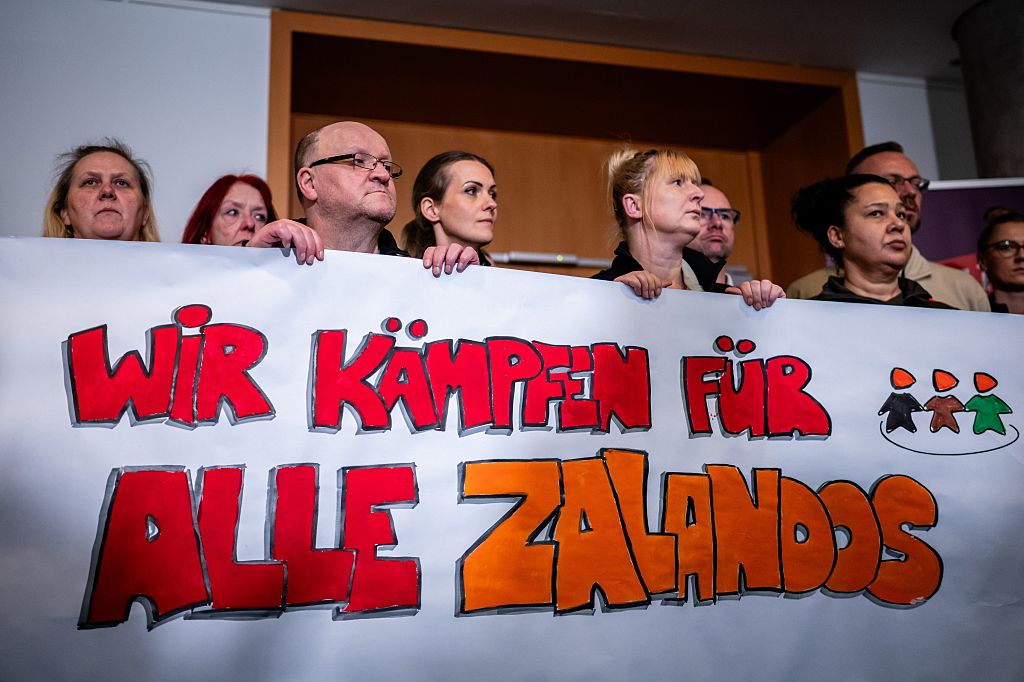
Zalando, a major employer in the German city of Erfurt is closing its local site, raising the question of who is responsible when corporations make such decisions despite receiving millions in taxpayer money over the years. The Alternative for Germany (AfD) is now speaking of a system that privatizes profits, hires primarily foreigners, and then places the social burden on the German taxpayer.
The Zalando logistics center has approximately 2,700 employees and an additional 300 external workers, but they now face likely layoffs as the site is being closed down. Zalando, a major online clothing retailer, is the largest private employer in the city, and the state of Thuringia has supported the logistics site with millions for years.
AfD member of the Bundestag Robert Teske sees the announced closure as a strategy seen with many corporations, according to Austrian outlet Freilich Magazine.
“We see a large corporation that generates billions in revenue and yet has been funded with a seven-figure sum of taxpayers’ money to create jobs,“ the MP said in a social media post.
He stated that despite receiving funding from the local state government, Zalando moved to hire workers from abroad. With the coming layoffs, these workers may now fall into the social safety net provided by Germany.
According to the works council, people from 62 nations are employed at the Erfurt center. Notably, Thuringia is one of the states that is most ethnically homogenous and has a very low rate of immigration compared to the rest of Germany. However, only 38 percent of the workforce are even German citizens.
Many employees come from Poland and Romania, where they can earn in euros and then send money back home that can go further in terms of purchasing power than in Germany. In addition, there are many people from Afghanistan and Syria.
Teske sees the approach as a system that repeats itself over and over again. He calls it a “well-known model“ of corporations to “abuse foreigners as wage-crushing workers and then send them to the welfare state.“
He said this is not a “social market economy,“ but pure “profit maximization“ at the expense of Germany.
Indeed, when companies open sites in Europe, they usually demand a pool of cheap labor, with foreigners often recruited from abroad. These workers are also seen as far less likely to organize and are used to working for lower wages and worse conditions. Additionally, even with these lower wages, they often have an incentive to work in euros, as this money can be transferred home via remittances.
Previous studies have also shown that foreigners drive down wages for Germans. When remittances are factored in, it makes it even harder for a German family to survive on the same salary compared to a foreign worker.
Logistic hubs like Zalando’s are seen across Europe and employ tens of thousands of foreigners; however, these sites are rapidly being automated. In the future, warehouses and logistics hubs may have little to no humans working in them, raising questions about what happens to these people after automation slowly replaces them.
Remix News addresses this automation wave and how Asian countries like China are winning the innovation race with nearly zero immigration. Instead, they are choosing AI and robotics to fuel their edge.