
The Covid-19 crisis may seem like ages ago, but massive fraud cases related to Covid-19 testing continue to reverberate through the German court system. Three recent cases illustrate how much was stolen from German taxpayers.
In all three cases, they appear to be German citizens with a foreign background, although in the third case, the only evidence to support the claim is that the suspect fleeing to Turkey. No name of the suspect has been released in court records, which makes this finding impossible to ascertain at this time.
Iyhab S.
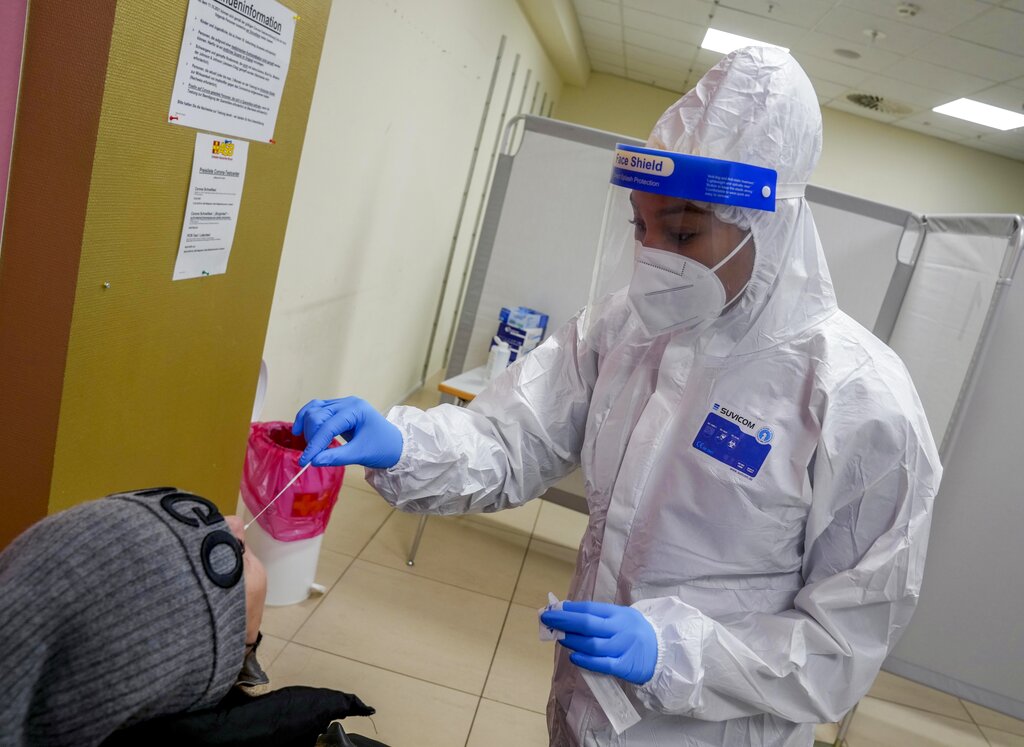
In the first case, earlier this month, the Hanover District Court sentenced a 27-year-old operator Iyhab S. to three years and five months in prison. Iyhab S., whose first name means “gift” in Arabic, defrauded the public of exactly €1,642,505 through a small testing center located in a backyard in Hanover-Anderten.
Between March and December 2022, he collected these funds for tests that the public prosecutor’s office determined were almost entirely never conducted in the city of Anderten, according to German outlet HAZ.
At the start of his trial, his lawyer, Michael Nagel, stated that all the charges are accurate.
“The allegations are true,” his lawyer, Michael Nagel, said to start the trial at the Hanover District Court.
His lawyer explained that his client had spent the money on luxury travel and cars in Monaco and Dubai, stayed in expensive hotels, and bought high-end goods.
Judge Laurin Osterwold, while delivering his verdict, pointed to the man’s luxury lifestyle, stating: “Gucci, Louis Vuitton, the whole shebang.”
The investigation into Iyhab S. uncovered clumsily manipulated data sets where the same 326 people were recorded as being tested in the exact same order on consecutive days, or individuals were shown as being tested multiple times within a single minute.
A police data expert testified that this was technically impossible.
While the defendant claimed to live off family support and have no knowledge of his business’s insolvency, investigators noted he had withdrawn €500,000 in cash. The court also highlighted a suspiciously low positivity rate of 0.04 percent compared to the regional average of 2.7 percent.
“I am very sorry for how far things have come. I wish I could undo it, the judge suspected the money had been passed to a criminal organization,” said Iyhab S.
Can G.
This case mirrors the fraud committed by 27-year-old Can G.,, whose first name means “soul” in Turkish, who operated testing centers in Groß-Buchholz and Herrenhausen.
He was sentenced to two years and seven months in prison for illegally obtaining €968,333.03 of which at least €877,058.33 was considered overbilled.
Similar to the other cases, a data expert found impossible sequences of names and instances where a person tested negative three times within three minutes. The prosecutor argued that anyone who falsifies the billing should not earn anything, demanding the confiscation of the entire sum.
Can G.’s defense team claimed their client could not repay the money because he and his fiancée had been robbed of up to €600,000 by armed assailants in late 2022.
“I deeply regret everything,” said Can G.
However, Judge Osterwold dismissed the robbery story as a tall tale. This specific robbery was allegedly linked to the operator of other testing centers, further suggesting a network of interconnected fraud.
According to the Association of Statutory Health Insurance Physicians of Lower Saxony, approximately 40 testing center operators have been reported for fraud, with total estimated damages reaching around €18 million.
Suspect fled to Turkey
In a separate instance of crisis-related white-collar crime, a 28-year-old man from Gifhorn was apprehended at Berlin Airport after fleeing to Turkey to escape an investigation into a testing station in Braunschweig’s Bürgerpark, according to HAZ.
He is alleged to have embezzled approximately €475,000 by billing for 90,000 tests when he had only documented 10,000 through his software.
In one instance, he submitted invoices for 861 tests on two days when only 17 were actually conducted.
Even as investigations began, the suspect attempted to bill for another €390,000 in fake tests, though this amount was never paid out. Following an international arrest warrant, the man was arrested in October 2025 upon his return to Germany and is currently in pretrial detention.