Germany is facing the cumulative effects of three crises involving war, energy, and raw materials. As a result of not taking action 15 years ago, Europe’s economic powerhouse finds itself in the grip of both the United States and China regarding the energy market and raw material extraction. This is the analysis set forth by Berliner Zeitung.
Germany’s economy has hit a “dead end,” the German portal argues, for three primary reasons. First off, Germany lacks a strategy to access critical raw materials needed to boost its economy, which could lead to Chinese dominance in the sector.
Secondly, the Merz government continued the ideologically motivated energy policy of Robert Habeck and the traffic light coalition without question, rendering Germany vulnerable to American energy imports.
Lastly, Germany allowed itself to be dragged into wars that were not its own, both the Russian-Ukrainian war and the Iranian war.
The country’s previously established green energy policies have left Germany excessively dependent on the supply of American liquefied natural gas, which, the authors in Berliner Zeitung say, “is more expensive, more uncertain, and more politically subject to blackmail than Russian natural gas and crude oil imports.”
“The claim that Russian gas and oil are cheaper than their alternatives is treated as a political conspiracy theory in Berlin. Anyone who points out the obvious fact that Russian pipeline gas was cheaper than American or Qatari tanker-delivered LNG is simply told that they are pushing the Kremlin’s cart,” they write.
When Robert Habeck led the Federal Ministry for Economic Affairs and Climate Action under Chancellor Olaf Scholz, Germany also invested heavily in LNG terminals, building three in Wilhelmshaven, Brunsbüttel and Lubmin, all to ultimately benefit the U.S.
Monthly U.S. LNG exports increased from 1.7 billion cubic feet per day in January 2017 to more than 12 billion cubic feet per day after three years of war in Ukraine. Almost half of the Russian natural gas displaced from the EU market was replaced by American companies.
Patrick Pouyanne, the head of TotalEnergies, was quoted as saying in November 2025 that Donald Trump was trying to replace dependence on Russia with dependence on the U.S.
Since the outbreak of the war in 2022, Berlin has been supporting Ukraine with financial and military means, regardless of the composition of the government, as well as economic sanctions against Russia, including the ban on the import of cheap Russian oil starting in 2027. That is why the US-Israeli air campaign against the Iranian terrorist state that began in late February and early March, and the subsequent closure of the Strait of Hormuz, have hit Germany particularly hard.
“The Iran war has pushed energy and fuel prices to all-time highs, jeopardizing supply chains and fuel supplies, destroying the German tourism industry, and severely impacting German household savings,” writes the Berliner Zeitung.
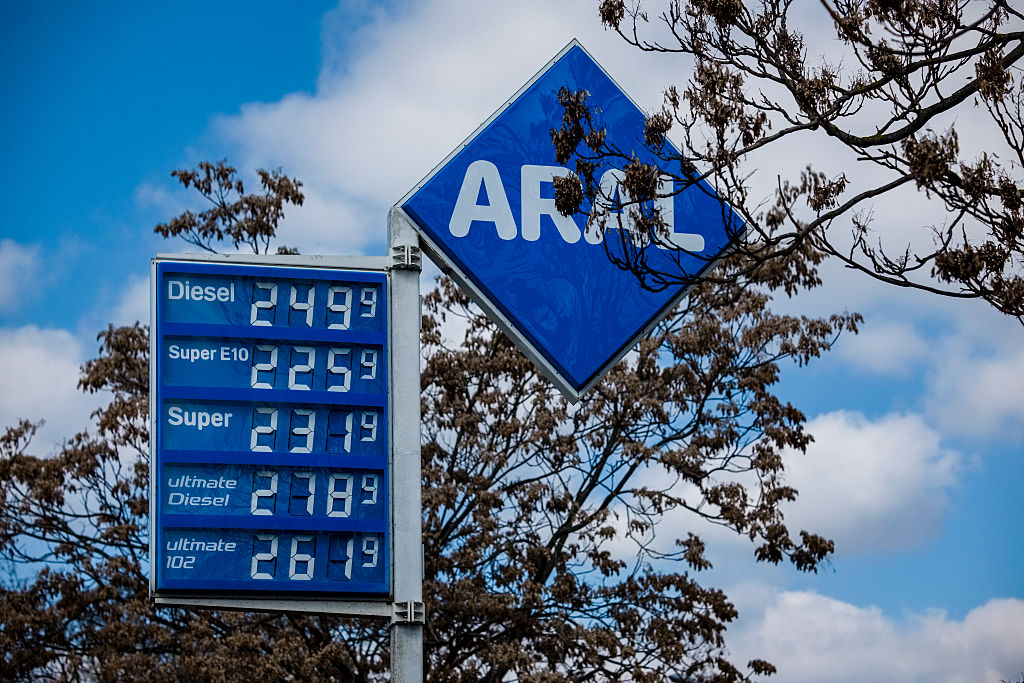
Diesel prices have risen to an all-time high. During the Easter weekend of 2026, a liter of diesel cost an average of €2.44. Super E10 fuel was around €2.19 per liter at German filling stations – far exceeding the wartime record prices of 2022. There are worries the price could still go higher.
A new German regulation imposed on gas stations mandates that they can only increase fuel prices once a day. But this provision has proven counterproductive, as oil companies are exploiting this opportunity to realize extra profits. The gas stations simply raise their prices once a day to a maximum price and slowly bring down the price over the course of the day. The federal government’s measures are therefore driving up prices, rather than bringing down fuel prices.
According to the BZ analysis, “Germany is in a bind – America is squeezing it in the energy market, China is squeezing it in the area of raw material extraction, and German defense capabilities are also at risk.”
Germany should have foreseen this 15 years ago, according to BZ.
“Unlike oil and gas, there are no German national reserves for critical mineral resources,” the portal states. Berlin should have a strategy already in place for access to raw materials, without which neither the energy transition, nor digitalization, nor defense capability is possible.
The EU’s list of critical raw materials currently includes 34 minerals, including lithium, cobalt, copper, rare earths, graphite, and nickel. Without these, there are no batteries, wind turbines, solar panels, digitalization, or defense capabilities.
The International Energy Agency predicts that global demand for critical minerals will increase almost sevenfold by 2030. The European Commission estimates that demand for lithium will increase 21-fold by 2050.
Germany does have lithium, but red tape is also an issue. German licensing procedures for mining are extremely slow, which means they are not producing their own lithium reserves. With zero domestic will to change this, China is further expanding its market dominance in the sector, including through targeted overcapacities that stifle any attempts to create alternative production sites at an early stage.
China has also responded to U.S. tariff policy by introducing export restrictions on rare earths and magnets, which has a direct impact on German companies, as they now have to apply for permits from the Chinese authorities without knowing whether they will receive them and, if so, when.