Greek farmers set up roadblocks across Greece on Wednesday as anger deepened over stalled EU aid, high production costs, and a corruption scandal affecting subsidy disbursements.
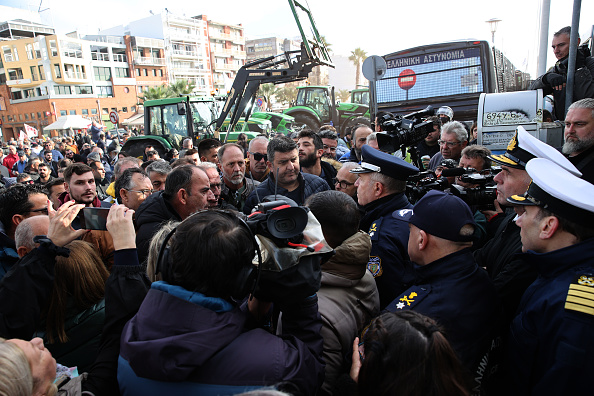
Farmers from Thessaly drove their tractors into the major commercial port of Volos, forming one of the most visible demonstrations in the nationwide protest movement. Large crowds filled the area as farmers demanded that the government address long-standing grievances over delayed European subsidies and rising production costs.
Heavy police forces were deployed around the port, including several riot police units. Authorities kept the gates closed and maintained a perimeter to prevent tractors from reaching the terminals.
Some farmers directed their frustration personally at Prime Minister Kyriakos Mitsotakis. As cited by the Ta Nea newspaper, one speaker told the crowd, “He should come here to see what is happening, to gather us and solve the problems, just as he used to gather the farmers in bales of straw and sit and tell them about the executive state.” Another farmer added, “We are the ones who voted for him,” expressing discontent at the delays in resolving key financial and regulatory issues.
Farmers from multiple blockades across Thessaly — including Nikaia, Platykambos, Karditsa, and Trikala — coordinated their march toward Volos early in the morning. Fishermen announced that they were preparing a parallel sea blockade.
Farmers, breeders, and fishermen unite in Volos, blocking the port with tractors and boats as they intensify their call for urgent agricultural reforms in Greece https://t.co/gYyp4Ntvd4
📸: Ayhan Mehmet pic.twitter.com/Y2pPOKbtHz
— Anadolu Images (@anadoluimages) December 10, 2025The organizers requested that riot police cages be removed from the site, saying they intended to protest peacefully. Trade unionist Christos Pantzios told local media, “We have a lot of people with us” and insisted farmers had “no intention of creating problems.”
Police officials said similar in a de-escalation of the events. General Police Regional Director of Thessaly told participants, “We have no intention of creating problems. However, there are specific instructions that we follow, and we must protect the basic infrastructure.”
The protests came after the Supreme Court intervened to remind authorities that offenses disrupting transportation safety could be prosecuted ex officio, that is, without the need for a formal criminal complaint.
Key highways across Greece remain blockaded, while other roads have been subject to daily one-hour shutdowns. Blockades also continued at four major customs offices on the North Macedonian border. Participants said they intended to escalate further despite warnings from the Supreme Court prosecutor.
Support for the movement expanded as residents, students, shopkeepers, lawyers, and doctors joined farmers at several sites.
According to Reporter.gr, farmers argue that unresolved subsidy delays, a major corruption investigation into falsified land titles, and the spread of sheep and goat pox — which has destroyed large herds — have created severe financial pressures.
“It’s a matter of survival,” Yannis Koukoutsis, a farmer from the central rural area of Larissa, told public broadcaster ERT. “We are looking for goodwill gestures from the government, including the cessation of tax debts.”
The government has acknowledged the delays and said additional payments would be released soon, but protesters insist their mobilization will continue until solutions are delivered.