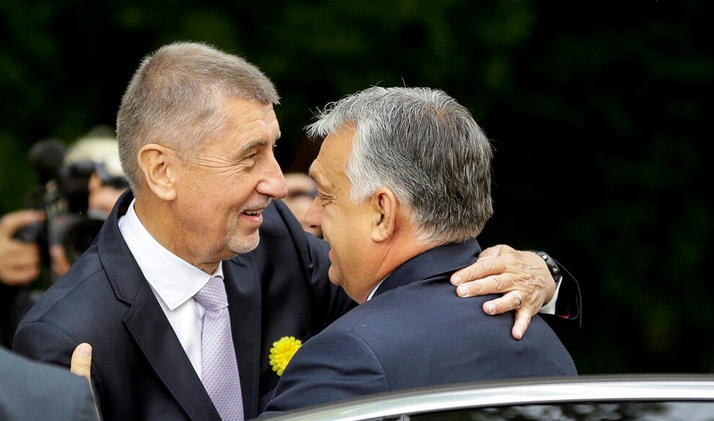
Czech Prime Minister Andrej Babiš praised his Hungarian counterpart Viktor Orbán in a wide-ranging interview with the Hungarian newspaper Mandiner, speaking favorably about Orbán’s leadership and political instincts as Hungary heads toward a hotly contested general election on April 12.
The interview, part of Mandiner’s Maximo program and conducted by the paper’s editor Zoltán Szalai, covered energy prices, inflation, EU policy, migration, Ukraine, and the future of the Visegrád alliance.
Throughout the conversation, Babiš repeatedly returned to Orbán as an example of a leader whose positions were initially attacked but later vindicated.
Referring directly to Hungary’s response to the 2015 migration crisis, Babiš said, “When Viktor Orbán took the first steps on migration in 2015, everyone criticized him.” He added that Europe later moved toward the same conclusions, arguing that Orbán had been proven right over time. “We lost a lot of time,” Babiš said, drawing a parallel between the migration crisis then and the current debates on energy security and wider economic policy regarding Ukraine.
Warning about the direction of the European Union, Babiš said, “If we do nothing, it will be a catastrophe… If we look at Germany, the previous German government damaged German industry. What has happened to European business is completely disconnected from reality. It is a huge problem not just for industry, but also for science and innovation.” He linked high energy prices to inflation, saying they were “the biggest problem,” and argued that EU policy had failed to protect industry and living standards.
Babiš embraced the populist label often used against leaders like himself and Orbán. “Populism is about people. I went into politics to make people’s lives better.” He presented this approach as legitimate and necessary, rejecting the idea that such politics should be dismissed as ideological.
The Czech prime minister also spoke positively about closer regional cooperation, calling for a renewed and stronger Visegrád-style alliance. “I think it should be strong again,” he said, adding that Hungary and Slovakia were natural partners for the Czech Republic in pushing back against policies decided in Brussels. “Hungary and Slovakia are very closely connected to us. When we are in Brussels, we must talk about Europe’s energy policies together.”
“We’ve cooperated excellently,” he added. “We fought together for the interests of our countries, with excellent results. I learned a lot from [Orbán] regarding European politics, and he probably learned a lot from me regarding financial matters. So, we complemented each other well, and that is why I wish him much success in the future, because Hungary is extremely important for the Czech Republic.”
On Ukraine and foreign policy, Babiš argued that Europe has largely sidelined itself. He suggested that the EU is unable to speak directly with Moscow, contrasting this with the role of the United States. He described Ukraine’s EU accession as “a political issue, not an objective one,” and warned about the scale of the financial burden involved in its reconstruction following any future peace deal.
“Europe cannot talk to Putin. The United States can. Trump talks to Putin, Europe talks to Zelensky, Zelensky talks to Trump. That is the reality. When Viktor Orbán spoke with Zelensky and then with Putin, he was heavily criticized. Now more and more people are saying that maybe it is necessary to talk,” Babiš said, warning that “without the United States, Europe will not be a player.”
The Czech prime minister warned that it would “not be possible to guarantee further loans to Ukraine,” warning that Brussels’ decision to further finance the war effort in Kyiv will result in “multi-billion euro damage” that will never fully be repaid.