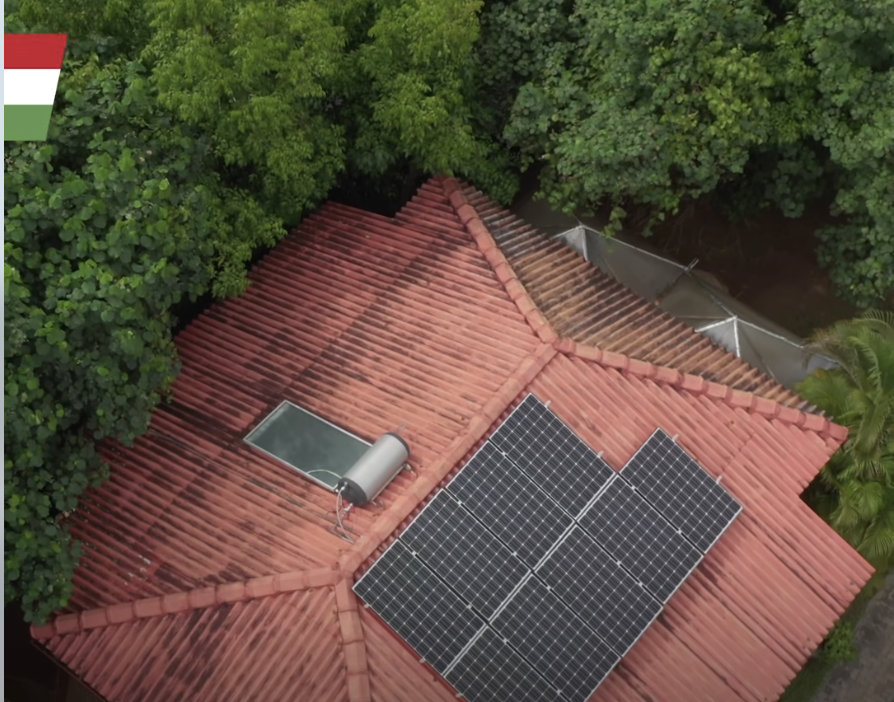
Hungarian Prime Minister Viktor Orbán has revealed that Hungary will once again offer incentives to families to use solar as their energy source. Like the previous Solar Energy Plus Program, which ended in January, this would entail individual family homes having their own solar panels to meet their energy needs.
Of course, as before, the issue of energy storage is still a challenge, and homeowners will need help paying for the storage batteries for this purpose.
In an interview with Economx earlier this month, Orbán said the government is “dividing and multiplying how to provide support to families to have batteries with which they can store the energy produced during the day.” According to the prime minister, this will affect hundreds of thousands of families and the state can “sweat out” the necessary resources for this, reports Mandiner.
Analysts at the Makronom Institute say that ideally, families would use the electricity generated during the day, but when the sun shines, a huge amount of electricity is produced — often much more than we can use immediately, creating a massive energy surplus.
Currently, around 310,000 households – single-family homes, townhouses and other privately owned properties – operate so-called “household solar power plants” in Hungary. These systems account for roughly a third of the country’s total solar energy generation capacity, and during their peak performance, when the sun is shining everywhere across the country and at high altitude, their production is equivalent to the emissions of today’s Paks nuclear power plant.
Just for comparison: Paks provided 47 percent of the country’s electricity production in 2024. However, since Hungary rarely uses this energy in full during sunny periods, it is critical to have some form of on-site energy storage.
In a recent interview with Mandiner, Hungarian Energy Minister Csaba Lajos Lantos had some stats to show how dedicated Hungary is to solar.
“Among the EU member states, Hungary had the third-highest increase in weather-dependent renewable capacity from 2019 to 2023. The domestic share of solar systems in electricity production was the third highest in the world and the second highest in Europe last year. With this, we are not only strengthening our self-sufficiency capabilities and energy sovereignty, but we are also making significant progress in fulfilling our climate commitments. While fossil-based energy production in Hungary decreased by 18 percent last year, that of solar power plants increased by one and a half times,” he told the portal.
In terms of the issue of storage, Lantos said that excess energy from family homes being dumped on the market can be avoided by way of on-site storage solutions, although there are no details yet as to how the new government program will help cover the cost of such batteries.