

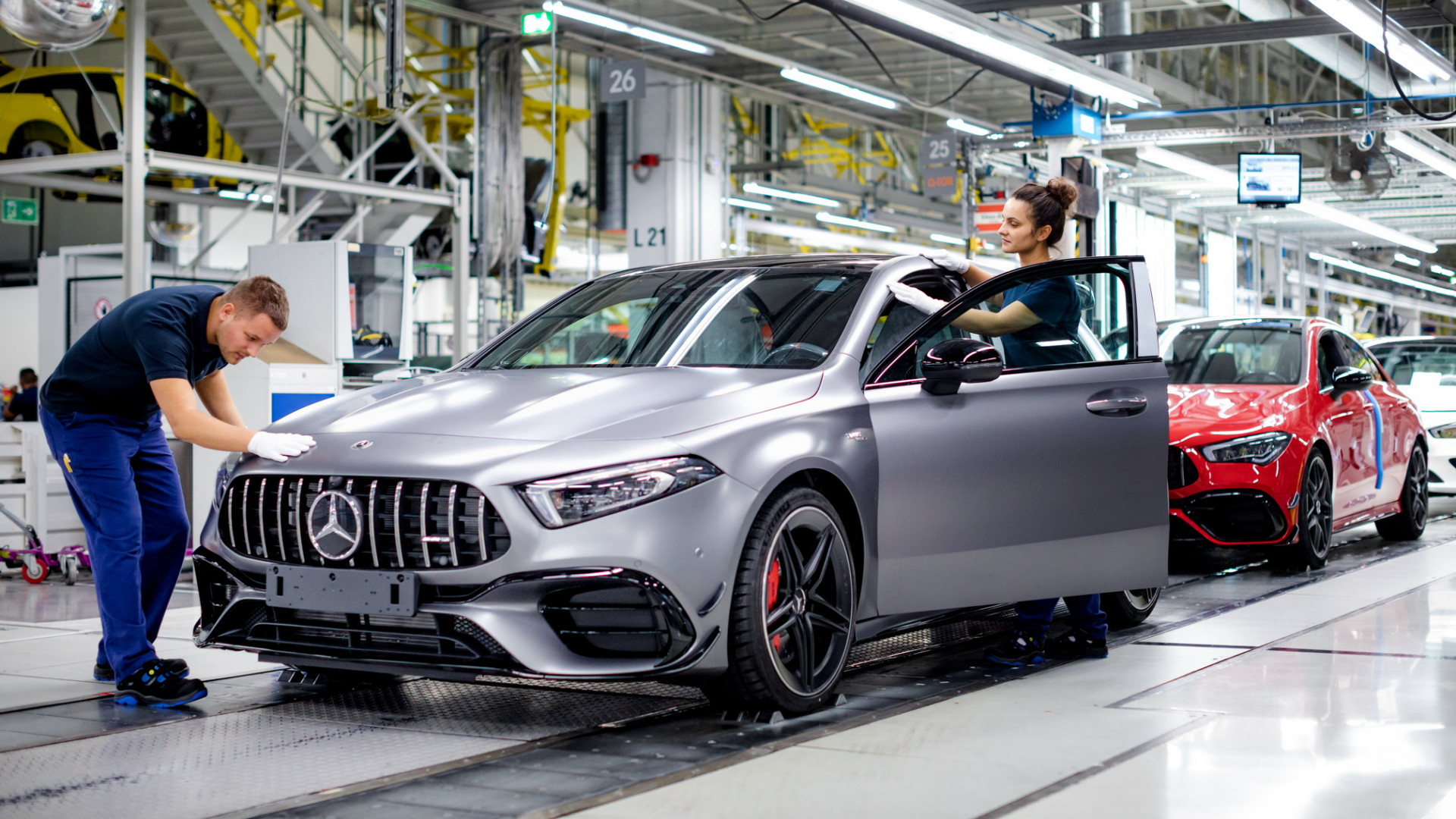
In yet another major blow to the German automobile labor market, Mercedes has announced it will be relocating production of its A-Class from Rastatt, Germany, to Kecskemét, Hungary. While Hungary’s foreign minister is taking a victory lap, Germany’s largest opposition party is sharply crticizing he government as signs grow that Germany’s automobile market is faltering.
Trade Minister Péter Szijjártó has officially confirmed Mercedes move, writes Budapester.
Szijjártó credited the success to “an economic policy based on sound common sense and a stable government that continually attracts new investment projects from global companies in America, Asia, and even Germany.”
However, the news is not being welcomed in Germany, with the Alternative for Germany (AfD) pointing out the dire economic situation the country is facing.
“Mercedes-Benz has stood for German engineering excellence and Germany’s economic upswing for decades. Yet, like many other automakers, the company is cutting jobs in Germany and expanding in other countries. As a result, the entire production of the A-Class is being relocated to Hungary. 20,000 employees are expected to lose their jobs as a result,” wrote AfD politician Christian Abel on X.
“This is a direct consequence of Friedrich Merz’s green climate and energy policies. To make Germany an attractive industrial location again, a genuine economic policy turnaround is needed through the termination of the energy transition, the combustion engine ban, the abolition of fleet emission limits, and the elimination of state-mandated reporting requirements. If this is not possible within the EU, Germany must seriously consider a Dexit,” he wrote.
His last comment has proven controversial in the AfD itself, with the mainline position that a Dexit will not be considered. In 2024, it was reported that AfD co-leader Weidel said she ruled out completely the idea that a Dexit, or exit of Germany from the EU, was possible.
Nevertheless, in 2023, the country lost a staggering 120,000 manufacturing jobs, highlighting serious problems.
However, Hungary, already a major manufacturing hub for German automobile producers, is now set to expand. Production of the A-Class is slated to begin at the Kecskemét plant as early as Q2, with production planned to continue until 2028.
“Hungary is demonstrating economic brilliance at a time when all of Europe is suffering from the consequences of the war in Ukraine and the misguided policies of the EU headquarters in Brussels,” Szijjártó wrote on social media.
Mercedes’ decision proves that investors embrace Hungary’s political stability, low taxes, and highly skilled workforce, with the Kecskemét plant its largest production site in Europe; only in China does the group have a larger capacity, notes Budapester.
Mercedes, named “Most Attractive Employer” in 2024, now directly employs more than 5,000 people in Hungary.
In October 2024, the plant celebrated the milestone of 2 million vehicles produced; in the future, the site will be able to manufacture both combustion engine cars and plug-in hybrids and all-electric vehicles.
Mercedes is also setting up its first R&D center in Hungary. With the relocation of A-Class production, the German automaker is now entrusting three models to the Hungarians, as the electric GLB and the new C-Class were already being built in Kecskemét.
Last December, Szijjártó also posted about new jobs in Szeged brought by Germany’s Rheinmetall as well. “Rheinmetall’s new hall has been completed, which means more than 300 new, highly skilled jobs in the city! Such investments contribute to Hungary becoming one of the most important European centers for future technologies, which is why we supported the German company’s 29 billion forint investment with 13 billion forints.”
The plant will produce high-tech components for both civil and defense applications, focusing on electromobility (e-mobility), hydrogen vehicles, and renewable energy power plants, alongside some military electronics. It’s Rheinmetall’s first major site outside Germany that combines civil and defense activities under one roof, creating jobs and positioning Hungary as a hub for future technologies.