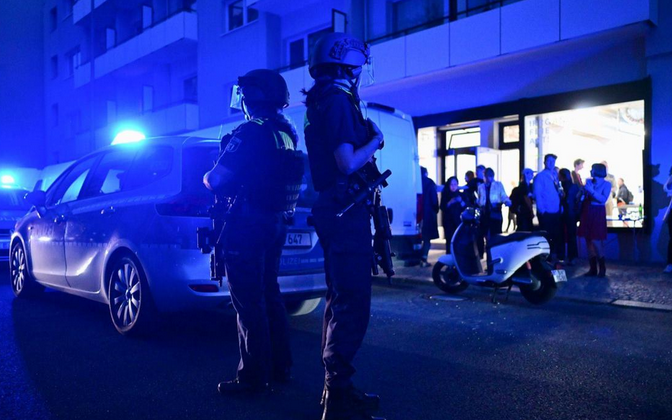
Police in Berlin say a new criminal network linked to migrant gangs is spreading fear across the German capital after a string of shootings, grenade attacks, and large-scale extortion attempts targeting local businesses.
Investigations reported by the broadcaster RBB’s political program Kontraste suggest the violence is connected to a group known as the “Daltons,” a network with roots in Turkey that authorities say has begun establishing itself in Germany.
Prosecutors are currently pursuing around 200 investigations linked to the group and similar criminal enterprises in Berlin.
Authorities say the gang primarily targets Kurdish asylum seekers for recruitment, who are allegedly drawn in through promises of money and status. Investigators believe some recruits were first approached in asylum centers before being used to carry out shootings and other attacks.
This modus operandi has been experienced in several other European nations, including the Netherlands, Belgium, and also Sweden, where the criminal network run by Rawa Majid — known as the Kurdish Fox — has terrorized the suburbs of Stockholm for years.
The crimes typically follow a clear pattern. Businesses receive large protection demands, sometimes reaching six-figure sums. If they refuse to pay, they are attacked.
One supermarket chain was reportedly threatened with a demand of €250,000. Shortly afterward, two of its stores were shot at. In another case, a 36-year-old man was shot seven times in the legs in the street. A bar in the Kreuzberg district was also attacked when masked individuals threw a hand grenade through a window.
Berlin’s justice senator Felor Badenberg warned that the campaign amounts to systematic intimidation targeting members of the Turkish-Kurdish business community.
“We are seeing a surge in crimes against shop owners from the Turkish-Kurdish cultural sphere. They are being pressured, intimidated, and in some cases, weapons are being used. The aim is to force them to pay protection money,” Badenberg said in comments reported by Kontraste.
Authorities say the gang represents a new generation of organized crime that operates far more openly than traditional mafia networks. Members frequently post videos and messages linked to violence on social media, openly boasting about their activities.
“They are completely unconcerned,” Berlin police spokesman Florian Nath said, describing how the group’s use of firearms and violence is far more brazen than earlier criminal networks in the city.
Investigators trace the origins of the group to Istanbul, where criminal gangs with similar names — including the “Caspers,” the “Smurfs,” and the “Daltons” — have been linked to dozens of murders in recent years.
Turkish authorities have attempted to dismantle the networks through large-scale arrests. In December last year, more than 300 alleged members of the Daltons, including many minors, appeared in court in connection with a sweeping crackdown.
But investigators say some senior figures fled abroad, and the groups have since expanded their activities into Europe.
Authorities believe the Berlin underworld has become even more volatile following the death in January of Mehmet K., a prominent organized crime figure nicknamed “Kurdish Mehmet.” His funeral drew large numbers of figures from the city’s criminal scene and required around 500 police officers to maintain order.
“All hell is breaking loose in Berlin now,” one associated told the German broadcaster. “Everyone wants to make a name for themselves. I think things will get worse from now on, because Mehmet Abi is gone, and he was the one who made sure everything here went smoothly.”
Investigators say the alleged leader of the Daltons, Berat Can Gökdemir — known as “Can Dalton” — is believed to be outside Germany. Turkish prosecutors accuse him of involvement in numerous violent crimes and say he faces potential prison sentences totaling more than 1,000 years.
Berlin police warn that the gang’s international connections mean the problem cannot be solved locally. Police president Barbara Slowik Meisel said authorities are now seeking stronger cooperation with European partners.
“We are dealing with structures that operate across several countries and recruit internationally,” she said.