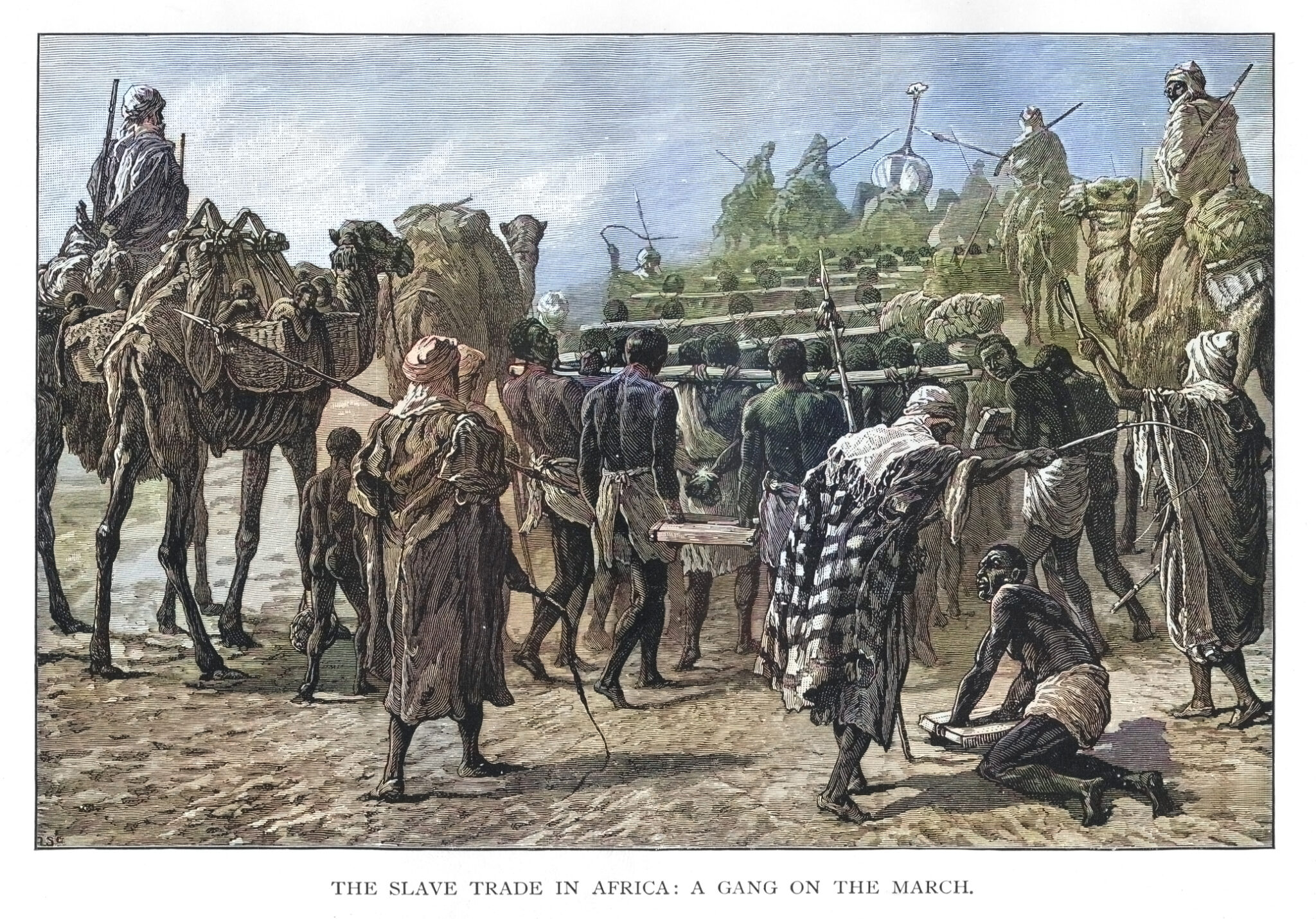
In a piece in Le Figaro Histoire entitled “Why do we never talk about the responsibility of Africans in the enslavement of their own people?” Marie-Claude Mosimann-Barbier calls for Africans to acknowledge the role they played in the slave trade “as suppliers, intermediaries, or organizers.” She also calls upon Western institutions such as the United Nations, to stop skirting the issue.
The article comes in the wake of the UN General Assembly resolution adopted last month that designated the Atlantic slave trade and its involvement in the slavery of Africans as “the most serious crime against humanity.” According to a UN statement, it seeks an order that “confronts historical truth while building mechanisms for equitable futures.”
However, the clear involvement by various African and Middle Eastern nations in the African slave trade continues to be “taboo,” often disallowed from the conversation entirely, writes Mosimann-Barbier, who is an honorary lecturer at the École normale supérieure de Paris-Saclay, member of the GRER (research group on racism and eugenics) at Paris-Cité University.
As Mosimann-Barbier points out, “since the beginnings of the trans-Saharan slave trade in the 7th century, Africans had been selling slaves to Arab Muslims,” and as demand grew from the New World centuries later, ethnic Africans happily met it.
“Long before the arrival of Europeans and the development of the Atlantic slave trade, internal slavery was a structural reality in most African societies,” she writes.
The Arab slave trade involved the enslavement of approximately 1 million White Europeans across Europe’s vast coastline. There was also ample involvement of the Arabs and Persians in the African slave trade.
According to scholars, any non-Muslim could be enslaved according to Islamic doctrine, and prior to the 20th century, the number of slaves numbered between 12 and 15 million, which substantially dwarfs the number of slaves in the United States, which reached 4 million at its height.
Even in the modern era, there are an estimated 40 million slaves worldwide, and almost none of these slave networks exist in Western nations.
What Mosimann-Barbier says is most alarming is that the resolution was the brainchild of President of Ghana John Mahama, who demanded reparations, formal apologies from slave-trading nations, and the return of looted cultural artifacts to address the lasting, systemic inequalities of slavery. Mosimann-Barbier notes that the Ashanti Kingdom, located in present-day Ghana, were one of the ethnic groups responsible for enslaving and selling slaves. Congo, Cameroon, Benin, and Nigeria were other nations known to have been home to active slave traders, ethnic Africans. She also noted the very robust slave (and ivory) trade in East Africa, run by Arab-Muslims.
In 2006, the government of Ghana did formally apologize for the role it played in slavery, encouraging other African nations to do the same. Another public apology came in 2022, made by the head of the Obokese University of Excellence to the African diaspora at a UN event.
“Ghana’s claim seems somewhat surreal: how can the seller absolve themselves of all responsibility in the trade and place the entire burden on the buyer?” However, Mosimann-Barbier asks:
A day before the vote, President John Mahama said: “This resolution is a safeguard against forgetting.”
Recently, Ferghane Azihari, columnist for Figaro Magazine and author of the new book “Islam against Modernity,” pointed out that slavery was widespread outside of Europe and remained widespread after it ended in Europe.
🌐"Why does the decline of slavery in Islamic lands owe almost everything to Western colonial intervention?"@FerghaneA challenges former government spokesperson Sibeth Ndiaye on the lack of democracy in the lands of Islam and its history of slavery.
"It was the French who… pic.twitter.com/2bpZkH4Yfl
— Remix News & Views (@RMXnews) February 3, 2026“Before Western colonization, most Muslim societies were totally authoritarian, stratified societies, which were, moreover, slave-owning societies that practised slavery in proportions sometimes higher than those we find in the United States. The Sokoto Caliphate in what is now Nigeria was one of the largest slave-owning societies of its time. What we need to remember is that these societies were incapable of abolishing slavery on their own initiative.
In another interview, he stated: “”It was the French who forced the Algerians to give up the slave trade, as it was known at the time, in 1848. It was the French who closed the slave markets in Morocco…I’m not saying that Islam has a monopoly on slavery. I’m telling you that unlike the West, Islam has not been able to challenge this institution. The slave trade, madam, is an invention of Islam. It was the Muslims who invented the first slave circuit. And why have they never been able to challenge it?”
🌐"Why does the decline of slavery in Islamic lands owe almost everything to Western colonial intervention?"@FerghaneA challenges former government spokesperson Sibeth Ndiaye on the lack of democracy in the lands of Islam and its history of slavery.
"It was the French who… pic.twitter.com/2bpZkH4Yfl
— Remix News & Views (@RMXnews) February 3, 2026