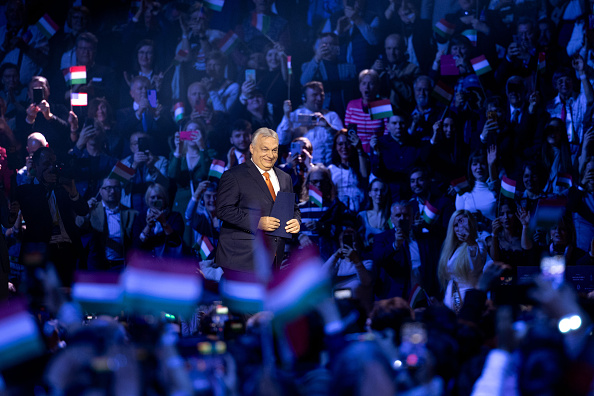
Hungarian Prime Minister Viktor Orbán has issued a stark warning ahead of Sunday’s parliamentary election, telling voters the country faces a decisive moment that will determine its future.
In a campaign video released Friday morning, Orbán said Hungarians would be choosing “not just a government, but the fate of the country,” pointing to what he described as 16 years of stability under his leadership. He cited key achievements, including job creation, pension increases, and the construction of border barriers to halt illegal immigration.
“We could now lose everything we have built together,” Orbán warned.
The prime minister also accused his political opponents of working with foreign actors to destabilize the vote, claiming that outside forces were attempting to influence the outcome through allegations of election fraud and by organizing protests. He described the situation as an “organized attempt” to challenge the will of Hungarian voters through pressure and unrest.
The election campaign has descended into entrenched warfare, with little actual debate between the two main parties of Fidesz and Tisza, and plenty of mud-slinging and accusations of foreign interference from both camps. Fidesz claims to have evidence of Ukrainian and EU interference, while Tisza has accused the Hungarian government of cozying up to Moscow.
Calling for unity, Orbán urged supporters to mobilize in the final days of campaigning, stressing that “this is not the time for division, anger, or hatred.” He is scheduled to hold final campaign events in Székesfehérvár and Budapest before polls open on April 12.
The Hungarian leader has also received high-profile backing from abroad. Former U.S. President Donald Trump publicly endorsed Orbán on social media, describing him as “a truly strong and determined leader” with “a proven record of outstanding results.”
Trump praised Orbán’s record on economic growth, job creation, and immigration control, and urged Hungarian voters to support his reelection, writing that he “fully” backed the prime minister and calling him “a true friend, a fighter, and a winner.”
The endorsement follows a recent visit to Budapest by U.S. Vice President J. D. Vance, who criticized Brussels for what he described as unprecedented interference in Hungary’s election process.
Support has also come from prominent European right-wing figures. France’s Marine Le Pen praised Orbán’s stance on the war in Ukraine, saying his position was “very brave” and arguing that peace efforts must take priority to end what she described as a “human massacre.”
Italy’s Deputy Prime Minister Matteo Salvini framed the Hungarian election as a broader contest over Europe’s future, contrasting a vision of centralized EU control with one emphasizing national sovereignty and independence from Brussels.
Backing has additionally been voiced by Alice Weidel, co-leader of Germany’s Alternative for Germany (AfD) party.
Hungary’s parliamentary election is expected to draw close international scrutiny, with observers across Europe and the United States watching closely. While the majority of opinion polls suggest a popular vote victory for the opposition, Hungary’s electoral system means that overall vote share does not always translate directly into parliamentary seats, and polling in the country is often viewed as politically partisan.