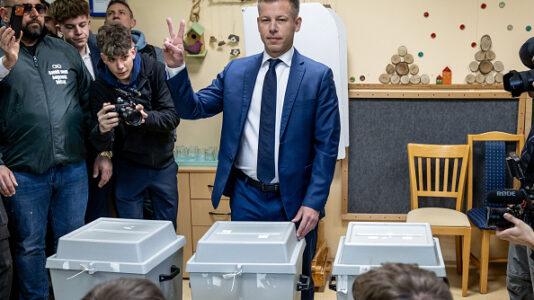


Polish conservative politicians granted refuge in Hungary are facing the prospect of extradition after Péter Magyar secured a decisive election victory, immediately raising tensions over the fate of high-profile exiles.
During the campaign, Magyar made clear that individuals such as Zbigniew Ziobro and his deputy Marcin Romanowski — both of whom had been granted asylum under the outgoing government — could be handed over to Polish authorities.
“If they’re still here when the Tisza government is formed, we will extradite them on the first day,” Magyar said in a widely shared interview clip from the election campaign, a remark now taking on a real threat following his victory.
Orbán’s rival Péter Magyar said that his government would extradite Polish fugitives—former justice minister Zbigniew Ziobro and his ex-deputy Marcin Romanowski—both sheltered by Orbán—on day one in office. Magyar added they may flee to Minsk or Moscow, hinting Orbán could, too. pic.twitter.com/iGLluXyvO4
— Szabolcs Panyi (@panyiszabolcs) February 15, 2026He also suggested the pair might preemptively leave Hungary, speculating they could head to “Minsk or Moscow,” before adding a pointed jibe, suggesting that someone else might join them on the plane, most likely referencing FM Péter Szijjártó, who Magyar has vowed to investigate for treason due to his alleged illegal sharing of information with his Russian counterpart.
The comments have sparked alarm among allies of the former Polish government, who view the pledge as a direct threat to political exiles, while supporters of Magyar argue it reflects a commitment to restoring legal cooperation with Warsaw.
Hungary 🇭🇺 Poland 🇵🇱 Europe 🇪🇺
Back together! Glorious victory, dear friends! Ruszkik haza!
— Donald Tusk (@donaldtusk) April 12, 2026Poland’s Prime Minister Donald Tusk was quick to celebrate the result, posting, “Hungary, Poland, and Europe back together! Glorious victory, dear friends! Ruszkik haza! [Go home, Russians].”
Magyar confirms he’s heading for Warsaw for his first trip as Hungarian PM, the Vienna followed by Brussels to get the “funds that belong to the Hungarians”.
— Maria Tadeo (@mariatad) April 12, 2026Magyar has announced that his first visit as prime minister will be to Warsaw in an attempt to reset relations with Poland after years of friction between Tusk and Orbán’s administration, which had been more aligned with Poland’s previous conservative government.
Ziobro and Romanowski had turned to Hungary after Tusk’s return to power. Tusk’s government pursued a sweeping overhaul of Poland’s judicial system. Supporters of the Law and Justice (PiS) politicians argue that these moves have gone beyond reform, amounting instead to a politically motivated effort to dismantle the legacy of the previous administration and target its key figures.
They point to a series of legal actions launched against former members of the PiS government, claiming these cases are designed to sideline political opponents rather than deliver impartial justice. Within this context, Orbán’s Hungary was seen as one of the few European countries willing to offer protection to those who feared prosecution at home.
Despite the rhetoric, any extradition process is likely to face legal hurdles. In Hungary, courts — not the executive — ultimately decide on extradition requests, and asylum protections can significantly complicate proceedings.